Did Giants Rule Earth Millions of Years Ago?
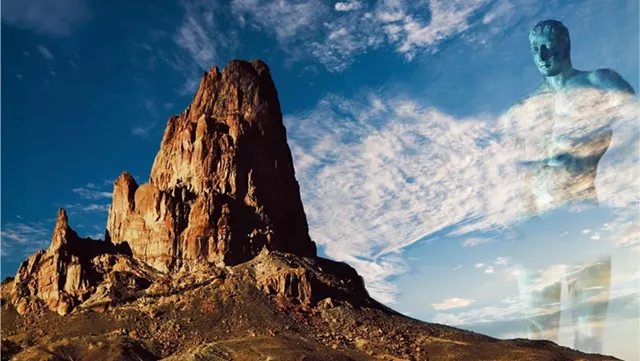
According to Darwin's theory of evolution, dinosaurs ruled the Earth millions of years ago, long before humans appeared. However, recent discoveries of prehistoric artifacts have raised questions about Darwin's evolutionary theory. Research suggests there was once a race of very tall giants who ruled the Earth, with dinosaurs serving merely as their mounts.
Giants Riding Dinosaurs in Carvings
In the small village of Ica, located in the northern area of the Nazca Plain in Peru, stones engraved with intriguing patterns were found in nearby hills. These relics from an ancient civilization depict giants riding on the backs of dinosaurs, implying that dinosaurs were simply mounts for these giants.
One of the stones features a Triceratops, a dinosaur reminiscent of a giant rhinoceros, named for the three horns on its head. The stone shows a figure riding on the Triceratops' back, wielding a weapon resembling an axe. The carvings suggest that giants once ruled over dinosaurs in prehistoric times.
Dr. Javier Cabrera from Peru began studying the Ica stones in the 1960s. Beyond the flat engravings, Dr. Cabrera discovered many three-dimensional sculptures related to dinosaurs in the Ica region. These sculptures also depict scenes of humans coexisting with dinosaurs, vividly illustrating the size differences between humans and dinosaurs at that time.
However, knowledge of these giants has been significantly suppressed by the U.S. government at the time. Reports from Dcxposed indicate that a confidential document released by the Smithsonian Institution dated back to the early 1900s, revealing that the Smithsonian was involved in a significant historical cover-up. To uphold Darwin's theory of human evolution, high-level administrators were reportedly ordered to destroy evidence of thousands of giant remains found in the United States.
"The release of these documents will help archaeologists and historians reevaluate current theories of human evolution," stated Hans Gatenberg, director of AIAA. "Finally, after a century of deception, the truth about our giant ancestors should be revealed to the world."
Acanthostega Dinosaur Statues
In 1944, in the town of Acambaro, 175 miles northwest of Mexico City, merchant Waldemar Julsruth accidentally discovered ceramic fragments unearthed by rain. Intrigued, he hired Odilon Tenaiero to assist in finding more artifacts.
From 1944 to 1952, Tenaiero's team excavated a total of 33,500 sculptures in the southwest part of the indigenous town of Acambaro, handing them over to Julsruth. On closer inspection, the merchant found something astonishing: alongside various figures resembling Europeans or Eskimos were numerous creatures resembling playful dinosaurs.
These unusual carvings soon caught the attention of some archaeologists. However, upon examination, they were disappointed since many of the subjects included dinosaurs. There were figures riding dinosaurs and women feeding baby dinosaurs, which seemed implausible at the time.
According to evolutionary theory, by the time human ancestors appeared on Earth, these ancient giants had long been extinct. Archaeologists who were proponents of evolution chose to discontinue further research.
Nevertheless, in 1954, the National Institute of Anthropology and History sent four representatives to the excavation site to continue the investigation.
A team of Mexican experts led by Dr. Eduardo Nogales reported internally that all aspects of the excavation were reasonable and normal, though they considered the notion of a possible unknown connection between humans and dinosaurs far-fetched.
Professor Hapgood, an archaeologist with a different view, dedicated his life to researching these unusual carvings. This now-deceased American historian received support from the local police chief, who readily granted him permission to excavate wherever necessary.
Hapgood and his team subsequently unearthed numerous artifacts from unexpected locations. Eventually, they even excavated beneath the police chief's office, finding many statues in a similar artistic style. The police station, built 25 years earlier, suggested these statues had been buried for many years and were not modern fabrications.
In 1968, Hapgood sent an organic artifact fragment from Julsruth to an isotope laboratory for carbon-14 dating. Experts determined the material to be approximately 6,500 years old.
Several years later, the U.S. magazine "Information" reported on the mysterious Acambaro statues, highlighting scenes of humans battling various monsters and coexisting with diverse types of dinosaurs. Many dinosaur statues closely resembled species known to modern scientists, appearing realistic rather than products of imagination.
"Information" magazine also noted that the Archaeological Application Science Center at the University of Pennsylvania conducted thermoluminescence dating on four samples. After 18 tests, scientists were perplexed and ultimately announced that the statues were created over 4,000 years ago, proving they were not the work of modern humans and leaving skeptics speechless.
In a similar vein, in 1972, Ecuadorian archaeologists discovered a prehistoric "metal library" in the Santiago Grand Tunnel. They found books and animal models made of high-purity gold, humanoid stone carvings holding the sun and moon while standing on globes, and temple models depicting figures with guns and hats. They also uncovered an intricately carved stone featuring a giant dinosaur.
In 1976, geologists discovered ancient human footprints intermingled with three-toed dinosaur tracks on the riverbed rocks of the Paluxy River in Texas, USA. After thorough investigation by numerous experts, the human footprints from the dinosaur era were confirmed to be genuine.
Today, ongoing archaeological discoveries and research into prehistoric civilizations continue to question the foundations of evolutionary theory. Many scientists speculate that the Acambaro statues and ancient Ica carvings in Peru, along with other ancient relics, are the works of prehistoric humans who lived alongside dinosaurs.