Exploring Prehistoric Civilizations: The Lost Continent of Mu, the Bermuda Triangle Pyramid, and Ancient Indian Cities

The Earth we inhabit today was not always as we know it. Over billions of years, it has experienced numerous geological transformations, including volcanic eruptions, floods, and glacial movements, which have shaped the geographical environment we see today. For instance, the "Paleo-Kuroshio" region off Japan's coast, just 90 kilometers from the Japan Trench and reaching depths of 2,600 meters, was once a prominent landmass above the Pacific Ocean, situated 120 kilometers east of the Japanese archipelago between 67 million and 25 million years ago.
Therefore, it's conceivable that if prehistoric humans developed civilizations, they might have been repeatedly obliterated by natural disasters, leaving only remnants preserved underwater due to geological shifts or rising sea levels.

Illustration
Ancient City Ruins Discovered Off the Coast of India
In 2001, marine researchers from the Indian National Institute of Ocean Technology made an unexpected discovery of two ancient city ruins located underwater at a depth of 120 feet in the Gulf of Cambay while assessing water pollution levels. These ruins are believed to be at least 9,500 years old, and scientists suggest that this could significantly alter the history of ancient human societies.
The sites are found 40 kilometers off the coast of Gujarat in western India. Geological analysis suggests the ancient city spans an area of 9 kilometers and includes features such as a defensive fortress and a public bath approximately the size of a modern Olympic swimming pool.
Preliminary testing of pottery, wooden carvings, and bone fragments suggests that some artifacts date back to around 7,500 BC. Moreover, items resembling building materials have also been uncovered. Among the artifacts is a large stone slab with inscriptions that scholars are studying to determine if it represents the earliest known form of writing.
Some experts believe this find provides concrete evidence that our understanding of civilization's history requires significant revision. Dr. Hancock, who has been researching ancient civilizations for over a decade, mentioned that sonar scans of the ancient city foundations suggest that the buildings may have been three stories high, with 400-foot-long walls and advanced geometric structures.
Archaeologist Dr. Kenneth from Durham University noted that if these findings in India are verified, they might necessitate a complete reassessment of historical theories regarding past civilizations.
Underwater Ruins in the Bahamas
In 1958, American zoologist Dr. J. Manson Valentine discovered strange structures on the ocean floor near the Bahamas during underwater research. These structures displayed unique geometric shapes, with some featuring straight lines extending for miles.
In 1968, Dr. Valentine identified a massive T-shaped stone wall near the northern Bimini Islands in the Bahamas. This wall measures 450 meters long, with two branches forming right angles to the main wall. The wall is constructed from enormous stone blocks, each weighing over one cubic meter. Additional findings revealed complex platforms, roads, dock-like structures, and a double-winged walkway, suggesting a port-like layout.
Illustration
Ancient City Ruins Discovered in Cuban Waters
According to a BBC report on December 7, 2001, the Canadian company ADC Exploration discovered what appears to be an ancient city submerged for thousands of years at a depth of 650 meters off western Cuba using advanced sonar equipment.
The underwater city was first detected in 2000 when explorers used scanning equipment that revealed symmetrical stone structures suggestive of urban planning.
Researchers revisited the site with advanced underwater photographic equipment, confirming the presence of large, smooth stone formations in the area. These stones appeared to be cut granite, forming pyramid and circular shapes.
Cuban geographer Manuel Iturralde later joined the project, presenting his findings at an international conference in Havana. While he did not specifically mention a lost city or ancient civilizations, he commented, "There is no clear explanation for these structures," highlighting the need to remain open to unexpected discoveries that challenge existing knowledge. This is another intriguing aspect of this investigation.
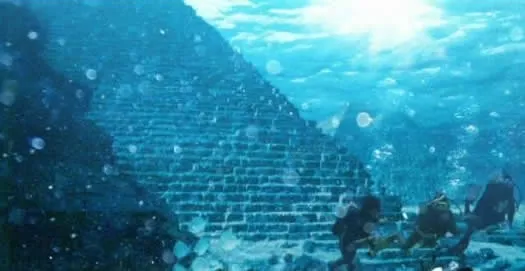
Pyramids Discovered in the Bermuda Triangle
Additionally, European scientists conducting underwater exploration in the Bermuda Triangle discovered a massive pyramid on the ocean floor, measuring 300 meters on each side and standing 200 meters tall. The pyramid features two large artificial openings, through which seawater rushes, creating a huge whirlpool that causes turbulent waves and mist in the surrounding waters. While it's difficult to estimate when this underwater pyramid was constructed, it's known that the land in this region sank beneath the ocean at least tens of thousands of years ago.
The Legendary Civilization of Mu
In the late 19th century, British Colonel James Churchward, while stationed in India, encountered a Naccal inscription from a Hindu temple, written in an extremely rare script. After much effort, he deciphered the story of the rise and fall of a great ancient civilization with the help of a high-ranking Indian monk.
In 1926, the colonel published a book titled "The Lost Continent," detailing the legendary tale of what we now refer to as the "Mu Continent."
According to the inscription, the Mu Continent was located in what is now the Pacific Ocean, where humans established a thriving and prosperous civilization, creating advanced literature, art, craftsmanship, and manufacturing.
The people of Mu possessed advanced architectural skills, capable of constructing large buildings, pyramids, stone monuments, castles, and roads. It's said that Mu's capital and cities featured neatly arranged stone roads and canals, with walls adorned with gleaming gold decorations, and that everyone lived in luxury. The inhabitants of Mu were also skilled navigators, engaging in maritime activities across oceans, and establishing a powerful colonial empire, earning Mu the title of "the pinnacle of world culture."
However, the flourishing Mu Continent abruptly vanished beneath the waves due to a catastrophic disaster. The horrifying events began with violent volcanic eruptions, triggering powerful earthquakes and fierce tsunamis, leading to further volcanic explosions. Eventually, under the onslaught of volcanic lava and seismic tremors, the ground surged like ocean waves, columns of fire and smoke obscured the sky, and everything on the surface crumbled like a house of cards. In an instant, the Mu Continent completely submerged beneath the Pacific Ocean.
While the story of the Mu Continent may seem legendary, considering it from another perspective suggests the possibility of human civilization being destroyed and later rebuilt.
The discoveries of various underwater ruins provide undeniable evidence of prehistoric civilizations. These scientific findings confirm that civilizations existed that we are currently unaware of, though integrating these prehistoric ruins into our history remains a challenge for contemporary archaeologists and historians, as they conflict with established historical perspectives. However, it is believed that by remaining open to new perspectives and re-examining historical truths, integration is only a matter of time.