Mysterious Underground Network Linking Four Continents, Circling the Earth Ten Times
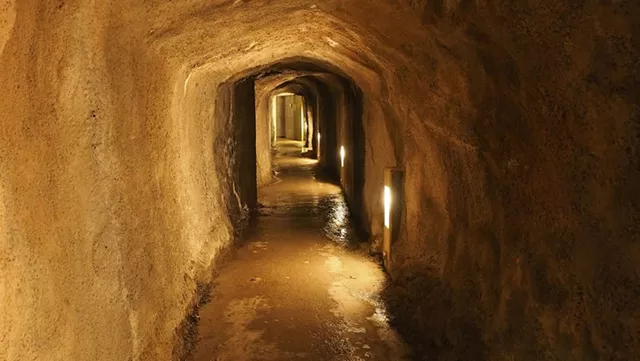
Below the Earth's surface lies a world shrouded in mystery. It's ancient, expansive, and spans the globe, bearing clear evidence of human excavation. Research indicates that this subterranean world predates the history of human civilization. How was such an enormous global system created, and for what purpose?
Over 100,000 Years of History
Throughout the ages, people have mostly looked to the sky, with few focusing on the mysteries beneath their feet. However, under the ground is an astonishing world that defies imagination. It isn't beneath the ocean but underground, commonly referred to as the subterranean world.
This global network of underground pathways isn't documented in any formal historical records. The scale and complexity of its construction surpass the achievements of human civilization. The most recently dated section in Europe is over 100,000 years old.
According to evolutionary theory, 100,000 years ago, humans were not significantly different from other primates. So, who constructed these underground corridors, and why?
Various sources mention a mysterious underground world across Europe, Asia, the Americas, and Antarctica, long considered a myth. It wasn't until the 1950s that archaeologist David Lam confirmed the real existence of these subterranean pathways.
David Lam's Major Discovery
Lam reported that he and his expedition team discovered the legendary underground world of "Agartha" in the Chiapas region of Mexico. They began their mission in 1943 and, after years of searching, uncovered clues to "Agartha" in the Chiapas rainforests. Due to this significant discovery, U.S. President Franklin Roosevelt even met with Lam and his wife.
At that time, a group of Mayan descendants, known as the Lacandón people, guarded the area, preventing anyone from entering this underground world. Initially, Lam's team sought to negotiate, but the guardians were unwavering. After negotiations failed, Lam sought help from U.S. authorities.
President Roosevelt dispatched military personnel and researchers to accompany Lam back to "Agartha." Yet, upon their return, both the guardians and the entrance had mysteriously disappeared.
The Underground Corridor in Cusco, Peru
Shortly after, archaeologists discovered another "Agartha" in the Cusco region of Peru and formed an expedition team that successfully accessed this underground marvel.
The expedition unveiled an underground corridor stretching over a thousand kilometers, traversing the Andes mountain range. From the north, it connects directly to Lima, and from the south, it leads to Bolivia. This finding astounded the world at the time. Nevertheless, Peruvian authorities sealed the corridor, fearing potential damage to the ancient tunnel's research value.
Discoveries in Ecuador, South America
Subsequent discoveries revealed more underground corridors, notably the largest in Ecuador. This passage extends 4,000 kilometers, descending 240 meters with a complex structure. Argentine archaeologist Juan Moritz discovered it after three years of exploration, but, as with other discoveries, this tunnel was eventually sealed permanently.
Artificial Construction Beyond Modern Technology
Numerous scientists, through field research, conclude that these tunnels are man-made. A German writer who visited the site described it as more akin to an underground palace than a mere tunnel.
Within, there are expansive hall-like spaces furnished with tables and chairs, suggesting past habitation. One hall spans approximately 20,000 square meters. The tunnels are remarkably straight, featuring smooth ceilings, with ventilation shafts about 1 meter in diameter spaced every 2 to 3 meters.
Scientists speculate that constructing such tunnels would require high-tech, ultra-high-temperature drill bits and electronic directional blasting—technology presently beyond our capabilities. This implies that the technology employed to carve these corridors surpasses modern advancements.
Artifacts and Metal Deposits
Many scientists have verified the unearthing of artifacts from these corridors, though they remain under study. Some items trace back to the guardians' ancestors, while others are mysterious and yet to be analyzed. Numerous valuable metal deposits have also been discovered.
In Ecuador's underground corridor, evidence of human excavation exists alongside highly ornate murals and numerous animal carvings.
Connecting Four Continents
In recent years, declassified documents from various countries reveal that underground corridors have been identified not only in Peru and Ecuador but also in Turkey, India, several European nations, and regions in China like Qinghai and Guizhou, as well as in Russia. Scientists suspect these corridors may be interconnected.
Experts suggest that if the lengths of these tunnels were combined, they could encircle the Earth ten times. The corridors in the Americas have already been confirmed to traverse North and South America, crossing the strait to reach the Eurasian continent.
While it's not currently provable that these caves form an independent underground world, many fringe scholars and enthusiasts of mysterious phenomena staunchly believe these caverns belong to an underground civilization.
As more information comes to light, there's a growing belief that beneath the Earth we tread lies another intelligent race. Otherwise, such a monumental global project seems inexplicable.