Why Does a 2,000-Year-Old Sword Remain Sharp and Gleaming?
Image source: Pixabay
On March 1, 1994, the world-famous "Eighth Wonder of the World"—the excavation of Terracotta Army's Pit No. 2—officially commenced. This is considered one of the most notable archaeological finds of this century.
Among the artifacts unearthed from Pit No. 2 are bronze spears, crossbows, arrowheads, and broken swords. Notably, a collection of bronze swords was discovered, each measuring 86 centimeters in length and featuring blades with eight facets. Using calipers, archaeologists found that the deviation between these facets was less than the thickness of a human hair. All 19 bronze swords uncovered exhibit this remarkable precision. These swords have a dense internal structure, a shiny, smooth blade, and detailed grinding marks without any overlapping patterns. Despite being buried under loess for over 2,000 years, they appear as bright and sharp as new.
Testing revealed that the swords' surfaces were coated with a layer of chromium salt compound, about 10 micrometers thick. This caused a global sensation, as chromium salt oxidation is an advanced treatment method that only became known in modern times—with Germany patenting it in 1937 and the United States in 1950.
During the initial excavation of Pit No. 1, archaeologists found a bronze sword bent under the weight of a 150-kilogram terracotta warrior, with a bend exceeding 45 degrees. To their amazement, once the terracotta figure was removed, the narrow and thin bronze sword spontaneously rebounded to its original straight form, showcasing a "shape memory alloy" effect—something contemporary metallurgists still aspire to achieve, yet found in an ancient tomb over 2,000 years old.
Interestingly, the technique of chromium salt oxidation was not invented during the Qin Dynasty; it was already mastered by the Chinese during the Spring and Autumn and Warring States periods.
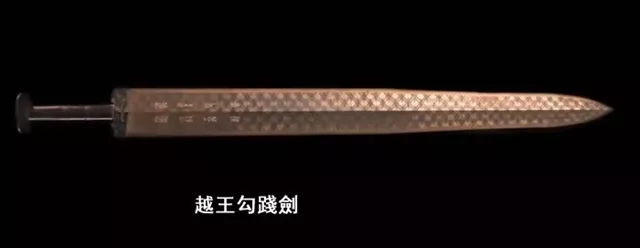
Image source: Video screenshot
During the era of the Five Hegemons of the Spring and Autumn period, King Goujian of Yue "endured hardship and tasted bitterness," eventually defeating King Fuchai of Wu, marking the climax of this epochal conflict. Over time, this dramatic war has quietly faded into history, and nearly forgotten by later generations.
In December 1965, the "Sword of King Goujian" was unearthed from Tomb No. 1 in Wangshan, Jiangling County, Hubei Province. This pivotal archaeological discovery captivated the nation, but even more astonishing was the scientific research report on this ancient sword.
The most striking finding for researchers was why this ancient sword, buried for over two millennia, still held its brilliance and sharpness without rust. Further investigation revealed that the "Sword of King Goujian" was protected by a chromium-containing metal coating. Chromium, known for its corrosion-resistant properties, is a rare metal with low prevalence in Earth's crust, making it challenging to extract. Additionally, chromium has a high melting point, approximately 4000°C.
The scientific advancements of the 1950s astonishingly appeared two millennia earlier. Who could have foreseen that the swords wielded by the soldiers of Qin Shi Huang were marvels that modern science had yet to invent? What were the origins of their technological prowess?
Chinese civilization is both profound and enduring, containing ancient wisdom and countless secrets yet to be uncovered by future scholars and explorers.