Unlocking Secrets of Prehistoric Ruins: The Enigma of 10,500 BC

The year 10,500 BC holds many mysteries. Ancient relics found in Egypt and Cambodia, particularly in majestic palaces and buildings, provide insights about this period. For the Egyptians and Cambodians, the sky was sacred, influencing them to align their architecture with celestial constellations, creating a "mirror of the sky."
The Pyramids and Orion
Egypt’s pyramids are traditionally seen as pharaohs’ tombs, but is that their sole purpose? At the heart of the largest "tomb chamber," where the queen’s sarcophagus lies, there is a square opening that extends into the distance. Calculations show this narrow tunnel points directly at the star Sirius in the sky. In Egyptian mythology, Sirius is the mother of the gods. Additionally, the three main pyramids are perfectly aligned with the constellation Orion. Orion is significant in mythology, symbolizing the pharaoh's divine ancestry and his return to the heavens to unite with the gods after death. Therefore, it is plausible that the pyramids were not just tombs but also places where pharaohs prepared for their ascent to the heavens...
Angkor Wat and Draco
While the Egyptian civilization is ancient, the history of Southeast Asia, particularly Cambodia's, is often considered more recent. Yet, the temples of Angkor contain the world’s oldest and longest stone carvings, depicting a legend of benevolent and malevolent gods working together to stir a "cosmic ocean." All constellations revolve around the Earth’s axis, which is not upright but tilted, similar to a spinning top. This axial cycle of 25,920 years means it shifts one degree every 72 years and three-quarters of a degree every 54 years, known as the precession theorem. This architecture reflects numerous references to the "precession coefficient." For example, the central axis of the structure deviates from true north by three-quarters of a degree, allowing builders to anticipate the winter solstice’s arrival three days early.
Intriguingly, Cambodia’s ancient structures correspond to the constellation Draco. However, constellations constantly move, and based on construction dates, Draco should not have been visible then. Computer simulations show Draco appeared at its lowest sky point in 10,500 BC.
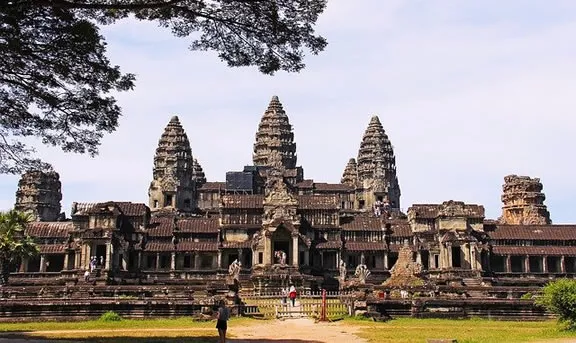
Angkor Wat
Angkor’s architectural style resembles a "mandala." Some suggest Angkor Wat is a replica of the Draco constellation, aligning Draco’s stars in a linear fashion with about 15 of Angkor’s main pyramid-like structures, showing striking similarity. If coincidental, this resemblance is quite extraordinary. When Draco and the Angkor temples face north, Draco not only sits directly above Angkor but the star distances nearly match ground distances. Given the maps used at the time were hand-drawn and not detailed star charts, this precision is startling.
Orion and Draco
Considering time, the connection between the heavens and earth becomes evident: on one side is Angkor—Draco, and on the other side are the pyramids—Orion, both perfectly aligned. During the spring equinox of 10,500 BC, they positioned themselves across the meridian from each other. At this moment, viewers would observe the constellation Leo, represented by the Sphinx, rising in the east, perfectly aligned in the same direction.
Orion and Draco, due to the precession of the equinoxes, have a seesaw-like relationship, with one ascending while the other descends. Simulations show both constellations move in opposite directions at a consistent speed. As Draco hits its lowest point, Orion is at its highest, after which they reverse direction again. Each ascent or descent cycle spans nearly 13,000 years, continuing this eternal cycle.
Interestingly, both Angkor and the Egyptian pyramids captured Draco's highest point and Orion's lowest—signifying half a precessional cycle. This was during the spring equinox morning of 10,500 BC.
Since 10,500 BC, the constellations have completed a half-cycle. Currently, Draco is approaching its lowest point, while Orion nears its highest, indicating an impending reverse in their motions.
Similarities between Egypt's pyramids and Angkor's pyramids include:
Sky: Reflecting the same sky of 10,500 BC.
Earth: Linked through complex astronomical clues.
Time: Defined by the slow precessional cycle.
Soul: The unity of all, aspiring for immortality.
Angkor's bas-relief deities and demons parallel the Egyptian deities Horus and Set. The Orion/Osiris legends also align with ancient Egypt's lion god myths. (All linked to the cycle of time)
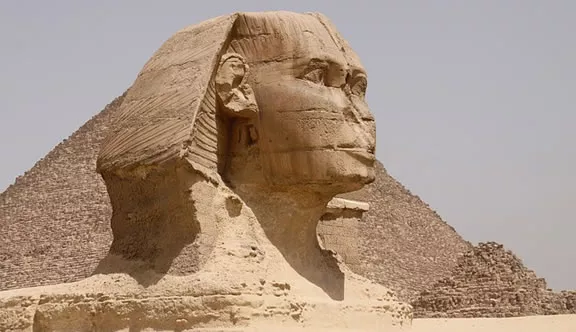
Turning back to Egypt, besides the pyramids, there is the Sphinx—another world wonder. If the pyramids are "tombs," what is the Sphinx's purpose? Why a "lion" and not another creature? We believe it's tied to astronomical events. Resetting the star chart to 10,500 BC reveals the Leo constellation appearing on the horizon, directly in the Sphinx’s sightline. Two vastly different structures, separated by millennia, point to the same constellation of 10,500 BC.
Indeed, 10,500 BC is an enigmatic year. In the ancient world, Cambodia's Angkor faced north to Draco; Egypt's Sphinx faced south to Leo; to the east, the pyramids aligned with Orion. Correspondingly, there must be similar ancient sites to the west.
Close Connection with Astronomical Phenomena
Research from Yonaguni Island, Japan, reveals a mysterious underwater city six stories high, with a base length comparable to that of the pyramids. The city is oriented southward, featuring a narrow path extending west to east for about 60 to 70 meters, with two massive pillars fitting the Stonehenge stones perfectly. Many ancient sites worldwide seem intricately connected to astronomical events.
Inside Egypt's pyramids, the most hidden stone chamber bears Pharaoh Khufu's name—the sole mention within the pyramid, offering substantial evidence against the pyramid merely being a tomb. This chamber, precisely situated at 30 degrees north latitude, aligns its axis due north. Egyptians combined soul science, astronomy, and mathematics, embedding the potential for immortality here. The sarcophagus comprises 100 stone blocks, with a 2:1 length-to-width ratio (20 feet long and 10 feet wide); the slanted triangular shape reflects the "golden ratio," a theory discovered by Greek scientists centuries later.
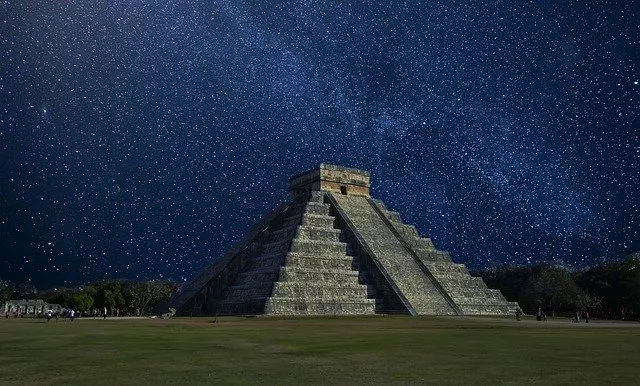
Clearly, Egyptians had grasped this concept long before. Mexico’s Yucatán Peninsula's square-topped pyramid has staircases on its east, south, west, and north sides, each with 91 steps, totaling 364 steps plus one at the top, matching the solar year. On the solstices, the sun rises along its east-west axes. The Mayan calendar, from its builders, was even more precise than today's, accurately predicting solar eclipses a millennium ago, including the one in 1991.
Some 150 years back, the sun directly shone atop the obelisk on two annual days. Applying a unique unit, the tower’s volume equals exactly one-hundred-thousandth of the Earth's volume. Experts suggest ancient peoples represented planes with lines, planes with spaces, and spaces with time (orbital time).
In Peru, massive stone drawings have puzzled scientists; their full form is only visible from the air, yet during their construction thousands of years ago, aerial transportation didn't exist. What purpose did these vast drawings serve? Some speculate they were alien landing runways or ancient rain-making tools. Analysis shows the large spider depicts Orion's long-term trajectory.
In Europe, numerous stone circles, dating back 5,000 years, are closely tied to astronomy. The circular stones have a gap in one stone perfectly aligning with the stone pillars behind, forming a small window to view the sunrise on the longest day of the year.
Moreover, every 19 years, the setting moon aligns perfectly within the stone circle. At Stonehenge, with its four observation points, the north-south points form a straight line for viewing the moon setting from 10,000 years ago.
Uffington, England’s white horse, parallels Peru’s large spider by recording constellations’ trajectories—specifically Taurus from 5,000 years ago, with Taurus's head matching the horse’s head, and its horns slowly rising over Uffington Hill. Legend says an ancient, now-submerged kingdom existed near Carnac, France, 10,000 to 13,000 years ago, substantiated by the island’s massive stone circle.
This world's largest stone circle encodes Earth’s circumference, latitude, and longitude data. Underneath the island's conical earth mound, a stone chamber bears peculiar wall patterns, illustrating the sunrise path on the winter solstice, as ancient folks believed this day bridged time and space, allowing souls to traverse to the sacred mountain.
In La Venta, Mexico, the Olmecs, flourishing 3,500 years ago, are closely tied to broader American cultures. Numerous stone statues exist, some 60 tons each. Conventionally, American peoples are viewed as Asian descendants who crossed during the Ice Age via the Bering Strait, yet the statues distinctly depict Africans, often as bearded gods in small boats alongside feathered serpents.
Legend claims the flying serpent introduced architectural prowess to Central America. Thus, which lost civilization disseminated its culture globally, leading to similar worldwide architectures and astronomical concepts? Easter Island’s stone statues are vital to solving this mystery, recording sunrise and constellation positions 11,000 to 13,000 years back, akin to other sites.
On Pohnpei Island in the Pacific, "Nan Madol," an ancient temple, is said to be crafted by two brothers who saw an underwater city. The temple's four massive pillars align with cardinal directions. Across various global civilizations, more than 600 recorded the myth of a great flood that eradicated civilizations, leaving only navigators who dispersed advanced culture globally...
Giza, Egypt; Angkor, Cambodia; Pohnpei; and Easter Island are not arbitrary locations. According to the "precession," all celestial phenomena shift one degree every 72 years, with Giza and Angkor exactly 72 degrees apart, while Pohnpei and Angkor, plus Easter Island, are 144 degrees apart—all known as the "center of the world."
These sites likely served as ancient celestial observation stations. Ancient peoples evidently measured Earth’s size, replicating it architecturally to a specific scale. Sir Isaac Newton, measuring Earth's volume in the 18th century, applied Egyptian methods, estimating via the pyramids’ shadow—a technique possibly discovered and utilized thousands of years earlier.