The Mysterious "City of Gods" and Its Connection to the Solar System and Sirius
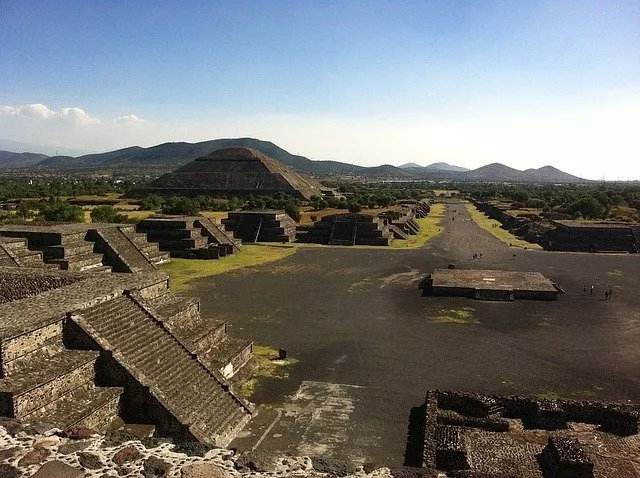
The Americas are home to numerous pyramid complexes. These structures are deeply connected to the enigmatic Maya civilization that has since vanished, as well as other ancient civilizations that once flourished here, capturing humanity's cosmic understanding and leaving a rich cultural heritage centered around their gods.
Archaeologists have established that, from the 7th century BC to the 15th century AD, people in Mexico, Guatemala, Brazil, Belize, Honduras, and El Salvador constructed over 100,000 pyramids, with nearly 10,000 situated in Mexico alone. The earliest pyramid on the continent was found beneath 8 meters of volcanic lava in Ikuirco, south of Mexico City. Carbon-14 dating has shown it to be over 2,500 years old. These areas also align with the spread of the Maya civilization, which began forming around 2500 BC and excelled in astronomy, calendar systems, mathematics, and arts. The scale and architectural artistry of Maya pyramids rival those of Egypt.
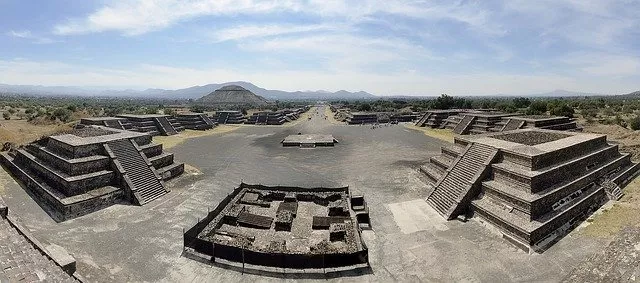
"The City of the Gods" Layout is Mysterious
Located about 40 kilometers northeast of Mexico City are the ancient ruins of Teotihuacan. Renowned as the "Holy City," it was built between 150 BC and 100 AD, with its buildings organized according to geometric shapes and symbolic significance. It is famed for its monumental structures, particularly the Pyramid of the Moon and the Pyramid of the Sun, earning it the name "City of the Gods."
The ancient city of Teotihuacan includes the renowned Pyramid of the Sun, Pyramid of the Moon, the Temple of Quetzalcoatl (Temple of the Feathered Serpent), and the "Avenue of the Dead," which extends 4 kilometers from north to south and is 45 meters wide. By the 10th century, the first Aztecs encountered the city deserted, viewing the buildings along the avenue as the tombs of gods, thus naming it the "Avenue of the Dead."
The Pyramid of the Sun, a place of worship for the sun god, features an impressive trapezoidal structure oriented from east to west, with hundreds of steps leading to its summit. The precision of its astronomical alignment amazes scientists. The pyramid's architects ingeniously designed air channels in the southern wall to direct Sirius's light onto the head of the deceased in the upper chamber, while Polaris's light could be guided through northern channels to illuminate the lower chamber.
The pyramid boasts 91 steps on each of its four sides, totaling 364 steps, plus a platform at the top, making exactly 365 steps—matching the number of days in a year. Its nine-tiered base is divided into 18 sections, perfectly aligning with the number of months in the Maya calendar year.
Located to the north of Teotihuacan, the Pyramid of the Moon is dedicated to the moon god. Slightly smaller than the Pyramid of the Sun, it features beautiful murals, carvings, and painted pottery.
The Temple of Quetzalcoatl, the most magnificent structure in the city, is now mostly collapsed, with only the base remaining. The craftsmanship of this base is so opulent and intricate that it's hard to believe it was made using only stone tools. It is adorned with numerous elaborate patterns and mysterious hieroglyphs, whose meanings scholars have yet to unravel.
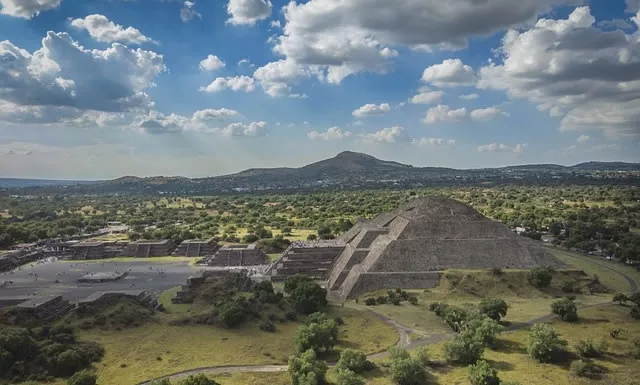
The Ancient City Built According to the Solar System Model
In 1960, scientists were captivated by the first aerial photographs of Teotihuacan, as the city's unique and precise layout puzzled them.
In the early 1970s, Anthony Aveni, an astronomer and archaeologist from Colgate University, suggested that a point 90 degrees west of the "Avenue of the Dead" corresponds to the location used to observe the Pleiades star cluster in Teotihuacan, linked to ancient Mesoamerican calendars.
At that time, Vincent Melosh, a Dartmouth College professor, suggested that this point marked where the sun sets twice yearly (on April 30 and August 13) directly opposite the "Pyramid of the Sun." August 13 is celebrated by the ancient Maya as "World Creation Day."
In 1974, at the International Conference on Mesoamerican Studies in Mexico, a man named Hugh Halstead claimed to have discovered a measurement unit applicable to all Teotihuacan's buildings and streets. Computer calculations showed that this unit is 1.059 meters. The heights of the Temple of Quetzalcoatl, Pyramid of the Moon, and Pyramid of the Sun are 21, 42, and 63 units respectively, maintaining a 1:2:3 ratio. Measuring the ruins along the "Avenue of the Dead" using this unit shows alignment with the orbital data of the planets.
It is clear that the "Avenue of the Dead" was constructed based on a solar system model, indicating that the city's designers possessed knowledge of planetary and solar dynamics. We only discovered Uranus in 1781, Neptune in 1845, and Pluto in 1930. How did these ancient builders know all this in prehistoric times?
The astronomical knowledge of ancient peoples is both astounding and admirable. Their profound connection with the universe seemingly allowed them to comprehend celestial mysteries, perhaps driven by their reverence for the divine and natural laws.
Images sourced from Pixabay