What Mysteries Lie Within the Kunlun Mountains?
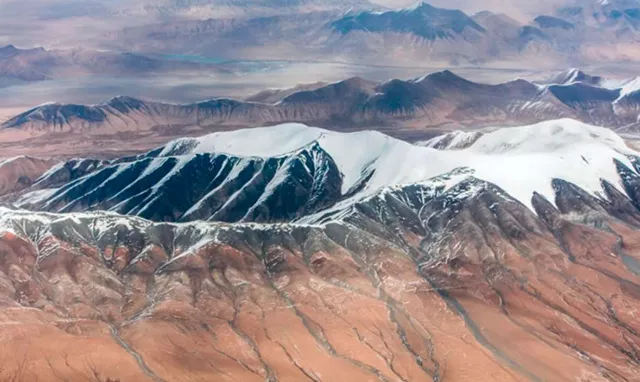
When people think of mountains, what typically comes to mind? Perhaps the Five Great Mountains of China, the world's highest peak, Mount Everest, or the famous Changbai Mountain popularized in films and dramas. However, when it comes to the most mysterious, deeply revered, and ancient mountain in the hearts of the Chinese people, Kunlun Mountain stands out significantly.
Kunlun Mountain, also referred to as Kunlun Xu, the First Divine Mountain of China, the Mountain of All Ancestors, Kunlun Hill, or Jade Mountain, stretches around 2,500 kilometers. Its average elevation ranges from 5,500 to 6,000 meters, with a width of 130 to 200 kilometers, covering a total area of over 500,000 square kilometers. Kunlun Mountain holds a distinguished place in the cultural history of the Chinese nation, often called the "ancestor of all mountains" and the "ancestor of the dragon vein" in ancient texts.
According to legend, the shepherds living near Kunlun Mountain would rather let their cattle and sheep starve on the Gobi Desert due to the scarcity of grass than venture into the ancient, silent valleys of Kunlun, where grass thrives. Most of China's ancient myths are linked to Kunlun Mountain, undoubtedly marking it as the foremost divine mountain in China. Yet, we haven't given this cultural heritage the attention it deserves, and few documentaries thoroughly introduce Kunlun Mountain.
Kunlun Mountain majestically begins in the far west of China, featuring a group of peaks composed of three towering mountains, each exceeding 7,000 meters in height. Nestled among these peaks is the stunning Karakul Lake. These three snow-capped peaks are fondly referred to as the "Three Heroes of Kunlun."
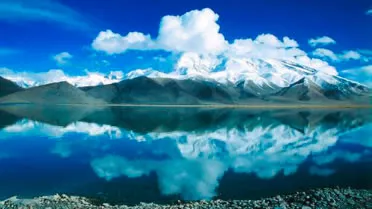
For the ancient people of the Central Plains, creating a divine mountain through the course of history was a formidable task. First, the mountain had to embody the image of a "fairyland." Each of the three towering Kunlun peaks can be considered a top-tier fairyland, highlighted by the unique sight of three peaks surrounding a lake. Secondly, a divine mountain must be difficult to access; if it were easily reachable, it would lose its mystery.
Take Mount Tai, for instance. Climbing to the summit of Mount Tai was not particularly challenging for ancient people, so it lacked any aura of mystery. Additionally, because many emperors conducted rituals there, it could only be seen as a communication channel with the heavens, rather than a divine mountain. In contrast, the Three Heroes of Kunlun are incredibly difficult to approach for the people of the Central Plains.
Legend says that beneath Kunlun Mountain flows a water so weak that it cannot even support feathers, and around it grows a divine tree that burns continuously without going out. At the summit of Kunlun is said to be the realm of the Yellow Emperor, guarded by enlightened beasts. Ancient myths tell that a deity known as "Xi Wang Mu," depicted as a woman with a human head and a leopard's body attended by two blue birds, resided in Kunlun Mountain. Later legends paired Xi Wang Mu with "Dong Wang Gong," forming the prototype of the Jade Emperor.
"The mountain has nine gates, guarded by enlightened beasts, and is the dwelling place of all gods" describes the notion that in the northwest lies a mountain named Kunlun Xu, serving as the earthly capital of the Heavenly Emperor and the home of the gods. This vast, towering mountain is said to be rich with rare treasures and fiercely guarded by beasts.
Today, we see that many mountains in western China are revered as sacred by locals for religious reasons. However, from the perspective of the entire Chinese nation, no mountain can match the divine status of Kunlun Mountain.
While Kunlun Mountain may have lost some of its mystery today, its majestic grandeur remains undeniable. The term "Kunlun" has found its way into martial arts novels, often as a location for various sects, maintaining a sense of ethereality, albeit with a hint of tragedy.
If you have the time, consider learning more about it and viewing some photos; I believe you will also be captivated by the beauty of Kunlun Mountain.