Mythical Beasts in Ancient Legends: The Qing Ji Story
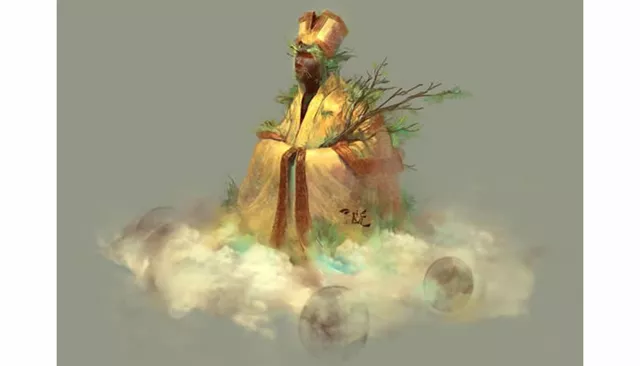
Qingji is a water deity from ancient Chinese mythology, specifically from the Qi region. Among the ten legendary mythical beasts of ancient times, Qingji is listed, yet it is considered both a divine creature and a "strange beast." This distinction suggests it has an unusual appearance that is noticeably different from that of ordinary animals.
Originally, Qingji lived in a water-rich environment and eventually transformed into a spirit, best summarized by the phrase "water spirit." In a positive light, it can be thought of as an elf; more bluntly, it is a monster, a creature of the water.
According to the "Guanzi: Water and Land," Qingji has a unique proclivity for running swiftly, reportedly capable of covering thousands of miles in a single day. For this reason, some believe Qingji acts as a messenger, much like a postal worker; whenever you call its name, it can deliver messages for you.
Furthermore, as a water spirit, Qingji is also adept at catching fish. By merely calling its name, it can provide you with an abundance of fish.
The Appearance of Qingji
In "Guanzi: Water and Land," it is recorded: "In a dry marsh for hundreds of years, where the valley remains fertile and the water never stops flowing, Qingji is born. Qingji resembles a human, standing four inches tall, wearing yellow clothing, a yellow crown, and a yellow cap, riding a small horse, and loves to run swiftly. By calling its name, it can travel a thousand miles in a day. This is the spirit of the dry marsh."
From an appearance standpoint, Qingji looks quite similar to a human but measures only about ten centimeters tall, precisely four inches, which translates to approximately 13.3 centimeters, making it quite petite.
It wears a yellow hat and a yellow robe, and rides in a small yellow cart (or, according to some accounts, on a small horse). It can traverse a thousand miles in a single day. Overall, it resembles a small yellow figure. Compared to other divine beasts, Qingji's appearance is closest to that of a human and is widely accepted as such.
Records of Qingji in Ancient Texts
According to the "Zuo Zhuan," Qingji was a relative of King Fuchai of Wu, who repeatedly cautioned him: "If you do not change your policies, your country will surely perish." When King Fuchai refused to listen, Qingji left the capital, Gusu, and moved to the Ai region (modern-day Nanchang, Jiangxi). He then seized an opportunity to go to the State of Chu. Upon learning that the State of Yue was preparing to attack Wu, Qingji requested to return home to negotiate peace with Yue. After returning, he aimed to eliminate disloyal individuals to earn favor with Yue, but he was killed by the people of Wu.
The "Wu Yue Chun Qiu" notes that Qingji was the son of a minister of the Wu king and a brave warrior of Wu. Renowned for his unparalleled courage, he could pursue beasts and catch flying birds, with a strong and agile build, covering hundreds of miles in a single leap. Ultimately, he was slain by an assassin sent by King Helu.
The "Guanzi" also references Qingji, suggesting it could refer to a monster. According to "Guanzi: Water and Land," it reads: "In a dry marsh for hundreds of years, where the valley is not barren and the water does not cease, Qingji is born. Qingji resembles a human, is four inches tall, wears yellow clothing, a yellow crown, and a yellow cap, rides a small horse, and loves to run swiftly. By calling its name, one can make it travel a thousand miles in a day. This is the spirit of the dry marsh."