Mythical Beasts in Ancient Legends: The Tale of Kui
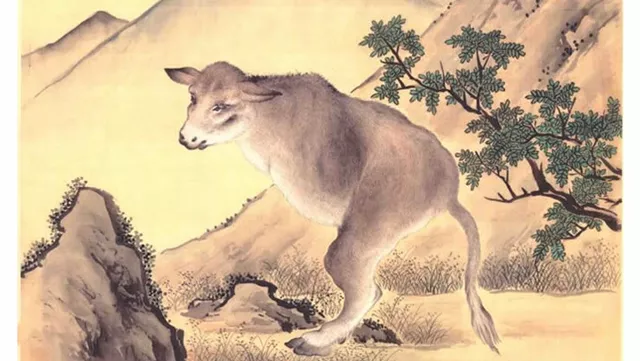
Kuí, also known as the Thunder Beast, is a mythical creature from ancient Chinese mythology. It is usually depicted with a single horn, one leg, an open mouth, and a curled tail. According to the "Classic of Mountains and Seas," "In the East China Sea, there is a mountain called Liubo Mountain that stretches seven thousand miles into the sea. On this mountain, resides a creature resembling an ox, but with a blue body, no horns, and only one leg. Whenever it enters the water, wind and rain follow. Its light is akin to the sun and moon, and its voice resembles thunder. This creature is known as Kuí. The Yellow Emperor captured it, using its hide to make drums and its bones for drumsticks, creating sounds that could be heard five hundred miles away, intimidating all."
Historical Records
The "Huangdi Neijing" narrates: "When the Yellow Emperor fought against Chiyou, the Xuan Nu crafted eighty Kuí drums for the Emperor, quaking the earth for five hundred miles and echoing for three thousand eight hundred miles." Xuan Nu ordered the soldiers to hunt the Kuí and fashioned eighty war drums, enabling the Yellow Emperor, with Xuan Nu's aid, to lead his forces into an epic battle against Chiyou at Zhongji. After establishing the "Qimen Dunjia" formation, he commanded the troops to strike the enormous Kuí drums made from the Thunder Beast’s bones. The drumbeats resonated throughout the battlefield, causing the ground to tremble and the heavens to swirl, with battle cries piercing the night. Chiyou's forces were rendered disoriented and ultimately defeated. "Chiyou had a bronze head and could consume stones," and he could "fly and navigate perilous paths." However, under the booming sound of the Kuí drums, "after nine beats, he could not escape and was subsequently killed." Following this, the Yellow Emperor also vanquished Yuwang at Banquan (now southeast of Zhuolu County, Hebei Province), and after this major battle, peace was restored to the world.
Legends Related to Kuí
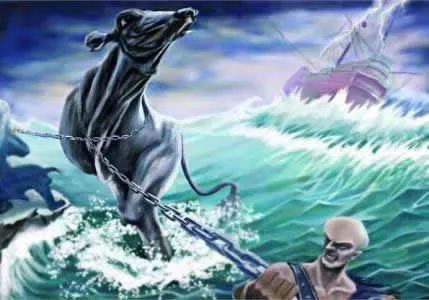
The "Classic of Mountains and Seas" records that if you journey seven thousand miles east along the East China Sea, you will reach Liubo Mountain. This mountain is home to a bizarre creature that looks like an ox but has only one leg (does it hop around? Intriguing). Its body is blue and lacks horns. When it enters the water, fierce winds and heavy rain follow. The creature's sound is thunderous, shaking the heavens and earth, and the light it emits shines as brightly as the sun and moon.
Despite its formidable powers, Kuí was ultimately tamed. The one who achieved this was Shennong. Part of a divine lineage, Shennong had innate divine strength. When he first saw the massive creature, its strange and daunting appearance surprised him. But the greater the challenge, the more determined he became to tame it, leading to a fierce battle. Eventually, following a lengthy struggle, Kuí was subdued, making Shennong's agricultural endeavors much easier.
It is said that only three Kuí existed in the world. During the Yellow Emperor's great battle with Chiyou, to invigorate his troops, the Yellow Emperor ordered one to be captured (the one passed down from Shennong), skinned for a war drum, and its bones used for drumsticks. This drum, known as the Heavenly Drum, reportedly could be heard over five hundred miles. The sound of the drum filled the Yellow Emperor's soldiers with enthusiasm and bravery, while instilling fear into Chiyou's troops.
By the time of the Shang and Zhou dynasties, the portrayal of Kuí had evolved somewhat, resembling a dragon, likely due to its single leg and reptilian appearance. Later, when Qin Shi Huang aimed to unify the world, he sought inspiration from the Yellow Emperor. Wishing to follow the Yellow Emperor's example of using the Heavenly Drum to inspire troops, he dispatched people to capture a Kuí. However, the results did not meet his expectations, leading to significant disappointment.
From this perspective, since Qin Shi Huang's time, there has apparently been only one Kuí left in the world, but its whereabouts remain unknown. Perhaps, one day in the future, the last remaining Kuí will be rediscovered!
Influence on Later Generations
Patterns
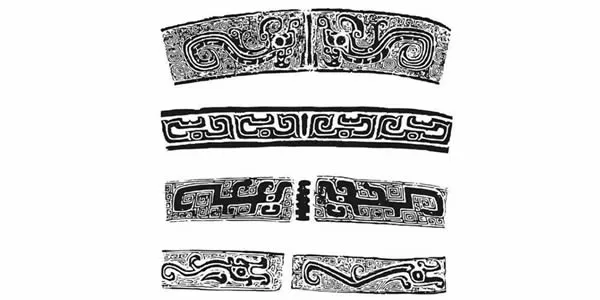
During the late Shang and Western Zhou periods, the Kuí dragon design was a prevalent decorative motif on bronze vessels. It is often depicted with a long, slender form possessing an open mouth and a curled tail, perfectly complementing the structural lines of the bronze's surface. It primarily features straight lines with curved embellishments, offering an ancient aesthetic. Dragon images on bronze items are often called Kuí patterns or Kuí dragon patterns. Since the Song Dynasty, any depiction of a one-legged, reptilian figure on bronze vessels has been referred to as Kuí, referencing the ancient texts that speak of "Kuí with one leg." However, the one-legged creature is a side view of a bipedal animal, so the term Kuí pattern is not commonly used now; instead, it's referred to as Kuí dragon pattern or simply dragon pattern.
The Kuí dragon pattern is a traditional decorative element commonly found on ancient bells and tripods, and it was prominently featured on Jingdezhen porcelain during the Ming and Qing dynasties. Recent archaeological finds at Sanxingdui, which gained attention online, revealed a square-mouthed bronze vessel with similar Kuí dragon patterns, providing strong evidence of the intricate connections between Sanxingdui culture and the Yin-Shang culture of the Central Plains.
Fiction
- A giant beast in "Divine Beasts," classified as a second-tier divine creature, surpassing a rhinoceros but below Xuanwu. In addition to giant beasts, the game also features magical beasts, spirit beasts, immortal beasts, and martial beasts.
- One of the ancient fierce beasts in "Zhu Xian," captured by the Ghost King using the Fulong Ding, which requires the sacrifice of four ancient fierce beasts to complete the Four Spirits Blood Array.
- One of the four fierce beasts featured in the novel, alongside the other three: Huangniao, Zhulong, and Taotie.
- A divine beast in "Records of the Gods," tamed by the Shennong messenger Tuoba Ye, and later killed by the Yellow Emperor's illegitimate son, whose skin was made into a drum to boost morale, eventually reclaimed by Tuoba.
- An underwater divine beast in "Gu Jian Qi Tan: Where is the Heart of the Sword," appearing in Gulu Bay and Longxiao Palace. The leader of the Kuí tribe, Yanmei, transformed into a human and, with his sworn brother, crafted the Lunbo Boat to help Baili Tusu and others successfully reach the ancestral continent to find the immortal herb.
Historical Records
In "Han Feizi: External Storage, Left Section, Commentary Two," Duke Ai asked Confucius: "I have heard that Kuí has one leg. Is that true?" Confucius responded: "Kuí is a person, why would it have one leg? It is no different from others, but it excels in music. Yao said: 'Kuí is one and has a leg.' It is used for music. Therefore, the gentleman says: 'Kuí is one, with a leg.' This doesn’t mean it only has one leg."
In "The Six Scrolls," it notes: "Kuí, with one leg, moves with a hop."
"The 'Classic of Mountains and Seas: The Great Wilderness, Eastern Classic' describes Kuí as: 'It resembles an ox, has a blue body and no horns, one leg, and whenever it enters the water, wind and rain follow. Its light shines like the sun and moon, and its voice is thunderous. This creature is called Kuí.' However, more ancient texts describe Kuí as a snake-like creature, a divine being resembling a dragon with one leg."
"Volume 5 of 'Yi Shi' cites 'Huangdi Neichuan': 'The Yellow Emperor fought against Chiyou, and Xuan Nu made eighty Kuí drums for the Emperor, shaking the ground for five hundred miles and resonating for three thousand eight hundred miles continuously.'"
Wu Renchen's "Extensive Notes on the Classic of Mountains and Seas" references the "Biography of Guangchengzi": "Chiyou had a copper head and could consume stones. By using the skin of Kuí (the Thunder Beast) for drums, after nine strikes, he could not escape and was killed."