Ancient Divine Creature - Three-Legged Golden Crow
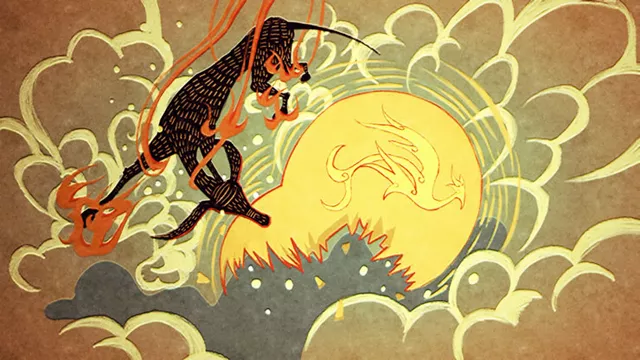
Three-Legged Golden Crow
The Three-Legged Golden Crow is a mythical creature found in ancient Chinese mythology. It is described as a black crow with three legs that lives in the center of the red sun, surrounded by a radiant golden glow, thus earning the name "Golden Crow." Initially depicted with two legs, it transitioned to a three-legged form by the late Western Han Dynasty. Remnants of the two-legged version have been discovered at the Mawangdui Han tombs. The third leg differentiates it from ordinary crows, and in Chinese mythology, the Three-Legged Crow is revered as the divine bird that guides the sun chariot.
Ancient Texts on the Three-Legged Golden Crow
First, "Sun Charioteer." The crow serves as the chariot for the sun, representing a master-servant dynamic between the sun and the crow. The "Classic of Mountains and Seas, Eastern Classic of the Great Wilderness" states: "Above the Tang Valley, there is a tree called Fumu; the sun rises and sets, all carried by the crow."
Second, "Essence of the Sun," also referred to as the Yang Essence or Yang Crow. Xu Shen's "Shuowen Jiezi" from the Eastern Han Dynasty describes: "The sun is the essence, the essence of the sun, unblemished." The ancient character for "sun" was an oval containing a "Z" shape, symbolizing a bird within the circular sun. Qing Dynasty scholar Duan Yucai explains: "It signifies a crow within the circle."
The "Book of Later Han, Astronomy," quoting Zhang Heng's "Ling Xian," notes: "The sun is the origin of Yang essence. Collected, it takes the form of a bird, resembling a crow with three toes. The essence of Yang is odd-numbered." Similar records appear in "Yunji Qiqian, Various Qi Methods": "The sun is the source of Yang essence, forming a shape that becomes a bird." "Wenxuan, Volume Seven" by Zhang Xie of the Western Jin Dynasty states: "The Yang crow flaps its wings, and Kuafu throws his spear." Li Shan comments: "The 'Yuanming Bao' mentions: Yang forms in threes, hence the three-legged crow in the sun. The crow embodies Yang essence."
In the Sui Dynasty, Xiao Ji's "Great Meaning of the Five Elements, Discussion of the Seven Stars" confirms: "The 'Yuanming Bao' says: Yang rises as one, making the sun travel a degree, and Yang forms in threes, thus creating the three-legged crow. The crow symbolizes Yang essence; commonly, it's seen as a crow, hence the name." These texts indicate the crow and the sun have become united, symbolizing the sun.
Third, "Bird of Service," serves the Queen Mother of the West. Ban Gu's "Book of Han, Biography of Sima Xiangru" states: "I soar over the Yin Mountains and today see the Queen Mother of the West. With a white head adorned with a crest, I am privileged to have the three-legged crow as my servant." Zhang Yi explains: "The three-legged crow is a blue bird, primarily serving the Queen Mother of the West, located north of Kunlun." Fu Xuan from the Western Jin Dynasty notes in "Zhengdu Fu": "The Eastern Father gazes afar with a blue canopy while the Western Mother commands the three-legged divine bird." Evidently, the crow serves both the sun and the Queen Mother of the West.
Records of the Three-Legged Golden Crow in the "Classic of Mountains and Seas"
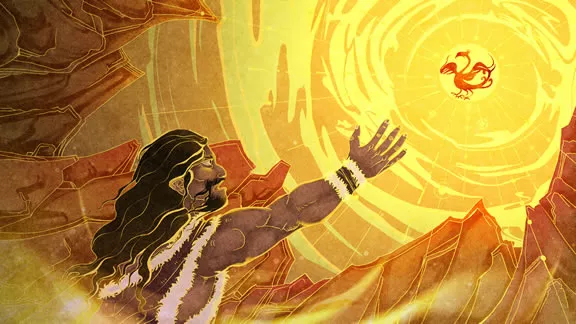
According to the "Classic of Mountains and Seas" and other ancient Chinese myths, the ten suns are the offspring of Di Jun and Xi He. They exhibit both human and divine traits and are incarnations of the Golden Crow, depicted as a three-legged crow and a solar deity capable of flying.
For example, in the "Classic of Mountains and Seas, Southern Classic of the Great Wilderness," it states: "Xi He is the wife of Di Jun and gave birth to ten suns"; in the "Classic of Mountains and Seas, Eastern Classic of the Overseas," it explains: "Above the Tang Valley, there is a tree called Fusang, where the ten suns bathe, located north of the Black Teeth. In the water, a large tree holds nine suns on the lower branches and one sun on the upper branches"; and the "Classic of Mountains and Seas, Eastern Classic of the Great Wilderness" reiterates: "Above the Tang Valley, there is a tree called Fumu; the sun rises and sets, all carried by the crow," recounting the myth of the ten suns.
The Myth of Hou Yi Shooting the Suns
Legend dictates that the three-legged crow represents the sun's essence, dwelling within it, with ten in total. They reside on the Fusang tree by the eastern sea, taking turns rising from Fusang under their mother, Xi He's, guidance as they traverse various mountains and valleys. The legend further tells of all ten Golden Crows causing chaos by emerging together, scorching the earth until Hou Yi shot down nine with divine arrows, leaving only one.
Records of the Three-Legged Golden Crow in Historical Texts
"Xuan Zhong Ji": "To the east of Penglai, on Mount Daiyu, stands the Fusang tree, ten thousand zhang tall. At its top, a celestial rooster perches. At midnight, the rooster crows, and the sun's Yang bird answers; as the Yang bird crows, all the roosters in the world crow." The three-legged crow, essence of the sun residing within it, often appears next to the Queen Mother of the West in Han Dynasty brick carvings, serving her as a bird for food, sometimes called the three blue birds.
Dongming Ji, Volume Four narrates: "(Emperor Wu of Han) asked: 'Is there anything that can grant eternal youth?' Shuo replied: 'In the northeast lies Zhi Grass, and in the southwest, a spring grass.' The emperor questioned how Shuo knew of it. Shuo responded: 'The three-legged crow frequently descends to eat this grass; Xi He, trying to guide it, covers its eyes, but the bird insists. This grass bestows youth; other creatures that consume it become lovely but immobile.'" "Yiwenzhai Ju, Volume One Hundred," quotes the "Yellow Emperor's Divination Book": "Seeing the three-legged crow in the sun foretells a great drought and red earth," symbolizing the sun.
"Hetu Kuodi Tu" mentions: "To reach Kunlun within the Ruoshui, one must ride a dragon. A three-legged divine bird serves the Queen Mother of the West for food."
Wang Chong from the Han Dynasty states in "Lunheng, On the Sun": "A three-legged crow resides in the sun; a rabbit and a toad are in the moon."
"Huainanzi, Spirit Training" states: "A three-legged crow dwells within the sun," with Han Gao You commenting: "Crouching, it signifies the three-legged crow."
"Yuanming Bao" notes: "A three-legged crow inhabits the sun," leading to the sun also being referred to as the three-legged crow or Golden Crow. Furthermore, the Queen Mother of the West's three-legged crow, a blue variety, serves her for food.
"Records of the Grand Historian, Biography of Sima Xiangru" mentions: "[The Queen Mother of the West] adorned with a crest, is blessed with the three-legged crow as her servant."
Zhang Shoujie’s commentary includes Zhang Yi's note: "The three-legged crow, a blue bird, primarily serves the Queen Mother of the West for food," later referring also to the sun.
In the Tang Dynasty, Du Fu's "Yuelu Mountain, Dao Lin Er Temple" poem reads: "The lotus flowers resonate with the life-giving bird, the golden list returns with the three-legged crow." Qiu Zhao'ao's commentary cites Huang Sheng: "The three-legged crow signifies the sun."
In the Song Dynasty, Lu You's "Short Song on a Moonlit Night" declares: "Though the morning star is high, do not rejoice; the three-legged Yang crow emerges from the sea."
The Golden Crow in Japanese Culture
In Japan, the sun or its emissary, the incarnation of deity Hamo Takezaki, became the progenitor of the duck clan. Influenced by Chinese mythology, it is often depicted as a three-legged crow.
During Jinmu's eastern expedition, under Takeminakata and Amaterasu's command, a crow guided Emperor Jinmu from Kumano to Yamato. In the Kumano Sanzan, it is revered as a divine messenger (misaki). Pre-modern times frequently featured the crow on the Kumano Ugyu treasure seal, used in petitions. The Saika clan of Kii Province adopted the Yata no Kagami emblem during the Warring States period.
The Three-Legged Bird in Ancient Goguryeo Culture
In ancient Goguryeo, the three-legged crow was worshipped similarly to dragons and phoenixes, symbolizing power and the sun god. Unlike the ancient Central Plains culture, which focused less on deities, Goguryeo worship emphasized a singular sun god. Goguryeo's reverence for the three-legged crow is illustrated in ancient tomb murals, and its images remain visible in Ji'an City, Jilin Province.
Goguryeo tomb murals often depict images of sun and moon deities, showing worship of the celestial bodies. In the Five Helmets Tomb, Tomb No. 4, "The sun and moon gods appear on the upper corners of a two-layered stone, both figures having a human head and serpent body. The sun god, male with flowing hair, holds the sun wheel above his head with a three-legged crow; the moon goddess, female with long hair, holds the moon wheel with a toad." Tomb No. 1 in Changchun's rear chamber displays a ceiling painting featuring the three-legged bird (sun god), a toad and rabbit (moon goddess), and the Big Dipper.
Archaeology of the Three-Legged Bird
Artifacts excavated from the Jinsha site include a ceremonial bronze vessel adorned with three divine birds, characterized by long necks, single legs, and magnificent tails, closely resembling the three-legged crow from sun mythology. Historically, these rich and imaginative motifs from the ancient Shu culture have influenced subsequent designs.
Images of three birds surrounding a sun can be found on bronze mirrors from the Warring States and Qin Dynasties, and Han Dynasty roof tiles feature three birds flying around a sun. Additionally, Han stone carvings like "Hou Yi Shooting the Suns" depict the three-legged Golden Crow on the Fusang divine tree, reflecting its iconic portrayal in ancient people's minds.