Mythical Creatures in Ancient Legends: The Gu Diao
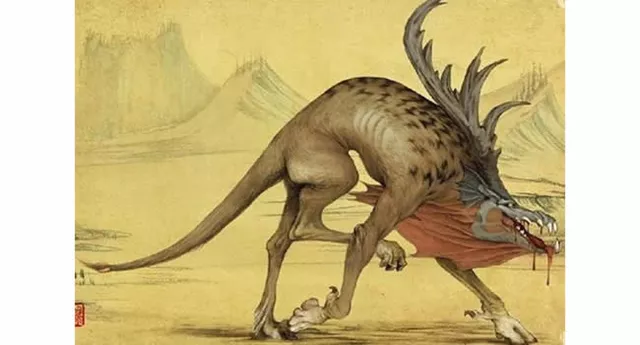
The Gu Diao, also known as the Zuan Diao, is a legendary creature from ancient Chinese mythology, resembling a bird but not entirely like one. It has the look of an eagle, with horns on its head, and its cry sounds eerily similar to a baby's wail.
According to the "Shan Hai Jing" (Classic of Mountains and Seas), Lu Wu Mountain lies five hundred miles east of Qu Wu Mountain. This barren place lacks vegetation but is rich in gold and jade. The Ze Geng River begins in the valley and flows south into the Bang Shui. In the Bang Shui River lives a mysterious and ancient water monster known as the Gu Diao, featuring a beast's body and a bird's head, complete with wings and horns. It is a man-eating water creature. When it hunts humans or livestock, it deceptively mimics a baby's cry with its sound.
Physical Characteristics of the Gu Diao
The Gu Diao's front half resembles an osprey, while its back half looks like a fish. Below its neck, its body transitions from feathers to scales, and a single fish fin extends from its chest. Its body structure is similar to that of a salmon, with branches growing from its shoulder blades above the pectoral fins, forming its wing skeletal structure. Its skull has two bony protrusions covered with a spiral layer of keratin, which is hollow inside.
The Gu Diao has a heavy body with a relatively small head, and its wingspan surpasses its body length. It possesses strong muscles and explosive power. When its wings are folded, they lie close to its sides, with feathers and scales matching in color, offering waterproof capabilities that help it blend seamlessly with fish. Although it can fly powerfully, it lacks feet, preventing it from perching on land, and it needs to stay moist, so it never strays far from water.
Living Habits of the Gu Diao
The Gu Diao is carnivorous, primarily preying on fish and shellfish, hunting at night similar to a salmon. Its call is high-pitched with a rising inflection, resembling a baby's cry. Generally, the Gu Diao does not attack humans or larger animals, but during food shortages, it will wait for long periods in riverbank grasses or fine sand on the riverbed. When a person or animal passes by, it swoops down and targets the vulnerable parts of its prey for a fatal strike. After a successful hunt, it does not immediately eat its catch but drags the heavy prey into the water to hide it as a food reserve.
Like other mythical creatures in the "Shan Hai Jing," the Gu Diao is a composite entity. It is said that the Gu Diao prefers to live atop jade mountains, often in areas abundant with jade. As a result, ancient people viewed the Gu Diao as an indicator of wealth; upon hearing a baby-like cry in the wilderness, many would pursue it, believing it could lead to discovering valuable jade.
However, the Gu Diao is not to be taken lightly. Many have been reportedly eaten by the Gu Diao while searching for jade, with only a few fortunate ones escaping. It is said that the famous jade known as the Xia Hou Shi Zhi Huang (as renowned as the He Shi Bi) was discovered beneath a massive stone where a male Gu Diao resided. This small piece of Xia Hou Shi Zhi Huang was valued equivalently to twenty cities! This is why many are willing to risk their lives pursuing the Gu Diao.
The Golden Monster in the Warring States Tomb
In 1957, an archaeological team discovered a Xiongnu tomb from the Warring States period in Shenmu, Shaanxi. A "golden monster" measuring 11.5 cm in height and 11 cm in width captured everyone's attention. Its design was unique, resembling a large deer but featuring an eagle's beak and horns on its head. It is believed that the tomb's owner was a member of the Xiongnu royal family with high status. This beastly bird-monster resembles the ancient water monster Gu Diao recorded in the "Shan Hai Jing" from the Ze Geng River.
This discovery indirectly proves that as early as the Warring States period, the Xiongnu were aware of the "Gu Diao" and regarded it as a guardian deity of the tomb, a messenger watching over the spirits of the deceased. However, to date, only one artifact of this shape has been unearthed, making it a unique find.