The Nine-Headed Bird (Ghost Car) in Ancient Myths and Legends: A Review
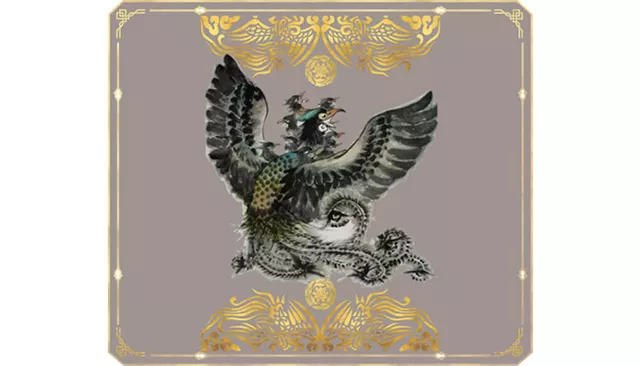
In ancient Chinese folklore, there is a mythical bird known as the "Ghost Car," also referred to as the "Nine Phoenixes," "Nine-Headed Bird," or "Gu Huo Bird." The earliest mention of this creature can be found in the "Shan Hai Jing" (Classic of Mountains and Seas), describing it as follows: "In the vast wilderness, there is a mountain called the Northern Polar Cabinet. The sea water flows northward. There is a divine creature with nine heads, a human face, and a bird's body, called the Nine Phoenixes."
The Nine Phoenixes are the earliest reference to the Nine-Headed Bird, suggesting that the Nine-Headed Bird originated from the Nine Phoenixes in the "Shan Hai Jing." The Phoenix is originally a divine bird in Chinese mythology, and the Nine-Headed Phoenix is even more extraordinary. According to legend, Zhu Rong, the ancestor of the Chu people, is the incarnation of the Fire Phoenix, the legendary fire god. The Nine Phoenixes are the revered nine-headed divine bird of the Chu people, serving as their totem. The divinity of the "Nine Phoenixes" is apparent from its name alone.
The "Nine Phoenixes" reside in the "great wilderness," the exact boundaries of which are unclear, but it certainly includes the land of Chu, as the previous emperor of the Chu people, Zhuang Xu, along with his nine concubines, were buried there. The "Shan Hai Jing: Classic of the Northern Wilderness" begins with: "Beyond the northeastern sea, in the great wilderness, between the rivers, at the mountain of Fu Yu, Emperor Zhuang Xu and his nine concubines are buried." The book "Classic of the Eastern Seas" states: "The Han River emerges from the mountain of Catfish, Emperor Zhuang Xu is buried in the Yang, and the nine concubines are buried in the Yin, guarded by four snakes." Fu Yu refers to catfish, an ancient term used interchangeably. Qu Yuan, a poet of Chu descent, states in "Li Sao" that he is "descended from the lineage of Emperor Gao Yang." This Gao Yang refers to Emperor Zhuang Xu. Zhuang Xu is buried by the Han River, and the Nine Phoenixes share the same location with him.
From Divine Bird to Monster
The Nine Phoenixes in the "Shan Hai Jing" are undoubtedly a divine bird or bird deity. However, after that, the Nine Phoenixes mysteriously disappeared from Chinese literature, replaced by various nine-headed birds bearing different names, which not only completely lost their divinity but also deteriorated over time into genuine monsters.
Various records, such as "Chronicles of the Three Kingdoms," "Records of Strange Tales from the Ling Mountains," "Correct Characters," and "Ancient Style," suggest the Nine-Headed Bird originated from a nine-headed monster in China, similar to an owl. With its wings spread, it can reach a length of 3 meters and is a nocturnal creature that circles the pitch-black night sky, feeding on souls. At night, people can hear the sound of the Ghost Car's wings as it circles. It lands on the rooftops of human dwellings, sucking the souls of the homeowners, leading to death. The rooftops where the Ghost Car lands are always stained with blood. Thus, wherever the Ghost Car lands, disasters and calamities tend to follow, which is a characteristic trait.
So, why did the revered Nine Phoenixes disappear and give way to the Nine-Headed Monster? Why did it transform from a deity into a demon, and when and where did this transformation occur? A famous poem titled "Ghost Car" by the Song Dynasty poet Ouyang Xiu provides some answers:
Once, Duke Zhou resided in Eastern Zhou, weary of this bird as if it were a foe.
At night, he called upon the Ting clan to drive it out of the Nine Provinces.
Since a dog bit off one head, blood has flowed ever since.
Now, three thousand years have passed, it hides by day and emerges at night like an owl.
Whenever it passes on dark, cloudy nights, the sight of its firelight startles and falls.
At times, its remaining blood drips down, and the household it visits will surely suffer.
This poem indicates that the Nine Phoenixes became tainted with demonic energy and transformed into the detestable Nine-Headed Bird due to the wars between the Zhou and Chu people during the Warring States period, just as Chi You, a deity of minority ethnic groups, became a monster in the eyes of the Han Chinese. The Ghost Car gradually evolved into a harmful creature in northern Han mythology. Stories from the Han dynasty, such as "Duke Zhou residing in the East, detesting this bird, commanded the Ting clan to shoot it, and blood from one head was shed, leaving nine heads remaining" began this narrative, which was later popularized by accounts in "Jingchu Seasonal Records," "Qiu Yang's Miscellaneous Notes," and "Records of the Eastern Wilds."
Thus, the Ghost Car ultimately transformed from the divine bird Nine Phoenixes into the monster Nine-Headed Bird.
Characteristics of the Nine-Headed Bird in Legend
The most notable characteristic of the Nine-Headed Bird is its nine heads. However, there are various interpretations regarding these nine heads. Some say it originally had ten heads, such as:
- Tang Dynasty's Duan Chengshi in "Miscellaneous Notes from Youyang," Volume 16, "Feathers": The Ghost Car Bird, it is said that this bird once had ten heads... one was bitten off by a dog.
- Song Dynasty's Zhou Mi in "Records of the Eastern Wilds," Volume 19: The Ghost Car, commonly known as the Nine-Headed Bird... It is said that this bird once had ten heads, one of which was bitten off by a dog, and to this day, blood drips on people's homes as a disaster... Its body is round like a winnowing basket, with ten necks clustered, nine have heads, and one is headless, dripping fresh blood, as commonly said.
- Ming Dynasty's Yang Shen in "Complete Works of Yang Sheng'an," Volume 81, "Ghost Car": "In the novel": Duke Zhou resided in the East, detesting this bird, commanded the Ting clan to shoot it, and blood from one head was shed, leaving nine heads remaining.
Others suggest it originally had only nine heads, with one head injured and bleeding incessantly. As mentioned in "Chronicles of the Three Kingdoms": In the garden of Qi, a Nine-Headed Bird was seen... all nine heads were crying. Also, Tang Dynasty's Liu Xun in "Records of Strange Tales from the Ling Mountains" states: The Ghost Car... some say it has nine heads, one of which was bitten by a dog and constantly drips blood.
Among these legends, the description in "Records of the Eastern Wilds" of "ten necks and nine heads" is the most terrifying. Just imagine, in addition to the nine bird heads, there is another bird neck dripping fresh blood—how horrifying is that?
Taboos Surrounding the Nine-Headed Bird in Folklore
As the Nine-Headed Bird is considered a fierce creature, there is great fear surrounding it in folklore, leading to various taboos and protective measures against it.
1. Taboos
- "Children raised in Yuzhang should not expose their clothes." (from "Commentary on the Water Classic: River Water")
- "Anyone feeding small children should not expose their hands; children's clothes should not be hung out to dry." (from "Miscellaneous Notes from Youyang: Feather Section")
- "Children's clothes should not be exposed at night." (from "Records of the Mysterious Middle")
2. Exorcism and Defense
- "It is said that those who hear it must bark at dogs and extinguish lamps to hasten its passage through the marshlands." (from "Records of the Eastern Wilds," Volume 19)
- "Upon hearing this bird, Duke Zhou commanded the Ting clan to shoot it." (from "Complete Works of Yang Sheng'an," Volume 81, citing the novel)
- "Every household should hammer beds and doors, twist dog ears, and extinguish candles to ward it off." (from "Jingchu Seasonal Records")