The Four Great Beasts of Ancient Mythology: Qiongqi Feel free to let me know if you're looking for any other specific adjustments!
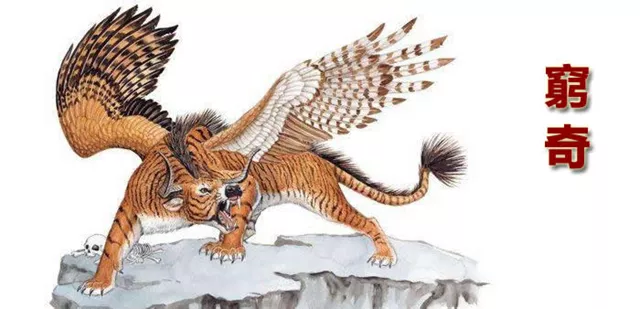
Qiongqi, one of the four notorious beasts in ancient Chinese mythology, is prominently featured in the "Shan Hai Jing" (Classic of Mountains and Seas). According to the "Hai Nei Bei Jing" section, Qiongqi resembles a tiger, has wings, and is known for eating humans, starting its meal with the head, marking it as a ferocious creature. However, in another section of the "Shan Hai Jing," the "Xi Shan Jing," Qiongqi is depicted differently, resembling an ox with spines like a hedgehog, contrasting with the description in the "Hai Nei Bei Jing." Despite these differences, both versions describe it as a man-eating beast.
Qiongqi is said to often fly to the site of conflicts, devouring those who are just and reasonable, and biting off the noses of loyal people. For those committing evil acts, Qiongqi captures wild beasts to present to them, encouraging more wrongdoing. In ancient times, individuals who ignored principles and favored the unworthy over the righteous were referred to as Qiongqi.
Appearance and Form
In the "Hai Nei Bei Jing," Qiongqi is described as resembling a tiger, being the size of an ox, having wings, and beginning its meal from the head, establishing its ferocity. In contrast, the "Xi Shan Jing" describes Qiongqi as being similar to an ox with hedgehog-like spines, presenting a significantly different depiction.
Some accounts also describe Qiongqi with snow-white fur, two light golden dragon horns on its forehead, a beak-like mouth similar to an eagle's, and black wings, indicating its taste for human flesh. However, the first two descriptions are considered more credible. Regardless, all depictions emphasize its nature as a man-eating beast.
Historical Legends
Fierce Beast Theory
Qiongqi exhibits a unique behavior; it targets and devours the just and reasonable during conflicts. If it encounters someone loyal and honest, it will attack by biting off their nose. Conversely, upon hearing of individuals committing numerous evils, it will hunt wild beasts to present to them, signaling its tendency to punish the good and reward the wicked.
A legend describes an ancient ghost-exorcising ritual named "Da Xie," involving twelve fierce beasts capable of devouring evil spirits, with Qiongqi among them. Unlike a champion of good, this Qiongqi symbolizes evil forces that encourage wickedness. However, during the ritual, all evil spirits would flee in fear of Qiongqi, afraid to harm humanity again.
Good Beast Theory
According to the "Book of the Later Han: Rituals," among the twelve deities known as "Chasing Evil Beasts," Qiongqi is mentioned as "Qiongqi Tenggen, who devours poison," suggesting that Qiongqi can eliminate harmful toxins and is portrayed positively as a divine beast.
In ancient China, before the Laba Festival, a palace ritual called "Zhu Yi" was conducted, where the Fangxiang clan paraded twelve strange beasts. Qiongqi, along with another beast named Tenggen, was responsible for devouring harmful poisons, indicating a benefit to humanity.
Guo Pu, when annotating the "Shan Hai Jing," wrote a poem in praise of Qiongqi, stating, "The beast Qiongqi is very ugly; it chases away evil spirits, and none can escape; hence it is named, called the divine dog," emphasizing Qiongqi's role in expelling evil spirits. These actions, which protect people from harm, contrast with its previous depiction as consuming the righteous and aiding the wicked.
In "Huainanzi: Chapter on Falling Shapes," Gao You noted that Qiongqi is "born of the vast winds," suggesting its lineage from the wind god, rather than being considered an unworthy offspring of the Shaohao clan.
Historical Origins
The "Records of the Grand Historian: Annals of the Five Emperors" recounts the origins of Qiongqi: "The Shaohao clan has an unworthy son who undermines trust and loyalty, spreading malicious words, known to the world as Qiongqi." Alongside the unworthy sons of the Di Hong clan, "Hundun," the Zhuanxu clan, "Tao Tie," and another from the Jinyun clan, they are collectively dubbed the "Four Fierce Beasts." The ruler Shun exiled them, "dispersing them to the four corners to guard against evil spirits."
Shaohao is recognized as the western heavenly emperor (the White Emperor), with a mother named Huang'e and a father known as the Yellow Emperor. Their tale is richly described in the "Records of the Lost," depicting a magical Qiong Sang tree that bears fruit every ten thousand years; consuming it grants eternal youth. Governing the west, Shaohao, also referred to as "Shao Hao," is known as "Qiong Sang Shi," or the "Golden Sky Clan," and more broadly as the "Qing Yang Clan." The terms "White," "Gold," and Shaohao's western location align with Qiongqi's northwest exile.