Li Daozhen: Interpreting Mythical Codes (Part 3) - The Divine Fusang Tree
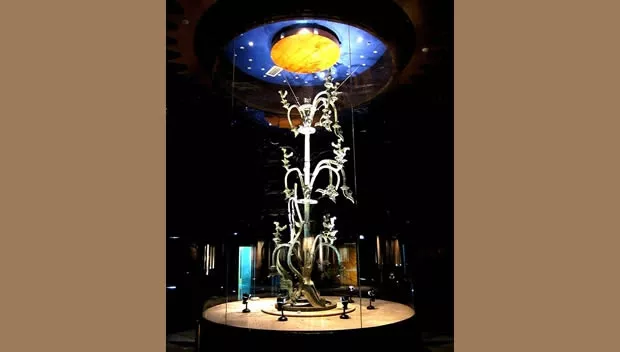
The bronze "Fusang Divine Tree" unearthed from Sanxingdui
III. The Fusang Divine Tree
The Fusang tree and the sun god bird are mentioned in the "Shan Hai Jing" (Classic of Mountains and Seas).
The legend goes that Xihe, the Empress of Heaven, gave birth to ten suns, which were nurtured at Gan Yuan. In a location known as Tanggu, a giant divine tree called Fusang stood, where the suns received their care. Nine suns rested on the lower branches, while one could be found on the top branch. Daily, one sun would return to the human world on a golden crow and another would depart to replace it, ensuring continuous service by cycling through the ten suns. Changxi, Xihe's sister, gave birth to twelve moons, which were also nurtured.
From our earthly perspective in this three-dimensional space-time, the sun is a source of energy, enabling all life on Earth to thrive, supporting the cycle of feng shui, and acting as the solar system's energy center.
From my viewpoint, the ten suns symbolize the ten Heavenly Stems, linking higher-dimensional space-time to the solar system and human space-time, serving as a high-level energy source for human space-time operations.
The ten Heavenly Stems (higher-dimensional space-time connections) work in tandem, interlocking with the twelve Earthly Branches (human space-time connections) like gears, which introduce energy into human space-time. This is my understanding of the significance of the ten suns rotating service in the human realm.
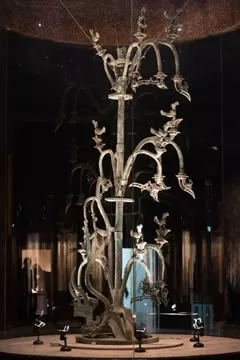
The renowned Sanxingdui site in Sichuan revealed the bronze divine tree and the sun god bird, sparking a sensation and affirming the "Shan Hai Jing" accounts.
What is the Fusang Divine Tree?
From my perspective, when seen from a higher-dimensional space-time, these connections resemble a tree. The Fusang tree's roots embed in high-dimensional space-time, with ten branches reaching human space-time, matching the twelve major connections (twelve Earthly Branches) in human space-time, supporting the grand cycle of heaven and earth and feeding energy to human space-time for its continued function.
Xihe might be a name for a deity in higher-dimensional space-time, analogous to the Earth Mother, and from whom the ten Heavenly Stems emerged, connecting from higher-dimensional space via the solar system to human space-time. This is how I understand the Fusang Divine Tree and the sun god bird.
What about Changxi, who gave birth to twelve moons? Changxi might be a title for the Earth Mother deity in human space-time, and the twelve moons likely stand for the twelve Earthly Branches, which are the twelve main meridians of human space-time. Why refer to them as moons?
My understanding is that the moon's phases align with the twelve major meridians (twelve Earthly Branches) of Earth, safeguarding the planet's gates while synchronizing in orbit and preserving its cosmic routine.
As mentioned earlier, Earth is a living entity, a form overseen by divine beings, historically referred to as the Earth Mother or Houtu by ancient cultures.
A fundamental Chinese cultural tenet is the harmony of heaven and humanity, suggesting that the human body aligns and integrates with nature and the universe. The human body is a microcosm of nature and the universe, while nature and the universe are a macrocosm of the human body.
My master has conveyed many profound cosmic principles, and from my understanding, I've realized that advanced deities are in harmony with nature and the universe.
Gods modeled humans in their likeness, making the human body analogous to the divine form, as well as to nature and the universe.
The human body possesses mechanisms for blood, energy, nutrient, and meridian circulation. Earth similarly manages water, air, biological chains, and dragon vein circulations. The human body contains temperature, bones, muscles, and marrow, analogous to Earth's temperature, soil, rock, and magma. Human bodies are guided by their spirit—the soul and three souls and seven spirits—while Earth is governed by divine entities known as the Earth Mother (Houtu) and other river and mountain gods. Why did ancient societies emphasize ritual, especially in worshipping the heavens, earth, mountains, and rivers? Typically led by emperors, such rituals connected directly with the divine.
The Earth is alive; for humanity, it's a vast living form, yet its life signals aren't obvious in human lower-dimensional space, often going unrecognized. Expanding this understanding could imply the universe itself is a colossal life form, with higher deities unified with nature and the universe, akin to the human soul's unification with the human body.
Exploring Connections:
The human body contains visible and tangible systems like arteries, veins, lymphatics, and nervous systems within its physical framework. However, traditional Chinese medicine proposes that the human body also has meridians, invisible and intangible, existing beyond humanity's lower-dimensional space within a higher-dimensional realm.
From my understanding: the human body comprises multiple layers across various dimensions, beyond just a three-dimensional existence. This complexity is due to the divine creating the human body in alignment with the divine form, interconnected with the divine body, and existing in multiple dimensions. This might explain why humans can cultivate divine being attributes, evolving into higher life forms and transcending space-time.
The human space-time encompasses more than the physical body, which is only a fraction of it; in other dimensions, the human body persists. Traditional Chinese medicine concepts of the five organs and six bowels refer to the human body's components in alternate dimensions. Still, the human body in other dimensions is entirely integrated with the physical form in our space-time reality, existing in union and inseparably, though beyond our scope and comprehension. It's like a three-dimensional hand submerged in a two-dimensional water surface; only a cross-section is visible, but it remains part of the whole hand, maintaining wholeness.
My understanding is that the human body in other dimensions is latent; presently, humans activate only the surface-level physical body in the three-dimensional space-time, remaining confined to its most superficial low-dimensional aspect.
Humans possess a mysterious third eye, referred to as the heavenly or celestial eye. Through cultivation, opening this eye allows one to see the unseen, perceive higher dimensions, or possess x-ray-like vision. This perspective suggests activating the sight of the human body in higher dimensions.
Why does the sun god tree from Sanxingdui appear so lifelike? How can traditional Chinese medicine precisely detail the human body's meridian and acupoint structure in other dimensions? Likely, because ancient people opened their third, or heavenly eye, visually documenting their observations just as we utilize physical sight now. Exiting human space-time unveils a distinct world and cosmic view—wondrous and unique—experienced differently at each level, yet indescribable. Meanwhile, we are ensnared within three-dimensional space-time, akin to frogs at the well's bottom, limited to viewing a narrow sky, mistakenly believing it encompasses the universe and world, inherently skeptical and unable to surpass the well's rim, representing a sad plight.
Cultivation yields extraordinary abilities. Throughout history and currently, many have demonstrated remarkable capacities, an undeniable reality. For instance, the heavenly eye, remote viewing, x-ray vision, telepathy, clairvoyance, levitation, telekinesis, wall-passing techniques, and more. These phenomena are real, with numerous individuals still exhibiting such traits today.
My understanding is this results from awakening higher-dimensional aspects of the human body, activating those parts, and gaining extraordinary abilities beyond the physical body, utilizing elevated energies. Cultivation can sequentially awaken the human body's higher-dimensional layers, ultimately achieving divinity and a higher life form status. This is because the human body interconnects with the divine form, crafted by divine standards.
Thus, traditional Chinese medicine addresses illness origins, while Western medicine primarily targets symptoms. Traditional Chinese medicine directly engages with the higher-dimensional human body, addressing the core source, whereas physical aspects represent only surface branches. Western medicine targets the physical body's most outer layer, treating superficially. No matter humanity's scientific advancements, it's minor compared to higher life forms, akin to children stacking blocks; human wisdom and divine insight never equate.
Since ancient times, mastering traditional Chinese medicine has required wisdom surpassing the ordinary, necessary for understanding and application. Esteemed ancient physicians like Qibo, Lei Gong, Bian Que, and Hua Tuo were Taoist practitioners with superior wisdom. Modern times, hindered by atheism, evolutionism, and a general moral decline, have practically impeded mastery of traditional Chinese medicine. Consequently, its practice has dwindled, even underperforming against Western medicine's methods, leading to dismissals by some as pseudoscience, reflecting human ignorance.
Traditional Chinese medicine, alongside the I Ching, astrology, and Tai Chi, are ancient, divine-derived teachings, not originating from ordinary human culture; a topic for further discussion.
Our bodies contain blood vessels circulating blood, distributing energy, nutrients, and oxygen surface-ward. Blood vessels are categorized into arteries, veins, and capillaries. Arteries are classified as yang, requiring pressure from the heart side to stop bleeding; veins are yin, necessitating pressure from the distal side. This represents the blood circulation mechanism in the human body.
In other dimensions, meridians exist within the human body, including the eight extraordinary meridians, twelve regular meridians, twelve meridian branches, fifteen collaterals, twelve skin regions, Sun collaterals, and superficial collaterals acknowledged in traditional Chinese medicine, all within the human's meridian system. Meridians are channels for the higher-dimensional human body's energy flow, also known as qi (气).
The qi (气) referenced in traditional Chinese medicine and Taoist practice isn't the air we breathe; it signifies a more subtle energy from another dimension. For example, the human body contains innate essence qi, true qi, acquired qi from five grains, and defensive qi. These energies are from another dimension, functioning within meridians of the human's higher-dimensional body.
The human body mirrors nature and the universe. While it possesses meridians, so does the natural world, such as the Earth's dragon and water veins. The human body has qi (气), and the broader world and universe possess qi (气), encompassing heaven's yang qi and earth's yin qi.
The "five movements and six qi" theory in traditional Chinese medicine stems from the "Huangdi Neijing" (Yellow Emperor's Inner Canon). It seamlessly aligns the human body with the natural world, presenting nature as a large human body and the human body as small nature, interacting and connected. This can aid in disease prediction, treatment, and health maintenance. For instance, last year's pandemic was predicted using this theory, displaying superior wisdom.
Traditional Chinese medicine contends that higher energies (气) circulate within meridians, with the human meridians' major energy flow known as the "Zhou Tian" (Great Cycle). Critical meridian points—"acupoints"—act as gateways, opening and closing meridians to manage the energy flow. A blocked acupoint results in the obstructed meridian, hampering energy circulation in the human body, potentially causing issues. A severed acupoint interrupts the meridian, resulting in energy leakage, possibly leading to death.
Moreover, from my understanding, acupoints serve vital roles in connecting various space-time levels. Meridians exist in the higher-dimensional human realm, inaccessible in current space-time, yet acupoints interlink higher-dimensional meridians to the physical surface form. Hence, traditional Chinese medicine can manipulate acupuncture and massage on physical acupoints to open higher-dimensional human body meridians, achieving healing purposes. Severed acupoints disrupt this connection, causing energy leaks. This builds on earlier discussions of Nuwa repairing the sky.
Returning to Changxi and the twelve moons, it was previously noted that the moons correspond with the twelve Earthly Branches, aligning with Earth's dragon veins. The moon's cycles align with the Earth's dragon vein operation, serving as Earth's sentinels.
Earth itself is alive; just as humans breathe, so does Earth. An unusual phenomenon on Earth is the tides.
This encompasses seawater's regular rise and fall cycles. Coastal residents know tides rise and drop predictably daily, unchanging over time. Tide heights also follow a consistent pattern, reaching their peak and valley monthly in sync with lunar cycles.
Not only does seawater show tidal effects, but land and air experience similar high and low cycles, known respectively as land tides and air tides. Collectively, these phenomena are modern scientific "tides."
Tidal changes correlate with lunar phases. While modern science attributes these to the moon's gravity, from my view, it's not lunar gravity but Earth's breathing, engaged in energy exchanges; effectively, the Earth's dragon veins' energy flow, symbolizing its life form. Physiological human processes, especially in women, cycle with lunar phases, linked to human-natural body correspondences. Earth's dragon veins' energy (dragon vein qi) flows from higher-dimensional space-time, entering via the grand heavenly and earthly cycle (Heavenly Stems and Earthly Branches cycle).
This is my understanding of the Fusang Divine Tree's symbolism.