Li Daozhen: Decoding Myths (Part 2) - Nuwa Repairs the Sky
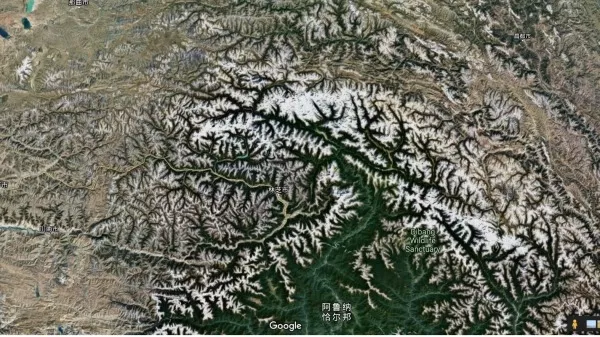
View of the Himalayas from space
II. Nuwa Mends the Sky
To discuss Nuwa mending the sky, we first need to address Gonggong's furious clash with Mount Buzhou.
Various versions of the legend exist concerning Gonggong's anger and his confrontation with Mount Buzhou, but the core narrative remains consistent. The differences mainly pertain to who battles Gonggong. We will delve into that later; for now, let's briefly explore the tale of the monumental battle between Gonggong and Emperor Zhuangxu.
Chinese civilization's current cycle spans over five thousand years. According to existing historical records, a lengthy prehistoric civilization preceded these five thousand years, known as the Three Sovereigns period. This era was represented by ancient emperors such as the Nest Builder, the Fire Starter, Fuxi, and Shennong. Our current five-thousand-year civilization began with the Yellow Emperor, marking the start of the Five Emperors period, which includes figures like the Yellow Emperor, Shaohao, Zhuangxu, Ku, Yao, and Shun. When Shun abdicated to Da Yu, Da Yu ascended the throne, establishing the first dynasty—the Xia Dynasty—followed by the Shang, Zhou, Qin, and Han dynasties...
Legend has it that Zhuangxu was the grandson of the Yellow Emperor. During Zhuangxu's reign, the water god Gonggong rebelled against his rule, waging war against Zhuangxu for control. Defeated, Gonggong crashed into Mount Buzhou in a fit of rage, breaking it. Mount Buzhou was one of the eight pillars supporting the sky. The pillar's destruction in the northwest caused the sky to collapse in that direction, while the earth tilted southeast. Simultaneously, a large hole appeared in the sky, causing floods to engulf the land, bringing humanity to the brink of destruction. Nuwa then melted colorful stones to mend the sky, restoring it and saving humanity.
The "sky" refers to the atmosphere above us, which might be dotted with a few clouds made of water vapor before extending into the vacuum of space. How could such a thing be supported by pillars like a roof? Can it have holes that need patching like fabric? And can melted stones really repair it?
If this legend were true, people would likely find it laughable. In a previous article, we discussed how humans and gods exist in different dimensions of time and space. We cannot use human concepts to interpret the language of gods, as their meanings differ entirely. We must grasp these concepts from a multidimensional perspective.
When Newton's classical mechanics couldn't explain the motion of high-speed or high-mass objects, Einstein introduced the theory of relativity, breaking the constraints of our singular time-space continuum. He proposed that time and space are distorted, offering a more comprehensive explanation that advanced physics and clarified previously unexplainable phenomena.
Our approach to mythology should be similar; we need to transcend the limitations of human time-space dimensions to unlock the human world's mysteries. Higher beings created humanity, embedding wisdom within myths. We must break free from the low-dimensional thinking patterns of humanity to unravel them.
The "sky" referred to by the gods is not the sky as humans conceive it, because gods exist in a higher-dimensional time-space. Similarly, the "earth" referenced by the gods is not the earth as we understand it. If the sky gods refer to is above our heads, then the sky above Americans is literally beneath the feet of Chinese people, as they are on Earth's opposite side. We see the moon in the sky, but if we were on the moon, the Earth would then be in the sky, creating chaos in perspective.
By stepping outside the limitations of human thought, the "sky" in the context of the gods signifies a higher-dimensional time-space, just as the "earth" referred to by the gods corresponds to human time-space. Any time-space higher than humanity's can be called "sky." Based on this understanding, when myths describe immortals ascending to the heavens, they refer to leaving human time-space and entering a higher time-space, rather than merely traveling to outer space. When human spacecraft travel into outer space, from a god's perspective, that's not "ascending to the heavens"; it remains on the ground because human time-space is considered "earth" in the eyes of the gods. Just as we observe life on a two-dimensional plane, no matter how they run or fly, we perceive them as being on the ground, as they cannot escape their time-space's dimensional constraints, all existing within that two-dimensional realm.
So, returning to Nuwa mending the sky, if Mount Buzhou was one of the eight pillars supporting the sky, how does a higher-dimensional time-space require pillars to hold it up?
We understand that every road, no matter how long, eventually comes to an end unless it forms a circle, creating a cycle, which then allows it to exist eternally without beginning or end.
From a personal perspective, everything in the universe must form cycles to endure; without this formation, it leads to an end and destruction.
The moon revolves around the Earth in a circular orbit, while the Earth orbits the sun, continuously going around. The sun also revolves around the Milky Way, and the Milky Way revolves around the local supercluster...
The human body is similar, with circulatory systems for blood, air, lymph, water, digestion, and energy meridians... Disruption in any of these cycles can lead to death.
The Earth also has water cycles, biological chain cycles, air cycles, cycles of the five elements, six energies, and dragon vein cycles... Any break in these cycles could result in human extinction. Only when these cycles flow smoothly can life continue.
In Taoist practice, an essential concept is "Zhou Tian." From the name, it refers to a complete cycle between heaven and earth, a full circuit. For example, when the Earth completes a cycle around the sun, it's called a Zhou Tian in astronomy. The Earth's own rotation is called a small Zhou Tian. In the human body, energy circulates through meridians, passing through the seven channels and eight vessels, and the twelve primary meridians is termed the great Zhou Tian cycle. Energy circulating through the Ren and Du meridians is called the small Zhou Tian cycle.
The universe's different dimensions of time-space may function similarly, with lower and higher-dimensional time-space interlocking like gears, corresponding in cycles. Thus, the universe and life can be seen as cyclical entities, and breaking the cycle leads to an end.
If the human time-space (earth) corresponds and cycles with a higher-dimensional time-space (sky), this cycle is the great Zhou Tian cycle of heaven and earth.
In practicing Taoist arts, there's a process where, after initiation, one opens the small Zhou Tian, then progresses to the great Zhou Tian. Opening the small Zhou Tian involves unblocking the Ren and Du meridians, forming a small energy cycle in the human body. This process requires navigating three critical points: the Tailbone Gate, the Spine Gate, and the Jade Pillow Gate. These gates are key points along the Du meridian on the back. Energy must ascend from the dantian against the Du meridian to pass through these gates, moving through the Tailbone, unblocking the Spine, passing the Jade Pillow, merging with the Ren meridian at the top of the head, and returning to the dantian, forming a small Zhou Tian cycle. Without opening these three gates, one cannot complete the small Zhou Tian.
From my personal view: the great Zhou Tian is as expansive as this time-space, representing the sweeping cycle from heaven to earth and back. Each level's great Zhou Tian is the largest cycle within that level, encompassing everything, without exception, and nothing can escape it. The Zhou Tian creates a formidable barrier, entrapping everything within that level. If one transcends this great Zhou Tian cycle, they step out of this time-space level and into a higher time-space level, entering the great Zhou Tian cycle of a higher level, which can also be described as ascending to the heavens, opening the heavenly gate of higher time-space—the gate of Zhou Tian.
Each level's great Zhou Tian is an independent grand cycle. Do all the great Zhou Tian cycles across different time-spaces interlock and correspond like gears, forming layered cycles?
Throughout history, people have believed that through cultivation, humans can become immortals, whether in Buddhism or Taoism. How does cultivation enable immortality? I believe that it requires first opening the Zhou Tian of the human body. Humans are creations of the gods, and the human body aligns with nature and the universe. Opening the Zhou Tian of the human body means circulating the body's energy, which connects to the greater Zhou Tian of higher-dimensional time-space, allowing higher-dimensional cosmic energy into the human cycle. This enhances the body's energy, enabling escape from low-dimensional great Zhou Tian cycles to enter a higher time-space level, becoming a higher form of life.
The prophet Shao Yong's poem "Plum Blossom Poem" includes the line: "The vast heavenly gate opens for eternity; how many return, how many come."
What is the heavenly gate? I believe it's not a doorway as humans understand it; it's the gate of the great Zhou Tian of this time-space level. The great Zhou Tian is the largest cycle of this time-space level, omnipresent, allowing ascension to the heavens from any position, entering higher time-space. We often hear stories from ancient times about a rustic thatched hut in deep mountain forests, where an old Taoist practices. It's seemingly shabby, but inside reveals a vast, wondrous world. Other stories tell of practitioners diving into cliffs and rock walls, entering expansive and magical realms. The "other world" in these tales likely refers to ascending to the heavens—entering higher time-space, not merely flying into the sky. Of course, flying into the sky can also mean ascending to the heavens, as the heavenly gate is everywhere, as we often read about practitioners from ancient texts ascending to the heavens in broad daylight.
Ancient texts discuss the Heavenly Stems and Earthly Branches. The ten Heavenly Stems are Jia, Yi, Bing, Ding, Wu, Ji, Geng, Xin, Ren, and Gui; the twelve Earthly Branches are Zi, Chou, Yin, Mao, Chen, Si, Wu, Wei, Shen, You, Xu, and Hai. These stems and branches correspond, rotating and interlocking like gears, forming cycles. For example, Jiazi, Yichou, Bingyin... After sixty combinations, it returns to Jiazi, forming a grand cycle known as a Jiazi.
Ancient people used the Heavenly Stems and Earthly Branches to count years, months, days, and hours. For example, 2019 was the year of Jihai, and 2020 was the year of Gengzi. Fortune-telling, observing celestial phenomena, traditional Chinese medicine, etc., all use the Heavenly Stems and Earthly Branches for correspondence and calculations.
What are the Heavenly Stems and Earthly Branches?
From my perspective: the Heavenly Stems and Earthly Branches are the meridians of the great Zhou Tian cycle between heaven and earth. The "Stems" resemble the main trunk of a tree, representing the Yang meridians, existing in the heavens (the higher-dimensional time-space system). The "Branches" are like the tree's branches, representing the Yin meridians, existing on the earth (the human time-space meridians). The Heavenly Stems and Earthly Branches interlock like gears, rolling and cycling, forming the great Zhou Tian cycle of heaven and earth within human time-space. It's the broad Yin-Yang cycle from heaven to earth and back, encompassing everything within human time-space.
In traditional Chinese medicine, there is a theory of the five movements and six energies, which predict the changes in fortune between heaven and earth each year based on the Heavenly Stems and Earthly Branches. This is used to forecast and treat diseases, corresponding to the human body with the natural world, employing the meridians of heaven and earth (Heavenly Stems and Earthly Branches) to deduce natural pulse changes and correspondingly address human diseases and treatments.
So, why does the sky need pillars to support it? Ancient texts state that these sky pillars are mountains. I believe these mountains are critical positions or nodes on the meridian of the great Zhou Tian cycle between our human time-space and higher-dimensional time-space. They can be seen as checkpoints or critical acupoints.
My master once explained that the Earth we inhabit is a living entity.
From my understanding, the Earth has energy circulation meridians, known as dragon veins. The dragon veins that reach the surface are the mountains and ranges we observe. While it may not be evident from the ground, Google satellite maps can demonstrate this. From a certain altitude on Google satellite maps, mountains across the Earth's surface resemble meridians. Not only do they look like meridians, but they are also almost identical to the meridians in the human body, with virtually no difference.
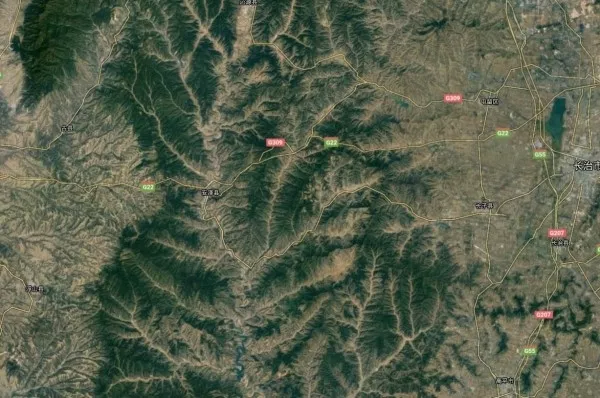
View of Earth's mountains from space (1) (Image source: Public Domain)
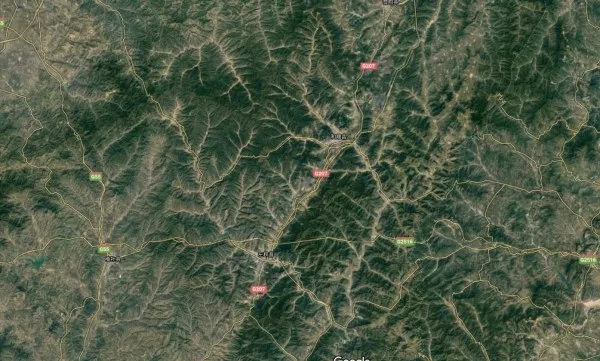
View of Earth's mountains from space (2) (Image source: Public Domain)
In Feng Shui, it's believed that the macro meridians in nature exist as mountains, representing the meridian structure of the natural world. This belief states that when choosing burial sites for Yin houses, one should follow the mountain's contours and directions, tracing the dragon’s flow. Acupoints, vital nodes, and checkpoints on the meridian, serve as entry and exit points for meridian energy and thus also appear as mountains.
From my understanding: the eight pillars of heaven are key checkpoints and acupoints on the meridian of the great Zhou Tian cycle between heaven and earth, manifesting as eight immortal mountains. However, they do not exist within our three-dimensional time-space; they reside in higher-dimensional time-space. This is my interpretation of the meaning behind the pillars that support the sky.
When a sky pillar is broken, that acupoint is severed, disrupting and leaking the great Zhou Tian cycle between heaven and earth. Therefore, when the sky is broken or leaks, human time-space is in jeopardy. Just as a crucial meridian in the human body can be severed, leading to death.
Thus, a deity from a higher-dimensional time-space—Nuwa—descends to the lower-dimensional time-space to mend the sky, repairing the leaks in the great Zhou Tian cycle to protect the humanity she created. Nuwa melting colorful stones can be interpreted as refining the Five Elements. Ancient people believed the Five Elements constituted all substances in our world; humanity and the three realms are composed of these five fundamental elements. The Five Elements encompass more than the 108 elements recognized in modern chemistry; all 108 elements can be categorized within the Five Elements.
This is my understanding of Nuwa mending the sky.
Illustration and text: Li Daozhen