Li Daozhen: Decoding Myths (4) - Pangu and the Creation of the World
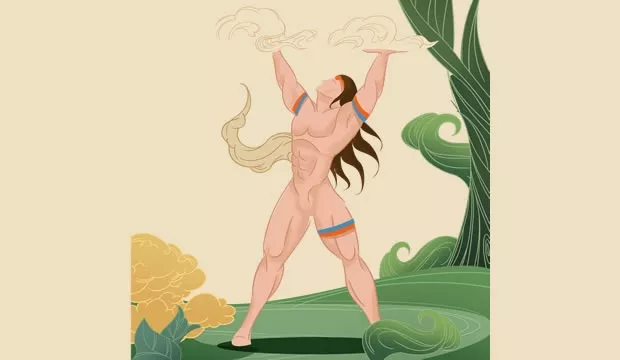
According to ancient texts like the "Chronicles of the Three-Five," "Records of the Five Movements," and "Accounts of the Strange," in the very distant past, the universe as we know it had not yet come into existence. During this time, there were no humans, no heaven and earth, and no multitude of things—only chaos. Much like life inside an egg, after a long period, a massive life form emerged from this chaos: Pangu.
With Pangu's birth, heaven and earth, along with all things, also came into being. During this process, yang energy rose while yin energy descended, separating yin and yang from the chaos; yin and yang generated each other, and the Taiji (Supreme Ultimate) rotated, leading to the formation of layers of heaven and earth and nurturing all things. Pangu's body grew larger each day, and all in heaven and earth grew alongside him, becoming parts of his immense form. Pangu continually transformed between heaven and earth; he was a deity above and a sage below, unified with all things, silently overseeing everything. Eventually, Pangu's body expanded infinitely, completing the heavens and the universe.
Pangu molded his body into the universe; the Earth we inhabit and countless galaxies are simply parts of his form. This might seem incredible. Over 2,500 years ago, the Buddha revealed to humanity: "In a single grain of sand, there are three thousand great worlds." The world illuminated by the sun and moon is termed a small world; three thousand great worlds equate to a billion small worlds, comparable to a vast galaxy!
In the film "Life of Pi," a brief scene, despite its brevity, serves as pivotal foreshadowing, leaving a lasting impression: when protagonist "Pi" was a child, his mother narrated a story about Krishna. She recounted how young Krishna, known for his mischief, liked to eat dirt. One day, after eating soil, Krishna's mother checked his mouth and saw the entire universe inside...
Krishna's story is recorded in ancient Indian epics like the "Mahabharata," "Bhagavata Purana," and "Gita Govinda." He is an incarnation of the god Vishnu on Earth. Vishnu, one of Hinduism's three principal deities, descended to aid humanity in overcoming tyrants and restoring peace at the Earth goddess's request. He transformed a strand of his black hair into Krishna. As a child, Krishna was mischievous. Following a dispute with cowherds, they complained to his foster mother Yashoda, claiming Krishna was eating dirt again. Yashoda scolded Krishna, who denied eating dirt, and asked him to open his mouth for inspection. To her astonishment, she saw the sun, the moon, and a magnificent starry sky within Krishna's mouth; galaxies shone amidst cosmic nebulas, revealing the universe itself. Overwhelmed by this sight, Yashoda fainted.
Pangu opened up heaven and earth, transforming his body into the universe where we live, with galaxies like the Milky Way operating within him—such images are strikingly similar.
Chinese Daoism and ancient Greek philosophers have historically communicated to humanity that the human body is a microcosm. The human body corresponds to the universe; one exists on a microscopic level while the other exists on a macroscopic level.
Modern science also reveals that if we magnify the human body infinitely, we see that our physical form consists of countless cells, made up of numerous molecules, which are further composed of atoms, and atoms consist of nuclei and electrons... This division goes on infinitely. Moreover, physicists discovered that electrons orbiting atomic nuclei follow the same three laws of planetary motion. Their movement and existence are remarkably similar; one exists in the microscopic world while the other in the macroscopic world. If electrons were enlarged to the size of planets, would the human body not represent a vast, boundless universe? Are there not countless more microscopic lives existing within it?
Conversely, if we were to shrink the universe we inhabit infinitely, we'd see that Earth and its fellow planets orbit the sun, forming the solar system. Numerous star systems like ours make up the Milky Way, which, along with other enormous galaxies, forms galaxy clusters. If we continue this shrinking down, might not all of this be merely a single cell, and, shrinking further, might we discover the true form of the god Pangu? Discover that all of this constitutes the body of the god Pangu, and we merely exist as tiny particles within his body?
"As one does not recognize the true face of Mount Lu, it is because one is born within this mountain," our human wisdom and insight are indeed limited. Therefore, over two thousand years ago, the divine spoke to Socrates, who then conveyed it to the world: humans lack wisdom; true wisdom lies in recognizing one's ignorance. Humanity must maintain a sense of reverence towards the universe and nature, avoiding arrogance; otherwise, we are on the path to self-destruction.
The ancient and enigmatic Chinese classic "Shan Hai Jing" (Classic of Mountains and Seas) comprises three parts: the "Mountain Classic," the "Sea Classic," and the "Great Wilderness Classic." The "Mountain Classic" is known as the "Five Cang Mountain Classic," divided into five major regions: southeast, southwest, northeast, northwest, and central. In ancient times, "Five Cang" referred to the five organs, indicating the Earth's five organs. The five regions in the "Five Cang Mountain Classic" encompass 26 mountain ranges. Similarly, the body's meridian paths, where acupoints are located, also number 26, comprising twelve primary meridians (symmetrically arranged) plus the Ren and Du meridians.
From a personal perspective, the Earth, like the human body, is also a divine creation and is multi-dimensional. Beyond what we can see, there are other dimensions we cannot perceive. For instance, dragon veins and water veins on the ground extend into higher-dimensional Earth. The myriad strange and wondrous realms, demigods, monsters, and sacred mountains recorded in "Shan Hai Jing" exist in the higher-dimensional Earth. Modern interpretations of the "Shan Hai Jing" have deviated, as it does not pertain to human time and space.
At the "Five Cang Mountain Classic" end, there's a summary: "Da Yu said, the famous mountains I traversed during my flood control efforts total five thousand three hundred and seventy, measuring sixty-four thousand and fifty-six li in length, distributed across the Earth, which I call the five organs of the Earth; the countless smaller mountains are too numerous to record."
In Daoist internal alchemy, the body's interior is viewed as a universe, a natural world. Ancients created a diagram called the "Neijing Tu" or "Inner Landscape Map," which serves as an internal perspective of the human body during Daoist cultivation. In this diagram, the internal body displays high mountains and flowing rivers, as well as the sun, moon, stars, and all of nature, resembling a world, a small universe, opening one's eyes. This is what practitioners perceive during cultivation using the "heavenly eye," reflecting a correspondence and manifestation of the human body with the natural body in another dimension.
Recently, astronomers and physicists discovered that black holes not only consume all matter but also constantly emit large amounts of new material after "digesting" it, which is strikingly similar to a digestive system. Modern science recognizes that our universe contains an immense amount of dark matter and dark energy. Based on Planck satellite observations, dark matter makes up 26.8% of our universe, dark energy 68.3%, while ordinary matter makes up only 4.9%.
Might we envision energy and matter from a higher-dimensional universe flowing into galaxies like the Milky Way through black holes? The energy entering the galaxy would circulate through higher-dimensional meridians to all star systems, including the solar system. Energy and matter flowing into the solar system would cycle through heavenly and earthly systems in higher dimensions, gradually being introduced into Earth via the land's dragon veins, subsequently flowing into nature, fueling life's operation and nature's cycles.
Now, consider the human body: food absorbed by the body transforms into qi and nutrients through the digestive system and five internal organs, circulating through meridians and blood to reach every cell and other dimensions within the body, nourishing it and sustaining life.
My master has shared many profound insights about the universe's higher realms with us. The understanding of the universe's structure presented here is a superficial interpretation of my master's teachings. Therefore, my personal understanding may not be entirely accurate. For more in-depth knowledge, I encourage reading my master's teachings and seeking your own insight.
From my perspective: not only is the human a living entity, but so are the Earth and the universe—each a colossal life form. The human body has a soul (original spirit) that governs it, unifying body and spirit. Nature and the universe also have higher-level lives (gods) governing them, with various gods uniting with the natural universe, almighty, extraordinary, and magnificent!
Modern biology has also found that every cell in the human body holographically corresponds to the entire body; each cell holds all the information and characteristics of the whole body, and any single cell can be cloned into an identical human body.
The renowned quantum physicist David Bohm mentioned a famous concept in his book "Wholeness and the Implicate Order," the "holographic universe theory." This was later formally proposed by Nobel laureate Gerard 't Hooft from Utrecht University in the Netherlands in 1993 and further elaborated by Leonard Susskind.
The holographic universe theory suggests that the universe is a unified whole with holographic relationships between its parts. Within the universe, sub-systems and systems, as well as systems and the universe, correspond holographically. In terms of latent information, sub-systems contain all system information, and systems contain all universe information. In terms of manifest information, sub-systems reflect the system, and systems reflect the universe.
In simpler terms, everything possesses holographic properties; there exists a holographic relationship between an entity's parts and whole, between things at the same level, as well as between different levels and systems, beginnings and ends, development processes, and time and space. Each part contains other parts while also being part of something larger. This is something modern science now acknowledges.
The Chinese cultural concept of "the unity of heaven and humanity" has long embodied this theory, offering an even more profound and expansive view.
This is my personal interpretation of the legend of Pangu opening the heavens and the earth.