Unveiling Moon Mysteries: Secrets from an Ancient Civilization
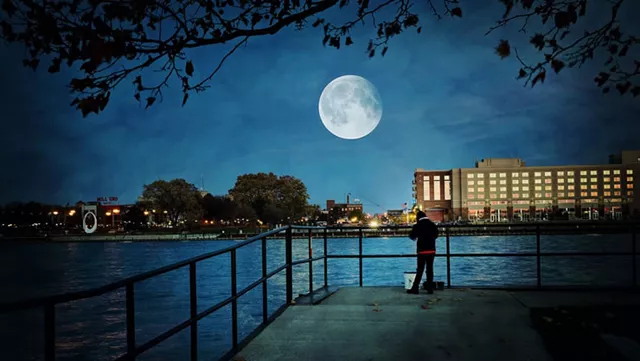
Ancient texts suggest that the moon is a hollow metallic sphere, maintained by "special personnel."
"Moon People" in Ancient Writings
During the Tang Dynasty, a scholar exploring Mount Song encountered a dense fog and lost his way in a valley. As he desperately searched for a path out, he stumbled upon a person dressed in white, emitting a soft glow, asleep in a bed of grass. This individual had a white bundle with them, prompting the scholar to approach and ask for directions. To his surprise, the person in white replied, "Did you know that the moon is made of seven precious metals?" He claimed that the moon is a sphere composed of seven types of metals, with a surface that is uneven, and that he was tasked with maintaining it. This story, which reads almost like fiction, is documented in the Tang Dynasty text "Youyang Zazu," particularly in the section "Tianji," where this white-clad figure is described as a "moon person" from 1,200 years ago.
Moreover, the "History of Jin: Astronomical Records" notes that during Emperor Taizong's reign, the moon unexpectedly veered off its course, "straying southward before returning to its original path." The moon’s ability to realign itself raises the question: is there indeed a "special person" maintaining it, as recorded in "Tianji"? Despite modern scientific progress, these extraordinary accounts from ancient texts continue to defy belief.
The Supposed Size of the Moon
Astronomers have determined that the distance from the Earth to the Sun is precisely 395 times the distance from the Earth to the Moon, and the Sun's diameter is also exactly 395 times that of the Moon. As a result, the moon appears to be the same size as the sun when viewed from Earth.
While larger planets in the solar system have their own satellites, the diameters of these satellites are generally much smaller compared to the planets themselves. Thus, a satellite the size of the moon is quite "unusual" in the solar system.
Some astronomers ponder the seemingly incredible coincidences found in this data. Could it be possible that the moon is not "natural"?
Is the Moon "Hollow"?
On July 21, 1969, when Armstrong’s foot touched the lunar surface, he declared, "That's one small step for a man, one giant leap for mankind," marking a new chapter in humanity's moon exploration. Later, on November 20 of the same year, astronauts from Apollo 12 deliberately crashed the ascent stage of their lunar module into the moon's surface, causing moonquakes that lasted about an hour.
This event was similar to striking a large bell with a hammer, where vibrations lingered for a long time before slowly subsiding. The prolonged shaking led scientists to consider whether the moon might be hollow.
The NASA report "Apollo 16 and the Lunar Surface" explains that moonquake research indicates the presence of a "hard layer" about 40 miles thick beneath the moon's crust. Dr. Wilkins, a lunar expert from the Royal Astronomical Society, estimated in his book "Our Moon" that cavities within the moon could amount to approximately 14 million cubic miles.
The Artificial Moon Hypothesis
Nobel Prize-winning chemist Dr. Harold Urey suggested that the primary reason for the moon's low density might be a significant hollowing of its internal structure. On the topic of the moon's hollowness, renowned American scientist Carl Sagan posited that a natural satellite could not be "hollow," leading to speculation that the moon might be "artificial."
In addition, analyses of lunar lava have shown a high concentration of rare metallic elements found on Earth, such as titanium, chromium, and yttrium. These metals are renowned for their hardness, heat resistance, and corrosion resistance. How could these high-temperature metals have formed on a moon that hasn't experienced volcanic activity for 3 billion years? Additionally, the metallic ores contain pure iron and pure titanium, which do not typically occur in nature. Pure metals are rare and usually require smelting technology to reduce them to single-element compounds. These findings unexpectedly align with the claims made by the "moon people" in the ancient text "Tianji," which describes the moon as a sphere made of seven metals.
Today, through lunar exploration, astronomers have confirmed that the moon is indeed "hollow" and contains pure metal ores not found in nature. What secrets lie hidden within its interior, and where do these pure metal ores originate? We cannot yet determine these mysteries, but the confirmed results spark skepticism, with many finding them too bizarre to accept. Thus, the content mentioned in these ancient texts continues to be regarded as fanciful fiction.