The Himalayas: Unveiling the Secrets of the "Rootless Mountain
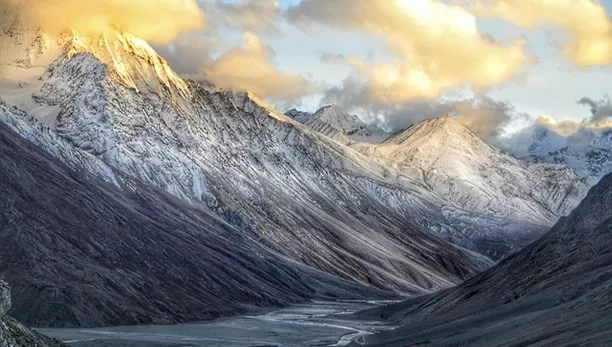
The Himalayas are the tallest mountain range in the world, boasting several peaks that soar above 8,000 meters, most notably the majestic Mount Everest. Yet, as early as 1994, scientists uncovered an astonishing fact: the base of the Himalayas seems to lack a "root," as if it were mysteriously floating above the Tibetan Plateau like a castle in the air. This discovery continues to baffle many in the scientific community.
Positioned at the southern edge of the Tibetan Plateau, the Himalayan mountain range claims the title of the highest in the world, featuring over 110 peaks that rise to 7,350 meters or higher. It forms a natural barrier between the East Asian continent and the South Asian subcontinent and serves as a boundary between China and countries like India, Nepal, Bhutan, and Pakistan. Stretching 2,450 kilometers from Nanga Parbat (8,125 meters) in Kashmir to Namcha Barwa (7,782 meters) at the curve of the Yarlung Tsangpo River, the range spans 200 to 350 kilometers wide.
"The 'Root' Ensures Mountain Stability
In geology, a "root" refers to the foundational part of a mountain range that extends into the Earth's crust due to the force of gravity, penetrating deep into the Earth's mantle. According to basic mechanical principles, the larger and heavier a mountain range, the larger and deeper its "root" should be to maintain stability and balance under stress. However, the Himalayas defy this expectation, presenting an exception to the rule at every turn.
The Tibetan Plateau, formed through geological activities, is relatively young and characterized by a thin crust. While vast mountain ranges like the Himalayas could theoretically penetrate the mantle, embedding a significant root deep within the Earth, this is not observed here. This enigma of the Tibetan Plateau remains a mystery that few have discussed over the years. The Himalayas, along with other prominent ranges like the Gangdise and Kunlun mountains, lack a "root," creating an illusion that they float above the Tibetan Plateau, prompting concerns over their potential collapse.
Recent studies suggest that the absence of a "root" beneath the Himalayas can be attributed to the orogenic processes that shaped the Tibetan Plateau. Approximately 400 to 500 million years ago, the Lhasa block, an integral part of the Tibetan Plateau, joined other landmasses to form part of the ancient supercontinent Gondwana. Millions of years later, during the Neogene and Quaternary periods, the region underwent intense orogenic activity, leading to significant uplift that continues today. This could explain why these monumental mountains on the Tibetan Plateau have failed to develop roots of their own.
While this theory sheds light on why the Himalayas lack a root, a challenging question persists: how do these massive mountains on the Tibetan Plateau maintain balance without a "root"? Despite numerous explorations and findings, compelling answers detailing their formation continue to elude us. We hold hope that the truth will one day emerge.
Huge Underground Spaces
Since 1995, an international team of scientists has established four extensive electromagnetic deep probing profiles across the Himalayan region to examine the crustal structure of the Tibetan Plateau. Their research unveiled a vast underground space, measuring approximately 100,000 to 150,000 square kilometers, beneath the Animaqing Mountains of the Tibetan Plateau.
Many practitioners and researchers of Tibetan Buddhism believe that the legendary land of Shambala (or Shangri-La) lies deep beneath the Himalayas, its secret entrance safeguarded by the great lamas of Tibet across generations.
Various speculations surround the possible entrances to the inner world, suggesting that the South Pole's strong magnetic field, the North Pole's "black hole zone," and the Bermuda Triangle could all serve as portals to another world.
Even today, our understanding of the Earth remains limited, with numerous mysterious phenomena defying explanation by modern science. Perhaps adopting a different mindset and perspective is necessary to explore the world we call home.