The Cambrian Explosion: A Biological Phenomenon Beyond Evolutionary Theory
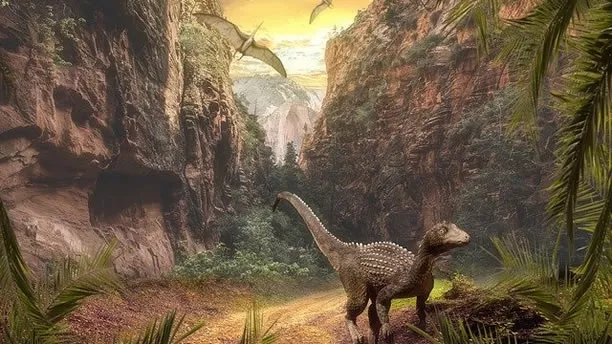
Image source: Pixabay
A fossil study reveals that 240 million years ago, there was a sudden surge in species on Earth, an occurrence known as the "Great Biodiversity Event." This event challenges the explanations provided by Darwinian evolution, suggesting that Darwin's theory of evolution may be an incomplete hypothesis.
Sudden Surge in Species Challenges Evolutionary Predictions
The study highlights that the discovery of a peculiar filter-feeding reptile, Sclerocormus parviceps, in Yunnan, China, in 2014, shows that early marine reptiles rapidly spread across Earth at a rate that surpasses evolutionary predictions following a mass extinction event.
According to The Guardian, Dr. Nick Fraser from the National Museum of Scotland, who was involved in the study, stated: “The research indicates that after the Permian mass extinction, diverse life forms quickly appeared to populate the desolate Earth, and their emergence occurred much faster than what evolutionary theory would traditionally suggest.”
Ben Moon, a paleontologist at the University of Bristol who was not part of the study, noted that the research brings attention to the aftermath of the Permian period's mass extinction, where fossil evidence shows 96% of species became extinct. Moon commented: “This finding suggests that species diversity at the beginning of the Triassic was far greater than evolutionary theory had predicted.”
Moon added: “It suggests that a group of marine reptiles appeared suddenly, filling the gap after this mass extinction, and subsequently evolved into various other forms.”
According to a report by Explore, another researcher involved in the study, Olivier Rieppel from The Field Museum in Chicago, explained: “Darwin's theory of evolution posits that evolution occurs through small, gradual changes accumulated over extensive periods. However, the results we're seeing do not match this pattern. This ichthyosaur-like species seems to have evolved rapidly, displaying numerous changes in a brief time, in a leap-like, explosive fashion.”
Life Events Unexplained by Evolution
In fact, paleontologists also acknowledge that the Cambrian explosion, which occurred 542 million years ago, represents another biological occurrence unexplained by evolutionary theory. Simply put, during the Cambrian period, species appeared in large numbers without adhering to the gradual, incremental changes envisioned by Darwin.
Records show that Darwin himself was puzzled by this, as he wrote in "On the Origin of Species": “This event (the Cambrian explosion) remains unexplained to this day. Therefore, some might use this example to challenge the evolutionary views I have proposed.”
More than a century after Darwin's death, the Cambrian explosion continues to be a major enigma in the scientific community.