The Earth's Interior is Hollow: Shocking Revelation for the World
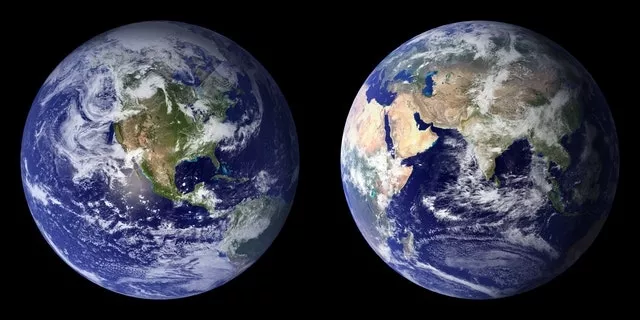
In 1692, Edmond Halley, a British astronomer, first proposed the bold idea of the hollow Earth theory. He posited that instead of being a completely solid entity, the Earth is made up of multiple concentric hollow spheres.
Between each of these spheres, there exists an environment similar to that of our own Earth, with lush vegetation and a mild climate. There are reportedly mysterious passages on the Earth's surface that connect to this inner world. If one could locate these passages, they could enter the enigmatic realm beneath the Earth's surface...
Ancient Indian texts mention an underground corridor known as "Agartha," which translates to "the world beneath" in Sanskrit. It is said that this subterranean world harbors countless caves, tunnels, and winding corridors, concealing the secrets of ancient civilizations and endless treasures.
Based on explorations and literature, the Agartha corridor is believed to be a subterranean passage under the Atlantic Ocean, linking the continents of Europe, Asia, America, and Africa. Over the years, it has intrigued many scientists and explorers who have endeavored to investigate it.
In March 1942, after returning from archaeological research in Chiapas, Mexico, David and his wife were hosted by then-President Franklin D. Roosevelt. They informed him of their discovery of the guardians of "Agartha"—a group of blue and white-skinned Native Americans.
According to their account, while traversing the Chiapas jungles, the couple encountered Native Americans with blue and white skin who were guarding the entrance to the underground corridor. These individuals surrounded the expedition team and sternly urged them to leave immediately, barring any further entry.
The couple's Native American guide learned that these guardians were descendants of the Maya, specifically a group known as the Lacandon. The Lacandon inhabit the dense forest in isolation, safeguarding a sacred site deep within the jungle, which encompasses the entrance to the underground corridor.
This passage leads to deep underground chambers filled with vast treasures and gold. The Lacandon follow ancestral teachings that forbid outsiders from entering their sacred land. Although the couple claimed to have discovered the entrance, they were unable to penetrate the tunnels guarded by the Lacandon.
The Underground Corridor of the Andes Mountains
In July 1960, a Peruvian expedition discovered an underground corridor in the Andes Mountains, around 600 kilometers east of Lima.
This corridor extends for 1,000 kilometers, linking Chile and Colombia. To protect this site belonging to an ancient civilization, the Peruvian government decided to seal the tunnel entrances due to the limitations of current technology in developing and safeguarding it. Moreover, this site has been designated as a World Heritage Site by UNESCO.
Mysterious Beings at Mount Shasta
In April 1972, three students from the University of California, Berkeley, climbed Mount Shasta, which stands at 4,318 meters. Though dormant for many years, the students observed disc-shaped flying objects entering and exiting near the crater.
Even more astonishingly, they sighted five "tall white beings" at the crater. These figures remained only briefly before disappearing behind a rock.
During World War II, a U.S. soldier named Heber was separated from his unit while fighting Japanese forces in Burma and found himself lost in the forests of Myanmar. One day, he stumbled across an entrance concealed by massive stones.
Upon entering, he discovered a place illuminated by artificial light, resembling a vast underground city. As he marveled at the sight, he was captured and detained for four years before managing to escape.
He claimed this underground kingdom had seven tunnels leading to the surface, each with secret entrances located worldwide.
The Underground Corridor of the Altai Mountains
In 1916, geographer Beloshinov published findings about underground corridors in the Altai Mountains, stretching from southern Mongolia to the Gobi Desert.
Through meticulous analysis of these corridors, Beloshinov speculated that Dunhuang in China could be an entrance to an "underground kingdom." Many theories exist about these entries, with the strong magnetic fields of the Antarctic, the "black hole" zone of the Arctic, and the Bermuda Triangle all possibly serving as gateways to another world.
A U.S. Major General Reveals Secrets from the Earth's Core
An extraordinary encounter with an underground civilization made them oppose the militarization of nuclear technology by surface dwellers, as they had witnessed the terrifying consequences of global destruction.
In his journal, Baird documented leading an expedition into the Earth's interior from the Arctic in 1947. Astonishingly, he saw a valley lush with greenery and streams.
In this icy Arctic world, Baird discovered a massive UFO base and extinct flora and fauna, where "superhumans" with advanced technology resided.
These mysterious beings revealed their home, "Arian," and shared that though they initially avoided contact with the surface world, the atomic bombings of Hiroshima compelled them to act, fearing the destructive power could annihilate the entire planet. They sent spacecraft to negotiate with world powers but were met with hostility, with some crafts even being attacked by fighter jets.
They warned that if atomic weapons were used, the surface world could face self-destruction, plunging humanity into another dark age.
Upon his return, Baird reported this encounter to high-ranking officials and documented it further in his diary: "That mysterious land and base in the Arctic are indeed profound mysteries."
William Reed, an American thinker, was the first to suggest openings at both Earth poles, publishing "Phantom of the Poles" in 1906.
This book presented early scientific evidence supporting the hollow Earth theory, based on Arctic explorers' reports. Reed estimated the Earth's solid crust as being 800 miles thick, with a hollow interior diameter of 6,400 miles.
Reed concluded: "The Earth is hollow. Its poles are illusions. At the farthest points of north and south are openings. Within its center lie vast lands, oceans, mountains, and rivers.
In this new world, vibrant plants and animals thrive, perhaps even humans unknown to surface dwellers."
Russian physicist Fyodor Nivolin theorized that during its early formation, Earth was a vast cold mass drifting in space. Influenced by the sun and cosmic energy, it heated and became molten, then slowly cooled, forming a solid outer layer. Beneath, molten rock remained in a boiling state, and expanding magma released gases that spread beyond Earth. After millions of years, this process created what Nivolin described as a "huge hollow shell." He believes that the North and South Poles are main gas diffusion points, serving as apparent geological evidence of these "huge openings."
The Claims of the Hollow Earth Theory
- No definitive proof exists to confirm a solid Earth. No drill has reached Earth's center, leaving all as speculation. While scientists use seismic waves to suggest solidity, these waves spread sideways rather than toward the center, lacking conclusive evidence for a solid Earth.
- The Earth could be hollow. Present conjecture suggests a core of liquid iron and nickel, both extremely dense. Although gravitational forces from Earth layers balance out, solar and lunar pull and Earth's rotation's centrifugal force suggest these materials should naturally move away from the center. Thus, a hollow Earth is possible.
- Entrances may exist at the poles. Among the evidence are four photographs of the North Pole from space, initially overlooked for two years before being published. These images have become significant evidence of Earth's hollow nature.
- UFO sightings at the poles raise questions. Who built these tunnels in Earth's core in prehistoric times? Who left treasures within? The mystery invites continued exploration…