World Within the Earth
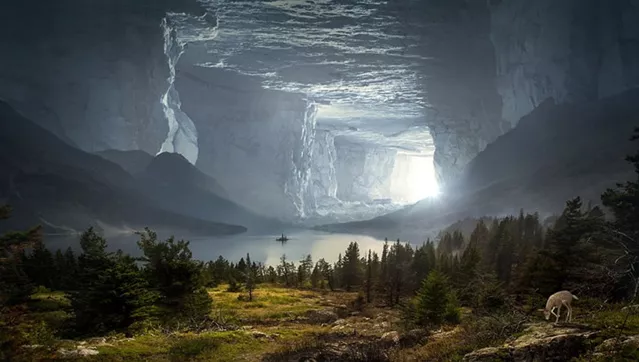
How much do we really know about the Earth we inhabit? Aside from life on its surface, could there be life elsewhere, like in the Earth's core? Current calculations estimate that the Earth weighs 600 trillion tons, suggesting that if the interior isn't hollow, it should weigh more.
The hollow Earth theory was first introduced by British astronomer Edmond Halley in 1692. He proposed that our planet isn't solid but made up of several concentric hollow spheres.
Between these spheres lies an environment similar to our own—rich in vegetation and blessed with a pleasant climate. Allegedly, there are mysterious passages on Earth's surface that connect to this inner world. Discovering these passages could lead one into this hidden world within the Earth...
Records in Ancient Indian Texts
Ancient Indian texts describe an underground world known as "Agartha," meaning "the world beneath" in Sanskrit. This subterranean realm is said to be filled with countless caves, tunnels, and winding corridors, hiding the secrets of ancient civilizations and immeasurable riches.
Based on explorations and literary accounts, the Agartha corridor is believed to extend beneath the Atlantic Ocean, linking the continents of Europe, Asia, America, and Africa. This notion has intrigued scientists and explorers for many years.
In March 1942, David and his wife, who had just returned from archaeological research in Chiapas, Mexico, were welcomed by then-President Roosevelt. They shared with him their discovery of "Agartha's" guardians—a group of blue and white-skinned Indians.
According to their story, while navigating the Chiapas jungle, they encountered these Indians guarding an underground corridor's entrance. The indigenous people quickly surrounded the team and sternly instructed them to leave, forbidding any further exploration.
David's guide explained that these were descendants of the Maya, part of the Lacandon Indian tribe. Living in isolation deep within the forest, the Lacandon people protect a sacred site where the corridor entrance is hidden.
This leads to distant underground realms filled with abundant treasures and gold. The Lacandon people, guarding their ancestral traditions, prohibit outsiders from entering their sacred land. Although the expedition spotted the entrance, the Lacandon's vigilance prevented them from entering.
The World Beneath the Surface
In July 1960, a Peruvian expedition unearthed a passageway in the Andes, located 600 kilometers east of Lima.
This tunnel stretches for 1,000 kilometers, reaching into Chile and Colombia. To safeguard this ancient site, the Peruvian government decided to seal the entrances, given that current technology was insufficient for proper exploration and preservation. UNESCO later designated it a World Heritage Site.
In April 1972, three students from the University of California, Berkeley, climbed 4,318-meter-tall Mount Shasta, a dormant volcano. To their surprise, they saw flying saucers near the crater.
Even more astonishing was the sight of five "tall white people" at the crater, who quickly vanished behind a rock.
During World War II, an American soldier named Heber got separated from his platoon in Burma's jungle while fighting against the Japanese. One day, he stumbled upon an entrance hidden by large stones.
Venturing inside, Heber found a city illuminated by artificial light. However, just as he became captivated by the underground city, he was captured and detained for four years before eventually escaping.
He described this underground kingdom as having seven tunnels leading to the surface, each featuring secret entrances worldwide. In 1916, geographer Beloshinov authored a report on underground corridors in the Altai Mountains, which span from southern Mongolia to the Gobi Desert.
After reviewing these underground corridors' paths, Beloshinov hypothesized that Dunhuang in China might be one of the entrance points to an "underground kingdom." Various theories exist regarding these entrances: the strong magnetic field in Antarctica, the "black hole zone" in the Arctic, and the Bermuda Triangle are all believed to be potential gateways to another world.
A U.S. Major's Adventure in the Earth's Core
In 1947, Byrd claimed in his diary that he led an expedition from the North Pole into the Earth's interior. Shockingly, he reported seeing a lush valley with flowing streams—a scene unexpected in the Arctic! He also noted a massive flying saucer base and extinct plants and animals, as well as a race of technologically advanced "superhumans."
These beings, who referred to their world as "Agartha," initially avoided contact with the surface world. However, after the U.S. dropped atomic bombs on Hiroshima, they grew concerned that the surface dwellers' weaponry might annihilate the planet. Despite attempting to negotiate with world powers, their flying vehicles were often attacked by fighter jets.
They warned that the use of atomic weapons could lead to self-destruction, plunging humanity into yet another dark age.
Upon his return to the United States, Byrd reported this extraordinary encounter to his superiors and documented it further in his diary: "That land lies in the Arctic, and that base is a vast enigma."
"The Illusory Poles"
The idea that Earth's poles contain openings was first introduced by American thinker William Reed in his 1906 book "The Illusory Poles."
His book presented the earliest scientific evidence for the hollow Earth theory, arguing that reports from Arctic explorers support the existence of openings at both poles. Reed estimated the Earth's outer layer to be 800 miles thick, with the hollow interior measuring 6,400 miles in diameter.
Reed concluded that within this new world, vast lands, oceans, mountains, and rivers exist—inhabited by prominent plants and animals, and potentially even humans unknown to those on the surface.
Russian physicist Fyodor Nivolin suggested that during its early formation, Earth was a massive cold body floating in space. Over time, it heated up due to the sun and cosmic energy, becoming molten before cooling and forming a solid outer rock layer. Beneath the surface, the lava remained in a boiling state. As magma expanded and gases escaped, the Earth's center evolved into a "huge hollow shell."
Nivolin believed the primary outlets for gas diffusion are at the North and South Poles, creating the "large openings" visible today—a clear sign of geological phenomena.