Which of the Ten Ancient Auspicious Beasts Will Bless You the Most?
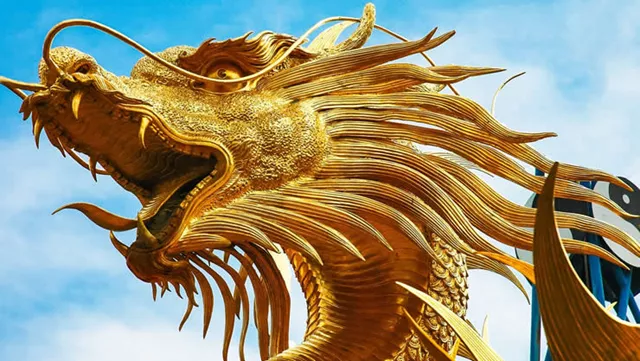
In ancient China, numerous legends emerged during its rich history of civilization, particularly involving mythical creatures. Yet, not many of these beasts are both symbolic and auspicious. Auspicious mythical beasts represent good fortune and prosperity; in ancient times, such creatures symbolized peace and stability in the world.
Which mythical beasts from ancient times are considered the top ten symbols of good fortune? Let's explore them below. All are renowned for bringing luck and prosperity, making them perfect for home protection, enhancing one's fortune, or giving as gifts.
1. Dragon
The dragon is a significant spiritual creature in ancient mythology. In traditional Chinese culture, it is one of the Four Sacred Beasts, along with the White Tiger, Vermilion Bird, and Black Tortoise—collectively known as the Four Spirits or Four Symbols. The dragon is also associated with the Phoenix, Tortoise, and Qilin in the "Four Spirits of the Book of Rites."
In folklore, the dragon is described as having a long snake-like body, a head similar to a Qilin, a tail like a carp, long whiskers, antlers like a deer, five claws, and a majestic presence. It is the most revered and beloved auspicious totem of the Chinese nation, symbolizing grandeur and good luck, warding off evil, averting disasters, and offering blessings.
In ancient times, people prayed for favorable weather and abundant harvests, linking the dragon to the ability to summon clouds and rain. It was also a symbol of imperial power, protecting the populace as the true dragon emperor.
Today, items like longevity locks or bracelets engraved with dragon motifs are gifted to children to wish for their healthy growth and success. The phrase "Dragon and Phoenix bring good fortune" is often used to signify joyous occasions.
2. White Tiger
The White Tiger was originally the god of the West in ancient mythology, named as such because "white" symbolizes the west. It is one of the four great mythical beasts in ancient Chinese mythology, known for its ability to ward off evil spirits and its immense power. The White Tiger represents the seven western constellations of the twenty-eight lunar mansions. It possesses various divine powers, including warding off evil, averting disasters, praying for abundance, punishing wrongdoers, bringing wealth, and fostering good relationships, embodying power and nobility.
The White Tiger is also considered the god of war, symbolizing might and military affairs, which might seem less auspicious at first glance. However, ancient sayings like "When the nation is about to prosper, the White Tiger plays in the court" indicate its appearance signifies peace, making it an auspicious beast.
The expression "Clouds follow the dragon, winds follow the tiger" highlights its connection with the Azure Dragon, forming the best team for subduing demons and warding off evil, often positioned together at home entrances. Many also place images of the Five Tigers or white jade tigers in new homes for protection and peace.
3. Vermilion Bird
The Vermilion Bird is a red bird symbolizing auspiciousness and purity. It is one of the Four Spirits, representing the Emperor of Fire and the southern seven constellations since the pre-Qin era. With the rise of the Five Elements theory during the Han Dynasty, its symbolic meaning expanded to include the fire element and summer.
Although some consider it a type of Phoenix, the Vermilion Bird differs significantly from the Phoenix and holds a higher status than the Phoenix in the "Four Spirits of the Book of Rites."
The Vermilion Bird is a deity of rebirth, representing auspiciousness and brightness, capable of attracting good fortune and ensuring safety. In the pre-Qin period, it was seen as a guide for souls ascending to heaven, and later generations considered it a source of longevity. After the Han Dynasty, Taoism adopted it as a protective deity, often referred to as the Divine Light Lord.
4. Black Tortoise
The Black Tortoise, a mythical creature formed by a tortoise and a snake, is one of the Four Sacred Beasts in ancient Chinese mythology. Also known as the Tortoise-Snake, it originated from ancient star worship, symbolizing the northern god of the seven northern constellations. In the I Ching, it corresponds to the Kan hexagram and associates with the water element, symbolizing the old yin in the Four Symbols and winter among the four seasons.
After the Han Dynasty, Taoism recognized it as a protective deity, calling it the Lord of Clarity and later honoring it as the True Martial Emperor.
The Black Tortoise symbolizes longevity and the pursuit of immortality, highly attractive to emperors and officials. As a result, its image is often carved onto jade pendants worn for longevity and peace. Additionally, it is linked to wealth and serves as a guardian deity.
The Black Tortoise's artistic representation appears widely in crafts, including bronze mirrors, lacquerware, stone carvings, bricks, and tiles.
5. Phoenix
The Phoenix, known as "Fenghuang," is the legendary king of birds in ancient tales. The term "Phoenix" refers to two colorful birds: the male called "Feng," and the female called "Huang," collectively known as the Phoenix. These birds boast colorful feathers, crests that resemble flowing water, and the ability to soar across the seas.
According to the "Classic of Mountains and Seas," the two Phoenix birds resemble ordinary chickens, but they are covered in vibrant feathers. Patterns on their heads symbolize "德" (virtue), their wings "羲" (sun), their backs "礼" (ritual), their chests "仁" (benevolence), and their bellies "信" (faith).
Whenever the Phoenix descends to the human world, it signifies a year of abundant harvest and peace. The phrase "The Phoenix flies together" signifies the harmonious union of male and female, often used to wish newlyweds a happy marriage and everlasting love.
6. Qilin
The Qilin, like the Phoenix, is also a pair of mythical creatures, where the male is called "Qi" and the female is called "Lin." According to legend, the Qilin is born from the scattering of the star of the year and thus represents good fortune. The Qilin is often associated with peace and longevity, and in traditional Chinese customs, it is crafted into various ornaments and figurines for wearing or placing in homes for blessings and protection.
Legends portray the Qilin as gentle, avoiding stepping on living grass, and having horns that grow meat, symbolizing virtue and longevity. Ancient emperors cherished the Qilin, viewing its appearance as a rare omen for the nation, symbolizing imperial power and clarity. In folklore, the Qilin is believed to dispel disasters, drive away evil spirits, protect homes, and promote wealth and advancement.
A famous legend states that before Confucius was born, a Qilin appeared in his family's courtyard, spitting out jade inscriptions, leading to the custom of "Qilin delivering a child." During the Southern and Northern Dynasties, people often referred to their children as "my family's Qilin." Gifting a Qilin as a wedding present symbolizes the wish for early offspring.
7. Pixiu
Pixiu is a significant symbol of auspicious culture, also called "Bixie," "Tianlu," or "Bai Jie," commonly referred to as "Pixiu." Resembling a lion's body with a dragon's head, it has a mouth but no anus, enabling it to swallow everything without letting anything escape, thus symbolizing the attraction of wealth and treasures.
The male is known as Pixiu, and the female as Qiu, although the versions that have survived do not differentiate between genders. Instead, those with one horn are called Tianlu, and those with two horns are called Bixie. Consequently, the three auspicious beasts of Tianlu, Bixie, and Pixiu are often considered the same.
Unlike dragons that soar to the heavens and dive into the sea, Pixiu is known for protecting homes, driving away ghosts, and attracting wealth. Therefore, housewarming celebrations often include a gift of a Pixiu to place in the main hall to bring wealth and protect the home.
8. Bai Ze
Bai Ze is a highly esteemed mythical beast in ancient Chinese mythology, symbolizing auspiciousness and turning misfortune into good fortune. Bai Ze is said to reside on Kunlun Mountain, is completely snow-white, can speak human language, understands the emotions of all beings, possesses wide-ranging knowledge, can predict the future, and understands matters of ghosts and deities. It appears only when "the ruler possesses virtue," capable of dispelling all evil.
A legend recounts that during the Yellow Emperor's time, he encountered a Bai Ze while touring the coast, who explained the world's various monsters, totaling 11,520 categories. The Yellow Emperor commissioned a record, resulting in the "Bai Ze Diagram." Fragments of this diagram were discovered in the Dunhuang Mogao Caves, with two remaining, housed in the National Library of France and the British Library.
The saying "With a Bai Ze Diagram in the house, monsters will naturally disappear" is well known. Consequently, Bai Ze has long been revered as a deity for exorcism and auspiciousness, commonly depicted hanging at doorways to ward off evil and avert disasters. It is also traditionally used as a symbol of auspiciousness on flags and official garments.
9. Xiezhi
Xiezhi (獬豸) is a mythical beast from ancient Chinese mythology. It resembles a large cow or a small sheep, similar to the Qilin, with dense black fur, bright, expressive eyes, and usually a single horn on its forehead.
Xiezhi is known for its intelligence and understanding of human language and nature, discerning right from wrong and identifying good and evil with its fierce gaze. It punishes dishonest and treacherous individuals by using its horn to knock them down and then consumes them.
Known for distinguishing between right and wrong, it is also referred to as the "Divine Sheep." It symbolizes bravery and justice, representing the principles of "fairness and transparency" and "justice and integrity" in the judicial system.
10. Kunpeng
The Kunpeng is a giant beast from ancient times, capable of transforming into a Kun to dive into the depths of the sea or into a Peng to soar through the skies.
The name Kunpeng first appeared in Zhuangzi's "Free and Easy Wandering," describing: "In the North Sea, there is a fish called Kun. The Kun is so large that its size is unknown, transforming into a bird called Peng. The Peng's back is also immeasurable. When it flies in anger, its wings are like clouds hanging from the sky." This illustrates the Kunpeng's immense size. It is also noted in the "Classic of Mountains and Seas" as a mythical beast.
In ancient Han mythology, it is said to embody the sea god and the wind god, Yu Qiang. The phrase "Kunpeng spreads its wings" refers to the Kun fish transforming into a great Peng bird, soaring thousands of miles. Used to describe a bright future and limitless potential, the Kunpeng also symbolizes auspiciousness in career and official success.
Reflecting on these tales, one can see that traditional Chinese culture is fundamentally rooted in auspiciousness. Through legends, beliefs, and customs, it embraces hopes for favorable weather and national stability. Auspicious mythical beasts not only represent the desire for a better life but also serve as guardians of peace and happiness.