Legendary Mythical Beasts: The Xiong
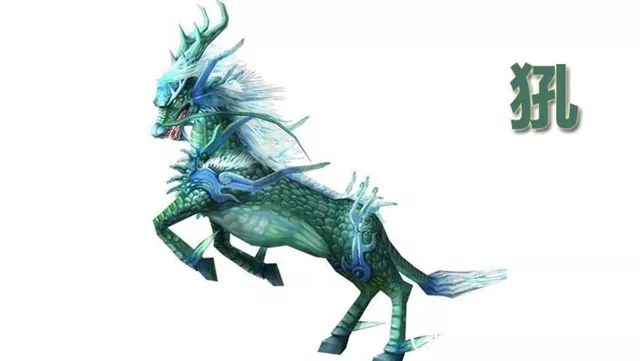
The Hound, also known as the Sky Howler, Morning Howler, or Dragon Stomper, is a legendary creature from Chinese mythology.
The Hound is an unparalleled and powerful divine beast, considered one of the four ancient gods alongside Nuwa, Haotian, and Fuxi. It is regarded as a divine beast primarily due to its extraordinary appearance, wisdom, and traits that set it apart from other mythical creatures. Some claim that the Hound is the ancestor of all divine, spiritual, and malevolent creatures. Regardless of the perspective, the Hound is undoubtedly the mightiest divine beast.
Another theory suggests the Hound is very similar to the Qilin and could be its ancestor. However, the Qilin is known for its gentle nature, avoiding harm to even the smallest creatures and plants. The water Qilin, in particular, is known for its benevolent role as a guardian of humanity, bringing good fortune wherever it appears. In contrast, the Hound is known for its playful yet aggressive nature, and the personalities of the Qilin and the Hound are completely different.
It is said that the Hound is a highly spiritual creature. Positioned on the Huabiao (a type of stone pillar) in front of the Tiananmen Gate, two stone Hounds facing south are called "Wang Di Gui" (The Return of the Emperor). They vigilantly watch the emperor's movements, urging him to return if he spends too much time away from his duties: "Your Majesty, please return to govern, as we anxiously await your presence."
Behind the Tiananmen Gate, two Hounds facing north are known as "Wang Di Chu" (The Departure of the Emperor). They monitor the emperor's activities within the palace, encouraging him to engage with the outside world if he remains in the palace for too long: "Your Majesty, please step out and understand the people's needs; do not remain engulfed in palace pleasures. We long for your presence outside."
The Origin of the Hound
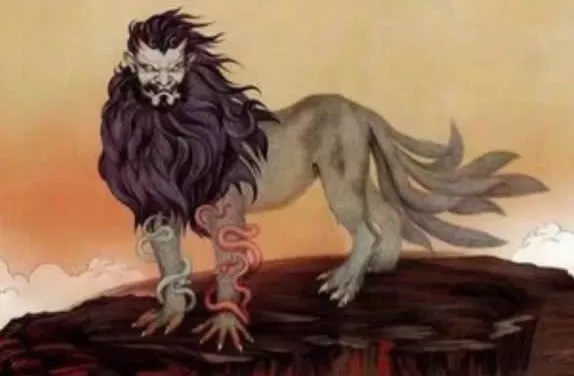
Transformed from Pangu
According to legend, Pangu was a great deity emerging from cosmic chaos, wielding an axe to create the heavens and the earth. After Pangu's monumental feat, the world lacked life. Over time, Pangu's body transformed into four ancient gods, with the Hound believed to have emerged from Pangu’s skull, granting it an invincible form. Even Haotian, Nuwa, and Fuxi would struggle to defeat the Hound!
Ancestor of Zombies
Legend also claims the Hound as the ancestor of zombies. Among the four great zombie kings (Ying Gou, Hou Qing, Han Ba, and Jiang Chen), their origins are closely linked to the Hound.
During the Emperor's battle with Chiyou, the Hound exploited the chaos to wreak havoc. Nuwa and Fuxi ultimately sealed the Hound, fearing its vengeance upon release. They extracted the Hound's soul, dividing it into three parts. These parts escaped, leaving Nuwa and Fuxi powerless.
Unbeknownst to many, the Hound had acquired a divine branch from Haotian, which, upon contact with its blood, integrated into the Hound's body, creating a new soul that eventually became the zombie king Jiang Chen. The other three parts of the Hound's soul inhabited different individuals, becoming three zombie kings just below Jiang Chen, one being the Yellow Emperor’s daughter, Han Ba.
This act can be seen as the Hound's vengeance against Nuwa, with the zombie kings, cursed to feed on human blood, causing havoc for ages!
Divine Beast of the Sea
The Hound is an ancient sea deity, known as the Dragon Stomper, resembling a dog engulfed in flames. Often seen in the north, it is a notorious dragon hunter, devouring dragon brains with a ferocious appetite. It is a formidable opponent, known for never losing against dragons unless mutually destroyed. Folklore even states, "One Hound can battle three dragons and two flood dragons."
Qing Dynasty's Dong Xuan Zhu’s "Shu Yi Ji" also mentions the Hound: "In the East China Sea, a beast called the Hound eats dragon brains, soaring fiercely. During the 25th year of the Kangxi reign, a Hound pursued a dragon for three days. Witnesses saw three flood dragons and two dragons duel the Hound. Ultimately, one dragon and two flood dragons perished, but the Hound succumbed, falling into a valley, still aflame post-mortem, confirming its identity as the Hound."
The Golden-Furred Hound in "Journey to the West"
In Chapter 71 of "Journey to the West," titled "The Traveler Uses a False Name to Subdue the Monster Hound, Guanyin Appears to Subdue the Demon King," Sun Wukong finally defeats a Star God, only for Guanyin Bodhisattva to arrive and capture the monster.
Wukong asked: "What is the origin of this monster you are capturing, Bodhisattva?"
Guanyin replied: "This is a golden-furred Hound I ride. A shepherd boy once failed to guard it, leading it to escape and wreak havoc in the King of Zhuzi’s kingdom."
Wukong hurriedly bowed: "Bodhisattva, while it brought disaster to the kingdom and harmed many, you state it was to eliminate misfortune. How so?"
Guanyin explained: "In the past, the current king, then crown prince, wounded a male peacock belonging to the Western Buddha Mother. I, upon hearing this while riding the Hound, intervened. The Hound later caused trouble with the queen, but now that three years have passed, the grievances have subsided, and with your help, I’ve come to capture this beast."
Wukong said: "While aware of its wrongdoings, I spare its life at your behest, though some punishment is warranted. I propose striking it twenty times before you take it."
Guanyin insisted: "Wukong, honor my arrival and spare it entirely; this counts as your merit in demon subjugation. It would perish if struck."
The Traveler bowed, acquiescing: "Since you’ve reclaimed it to the sea, ensure it no longer threatens mortals."
Guanyin commanded: "Reveal yourself, wicked creature!" The monster returned to its true form, allowing Guanyin to mount it. The golden-furred Hound, with flaming legs and golden threads, returned to the South Sea.
The Appearance of the Hound
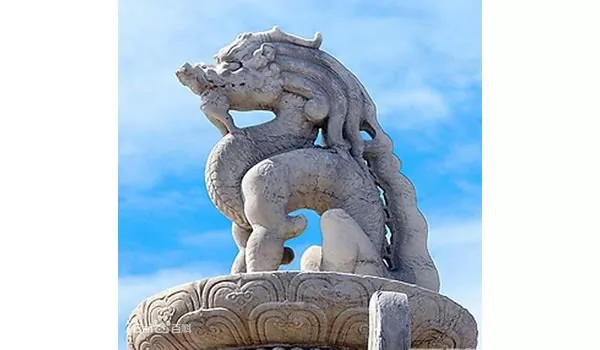
Descriptions of the Hound depict it with antlers like a deer, a head like a camel, cat-like ears, shrimp-like eyes, a donkey-like mouth, lion-like hair, a snake-like neck, a clam-like belly, carp-like scales, eagle-like front claws, and tiger-like hind claws.
An account from the East China Sea describes a beast resembling a rabbit, with elongated ears, merely a foot long, feared by lions because its roar induces decay, as mentioned in "Yan Pu Yu Tan." Despite its diminutive size, it is capable of battling dragons and consuming them upon victory.
The Symbolism of the Divine Beast
In terms of status
The Sky Howler is revered as the ruler of all, atop Mount Meru, symbolizing the universe's center, adorned with a lotus flower and Buddhist beads.
In terms of loyalty and righteousness
The Sky Howler brings blessings to its devotees, leading emperors to worship it throughout their lives. During their reign, it helps discern truth from deceit, eliminates enemies, and ensures prosperity and stability. After death, it accompanies rulers into the tomb, bridging realms to expedite reincarnation. Therefore, it signifies ultimate loyalty and morality.
In terms of function
Recognized as China's greatest national beast, the Sky Howler protects against evil, repels malevolent forces, and ensures prosperity and safety. As a sacred totem, it’s prominently placed atop the Huabiao at Tiananmen, surrounded by clouds and dragons, receiving generational reverence alongside deified ancestors.
Images and text sourced from the internet