Divine Ancient Beast: Golden-Winged Great Peng
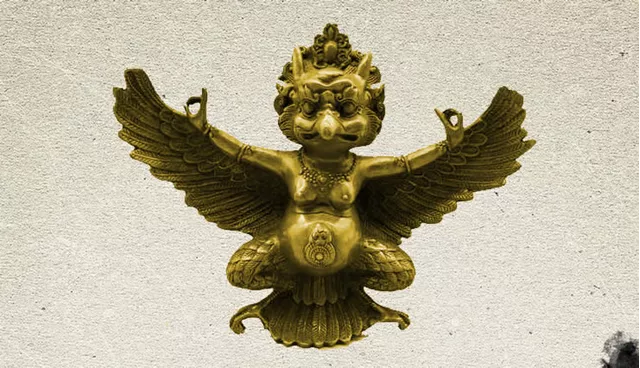
The Ancient Divine Beast — The Garuda
The Garuda, also known as the "Qiong Bird" in Chinese, is called the "Golden-Winged Bird." In Sanskrit, it is Garuda (गरुड़), and in Pali, garuḷa. Other names include Kalavinka, Kalura, and Jialuoluo Bird, meaning "the one who consumes the sorrowful cries." Additionally, it is referred to as Suparna (सुपर्ण), which translates to the golden-winged or marvelous-winged bird.
Legend has it that countless eons ago, under the rule of the Wheel-Turning King, there were 1003 princes, all of whom developed a unique Bodhi mind—an aspiration to help all sentient beings achieve Buddhahood. The youngest prince pledged, "If any obstacles arise when my brothers attain Buddhahood, I will remove them." Consequently, due to this vow, he transformed into the Garuda and acquired divine powers to eliminate all difficulties.
The Garuda is said to live on the great iron tree on the northern side of Mount Sumeru and possesses five supernatural powers: the power to move freely, read minds, recall past lives, hear divinely, and see divinely. From birth, the Garuda can fly with golden wings spanning millions of miles. It has a beak and claws as strong as iron, horns resembling diamonds, and on top of its head, a radiant jewel. Its fiery eyes gleam like the sun and moon, while its beak, resembling an iron hook, and sword-like wings release hot sand through the gaps in its golden feathers.
The Garuda is mentioned in many Buddhist scriptures. For example, in the Long Agama Sutra, it is stated that the Garuda can be born in four ways: from eggs, wombs, moisture, and transformation. Egg-born Garudas can consume egg-born evil dragons, womb-born Garudas can eat both egg and womb-born evil dragons; moisture-born Garudas can devour moisture, egg, and womb-born evil dragons, while transformation-born Garudas can consume all types, including transformation-born evil dragons.
Each part of the Garuda has symbolic significance: its head represents generosity; the mouth with a snake symbolizes swallowing anger and developing compassion, epitomizing endurance; the bird-shaped beak indicates diligence; the horns are symbolic of upholding precepts; the hands represent meditation, and the eyes symbolize wisdom. It is said that the Garuda lives atop the Buddha's head, and when the Buddha moves, the Garuda circles in the sky to ensure his safety.
Mythological Legends of the Garuda in Hinduism
In India's earliest Vedic texts, the Garuda is not mentioned, and its complete legends likely surfaced during the epic period. The great epic "Mahabharata" provides detailed myths about this bird. Sage Kashyapa wedded the two daughters of the celestial Daksha, Kadru and Vinata. Kadru gave birth to numerous serpents (Nagas), while Vinata gave birth to Aruna (the god of dawn) and the Garuda. Kadru and Vinata made a bet regarding the color of the tail of the divine horse from churning the ocean of milk; the loser would become the winner's slave.
Kadru guessed black, Vinata guessed white; however, Kadru cheated by instructing some of her sons to attach themselves to the horse's tail, making it appear black, leading to Vinata's enslavement. Soon after, the Garuda was born in a fiery explosion that frightened the gods and sages, who mistook it for the wrath of the fire god Agni. Upon realizing it was the Garuda, they rushed to praise it. Discovering that its mother and her serpent offspring were slaves, the Garuda decided to seize the divine nectar of immortality from the gods to liberate them.
Possessing extraordinary power, the Garuda easily defeated the gods and snatched the nectar. On its return, it met Vishnu, who chose the Garuda as his mount and emblazoned its image on his banner. Vishnu granted the Garuda two boons:
- To achieve immortality without consuming the nectar.
- To have the serpents of Kadru as a perpetual food source.
The king of gods, Indra, pursued the Garuda, but even his most powerful attack only knocked off a single feather. The beauty of the Garuda’s feathers amazed all beings, earning it the name Suparna (Beautiful Wing). Unable to defeat the Garuda by strength, Indra negotiated: as long as the nectar was placed down, he could reclaim it. Thus, Vinata gained her freedom, the gods retrieved the nectar, and the serpents were left with nothing.
Legends of the Garuda in Buddhism
In Buddhism, Garuda is considered one of the Buddha's protectors among the Eightfold Divisions of Devas and Dragons, adorned with various majestic symbols, a golden body, a head adorned with a wish-fulfilling jewel, and a sorrowful cry. Each day, it consumes one dragon king and five hundred venomous dragons. Eventually, as poison accumulated within, the Garuda could no longer eat. After flying up and down seven times, it traveled to the Vajra Wheel Mountain, where the poison erupted, causing self-immolation, leaving only a pure blue glass heart behind. There are countless Garudas in the world, governed by the four great Garuda kings: Wei De, Da Shen, Da Man, and Ru Yi. Furthermore, Garuda is a protector of Avalokiteshvara, manifesting in various forms, including that of Garuda. In the tantric tradition, Garuda (known in Tibetan as khyung) is the mount of the northern Buddha Vajrapani, symbolizing the ability to attract all beings as the Dharma king.
The Application of the Garuda in Feng Shui
The Garuda symbolizes wisdom, power, and harmony. In Tibetan areas, people place images of the Garuda at home entrances, Buddhist altars, and offices to ward off evil spirits, prevent illness, avoid nightmares, eliminate obstacles, ensure health, promote career success, and ultimately eradicate karmic hindrances to achieve Buddhahood. Its main benefits include:
- Ensuring Safety and Wealth: Placing the Garuda in the home stabilizes financial luck and protects the family, serving as a powerful guardian.
- Improving Interpersonal Relationships: As an adept negotiator and conflict mediator, placing the Garuda in the workplace can foster good connections, resolve crises, and bring good fortune.
- Resisting Illness: Having the Garuda in Buddhist altars or placing its image above the bed can ward off evil spirits, prevent illness, calm the mind, and promote health.