The Enigma of the French Sleeping Beauty: 126 Years of Defying Nature's Laws
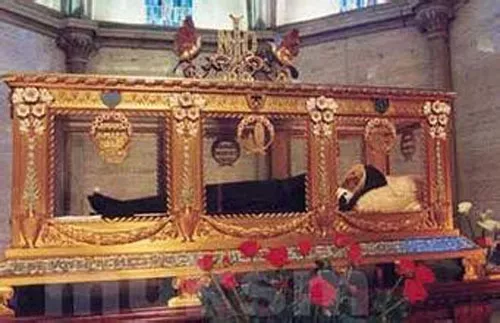
126 Years After Her Death, Her Appearance Remains Soft and Resilient
The Catholic Church defines "incorruptibility" as the state of being "soft and resilient like a living person, not subject to decay." Saint Bernadette died at the age of 35 and was laid to rest in 1879. Before she was canonized, her body was exhumed three times at the Church's request for examination. These exhumations were witnessed by numerous doctors, priests, and significant figures. Remarkably, Bernadette Soubirous' body showed no signs of decomposition, defying the natural laws of decay.
Today, pilgrims journey to Nevers, France, to pay their respects to the saint. She rests in a glass coffin, her miraculous preservation serving as a testament to her serene beauty. Her story also draws modern scientists to Nevers, eager to study Saint Bernadette's body. Could the mystery of the "Sleeping Beauty's" incorruptibility be unraveled?
Bernadette Soubirous was a country girl from Lourdes, France. At 14, she experienced her first vision of the Virgin Mary, with several more following. Soon after, Bernadette left her family to join a convent in Nevers, where her body now resides. Despite her frailness and frequent illnesses, she inspired those around her. Even before her official canonization, everyone who knew Bernadette regarded her as a saint.
Saint Bernadette passed away at 35 and was buried in 1879. Prior to her canonization, the Church required her body to be exhumed three times for examination. Many doctors, priests, and notable figures were present to witness these exhumations.
One would typically expect only a skeleton to remain after 126 years. However, records from each exhumation indicate that Saint Bernadette's condition was extraordinary: despite her rosary being rusted, her body was astonishingly well-preserved, with soft, elastic skin and lifelike features.
Did the "Saponification" Phenomenon Contribute to Her Body’s Preservation?
Jacqueline Taylor, a professor of funeral service education at Mount Ida College near Boston, is an internationally recognized authority in body restoration and preservation.
Jacqueline expressed, "In my studies of incorruptibility, Saint Bernadette is the most intriguing. She is incredibly lifelike and serves as the best-preserved example of incorruptibility."
Paul Boccetti, a member of the Italian Committee for Paranormal Investigation, has explored numerous so-called paranormal phenomena with his mentor, Luigi Galachelli, an obscure Italian organic chemist. Due to his investigations, Paul often faces skepticism from believers. At Jacqueline’s request, Paul will assist in examining incorrupt bodies and photographing them.
Paul suspects that some incorrupt bodies might have been discreetly treated with preservatives by followers. Environmental conditions, such as humidity, can significantly influence decay rates, with humid conditions accelerating decomposition. Nevertheless, not all incorrupt bodies have been treated with chemicals or interred under stable conditions.
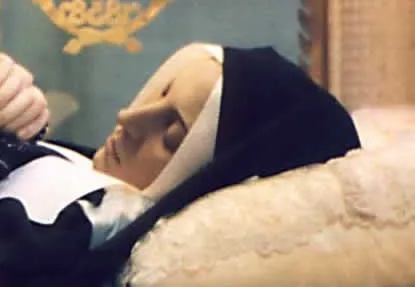
The Possible Reasons Behind the "Sleeping Beauty's" Incorruptibility
Paul explored the possibility that another factor could aid in preserving the body.
Jacqueline explained, "During decomposition, a process known as 'saponification' occurs, where the body's fat converts into 'corpse wax,' a waxy and viscous substance."
In simpler terms, the body's fat transforms into a soap-like substance, giving the skin a plump and radiant look. Saponification remains mysterious, and scientists have yet to fully understand the triggers behind the transformation of body fat into this soap-like material. Some suggest it results from a combination of chemical and geographical factors.
Jacqueline remarked, "The rarity of saponification is its beauty; it likely results from a blend of internal and external factors acting on the body."
The rust on the crucifix necklace suggests that air and moisture penetrated the coffin, raising the question: why didn’t the body decompose?
Jacqueline and Paul traveled to Nevers, France, to investigate the body of Saint Bernadette, where many enigmas remain unsolved. Saint Bernadette is neither a desiccated mummy nor bloated from saponification. Perhaps further research is essential to unlock the truth.
Scientists have committed to further investigating this mystery, while the "Sleeping Beauty" lies peacefully in her gilded glass coffin, her secrets still veiled behind a gentle smile that has persisted for over 126 years. Her body bridges past and present, representing a legacy of gentleness and humility.
The secrets of Saint Bernadette extend far beyond her seemingly flawless exterior. Jacqueline asked Paul to sift through the literature. Certain excerpts could hold answers, but after his review, Paul found that the mystery of the "Sleeping Beauty" remains cloaked in uncertainty. Reports from all three exhumations affirm that Saint Bernadette's body was remarkably preserved.
"Her hands crossed perfectly over her chest." "There was no odor of decomposition." The doctors concluded that Saint Bernadette's body was intact. "Her beautiful hands clutched a rusted rosary, and the crucifix on her chest was also covered in rust."