Li Daozhen: Decoding Myths - Nuwa and the Creation of Humanity Feel free to adjust based on your specific needs!
Prologue:
Let's delve into the myths—the stories we've heard from our ancestors since childhood yet never fully understood. It's time to lift the veil hiding these myths and discover their profound truths. Let's unravel the mysteries of these tales and journey into a mystical world untouched and previously unknown…
Table of Contents:
The Creation of Humanity by Nüwa
Nüwa Mends the Sky
The Divine Tree of Fusang
Pangu Creates the World
Mythical Legends
Prehistoric Civilizations
The Connection Between Heaven and Earth
Da Yu Controls the Flood
Hou Yi Shoots Down the Suns
The Purpose of History
1. The Creation of Humanity by Nüwa
Before we dive deeper, let's briefly introduce some scientific concepts. We aspire to transcend modern scientific limitations to lay the groundwork for the important insights that follow. Otherwise, our limited human perspective might miss the deeper meanings of these myths.
Throughout history, many mysterious phenomena have remained unexplained, such as the concept of time travel popularized by modern films.
Today, many progressive scientists believe in the possibility of time tunnels. Einstein's theory of relativity suggests that time and space are not fixed; the universe lacks a singular time or space. Mass can bend time and space, which he identified as the cause of gravity. In essence, Einstein theorized that mass distorts spacetime—a view widely accepted in the scientific world.
Modern cutting-edge science has introduced us to the idea of "curved space." Imagine two points, A and B, separated by 10 centimeters on a piece of paper. To reach point B from point A, you must traverse at least 10 centimeters. However, if you bend the paper so that points A and B overlap, the distance is reduced to zero, allowing for an instant transition from A to B without passing through space or time. This concept underpins the idea of time tunnels, also known as "wormholes."
Let's explore further into spacetime dimensions. We know points form lines, lines form planes, and planes form volumes. A point is 0-dimensional, having no length, width, or height. Countless points form a one-dimensional line, which has only length. Countless lines form a two-dimensional plane, having both length and width. Finally, countless planes form a volume, which is three-dimensional, possessing length, width, and height.
Our world, as we perceive it, is three-dimensional; we exist within this three-dimensional spacetime. But could higher-dimensional spacetimes exist beyond our understanding?
At the forefront of modern physics, string theory posits that the universe comprises at least 11 dimensions, many of which we cannot perceive but that indeed exist.
Lower-dimensional spacetimes can warp within higher-dimensional ones, creating portals to other realms.
For example, a straight line is one-dimensional, while paper represents two dimensions. You can bend a one-dimensional line into a curve on a two-dimensional surface. Similarly, we exist in three-dimensional spacetime, while a piece of paper is two-dimensional. If you fold the paper into a box or roll it into a cylinder, this two-dimensional paper bends within three-dimensional space. In the same way, three-dimensional space can bend within four-dimensional space…
As beings in three-dimensional space, our world is contained within these three dimensions. But could life exist in higher-dimensional spaces? Modern science hasn't confirmed the presence of life in higher dimensions, but it doesn't rule it out either. If such life does exist, they could be considered higher beings or advanced life forms. Throughout history, the gods and immortals of human lore—are they not higher beings residing in higher-dimensional spaces? Let's entertain this hypothesis: if it can be satisfactorily explained without contradictions, it stands as a valid theory in the spirit of scientific inquiry. So, let's continue:
Life in lower-dimensional spaces is unaware of higher-dimensional spaces. They're bound by their dimensional limitations, forming thought structures based on that dimension. They cannot escape their constraints or grasp the existence forms of higher-dimensional spaces. On the other hand, beings in higher-dimensional spaces can freely enter or exit lower-dimensional spaces.
For instance, a flat surface is two-dimensional. If we place a leaf on water from our three-dimensional perspective, that leaf entering a two-dimensional space seems to appear out of nowhere. Once removed, it disappears from the two-dimensional space, as if it never existed. This phenomenon parallels mythological tales where deities materialize out of thin air and vanish, only to reappear elsewhere. If these deities exist in higher-dimensional spaces, such occurrences become more understandable.
The Large Hadron Collider in Europe is currently the largest and most powerful particle accelerator worldwide. Situated 100 meters underground at the Switzerland-France border, it began operations in 2008.
Recently, the Large Hadron Collider detected a strange particle. Dubbed a particle, it mysteriously disappears and sometimes exists in our world while at other times, it does not. Named the odderon, it can vanish from our world and reappear mysteriously. This particle's existence has temporarily unsettled the physics community, leading to deep contemplation.
Moreover, while beings from higher-dimensional spaces can partially enter lower-dimensional spaces, they can't fully immerse themselves. For example, if we vertically submerge a hand into water, only the cross-section of a finger, a circle, is visible in the two-dimensional water space. Introducing two fingers shows two circles, their cross-sections, making the full hand shape impossible to display. While trying to explain a hand's shape to beings in two-dimensional spaces, they wouldn't grasp it; their limited dimension means they can't conceptualize it. They might perceive a 3D hand as one or several circles, much like blind men describing an elephant. From their perspective, this interpretation is accurate within their lower dimensions but seen from higher dimensions, it seems absurd.
Thus, there is a saying among the Jewish people: "When humans think, God laughs."
Consider a flat Earth as a two-dimensional space, with us standing on the ground—this two-dimensional space is beneath our feet and can be called Earth or soil. However, beings within that two-dimensional space wouldn't comprehend this; their concept of Earth and soil is merely a one-dimensional line below their feet. To them, what we call Earth in three-dimensional space is just a line, not their entire flat world. Such misunderstandings arise from different interpretations across diverse spacetime dimensions.
Similarly, our three-dimensional space is just a surface, the lowest layer of a higher-dimensional space where divine beings might exist, beneath their feet. Deities might call our space Earth or soil. Therefore, when God says He created humanity from clay, He might be referring to the materials of our three-dimensional spacetime, instead of literal soil from our world. This possible misunderstanding stems from different spatial dimension meanings.
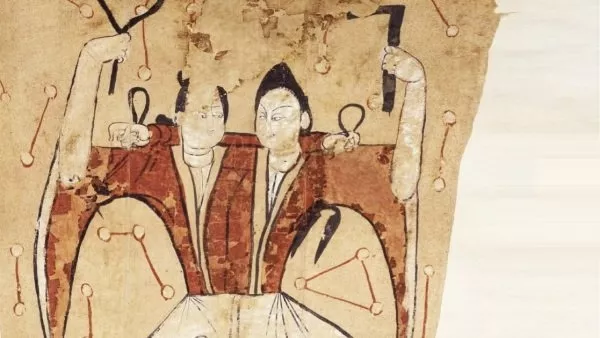
The Bible recounts God creating humanity from clay; similarly, Chinese legends narrate Nüwa doing the same, while in ancient Greek mythology, Prometheus forms humans from clay. Indigenous myths from Native Americans, the Diegueno, the Shoshone, the Indian Korku, the Maori of New Zealand, the Bilin people of Australia, and the Sakalan people also feature deities crafting humanity from clay. This commonality is intriguingly consistent across almost all ancient cultures.
We often assume ancient humans lacked advanced transportation, with continents divided by oceans, deserts, and mountains, hindering cultural exchange. If the idea of deities creating humanity from clay is mere fantasy, random variations should exist. One culture could claim humans sprung from trees, while another might say they came from water—scenarios more conceivable. Yet, nearly all cultures worldwide share similar creation myths, as though following the same blueprint. If merely fiction, how did ancient people, separate by vast geographical barriers, orchestrate such collective deception? Who could have engineered such a grand illusion?
Our three-dimensional spacetime consists of molecules; everything here is composed of these particles, hence termed molecular spacetime. When God says He made humans from clay, does it suggest He used the materials of our molecular-based spacetime to create them? While existing beneath divine feet, everything in our space, in higher-dimensional divine language, could be regarded as clay or earth.
This is one interpretation of the story of Nüwa creating humanity.
Source of text and images: Look China