Facial Features Illustrated: The Four Beasts of Kyushu and the Six Luminaries of the Five Peaks
Basic Chapter: The Five Elements and Six Relationships
A significant diagram: Five Stars, Six Luminaries, Nine Provinces, Four Beasts, and Five Mountains:
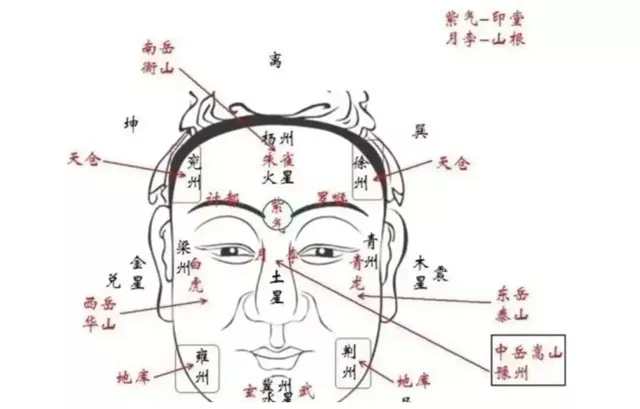
Men's faces are examined from the right, while women's faces are viewed from the left.
- Upper section: The area from the eyebrows to the hairline corresponds to Mars, representing the fire element on the entire forehead;
- Middle section: The area below the eyebrows to the tip of the nose corresponds to Saturn;
- Lower section: The area from the tip of the nose to the chin corresponds to Mercury;
The area from the left eyebrow to the left cheek and left ear corresponds to Jupiter;
The area from the right eyebrow to the right cheek and right ear corresponds to Venus.
Five Elements and Six Relationships Determination: In face reading, the tip of the nose is considered the Tai Chi point. The nose represents the self and is linked to the earth element, indicating personal wealth and capability. Fire creates earth; those who nurture me are my parents, with the forehead symbolizing Mars and thus representing parents. Those who control me are represented by wood (the left cheek and left ear indicating career success and official fortune); those I nurture represent descendants, associated with metal (the right cheek and right ear indicating progeny). Finally, those I control signify talent, with the chin and Mercury indicating wealth and spouse.
On the Forehead: A high, wide, and smooth forehead without blemishes is ideal; fire represents the Li Palace, symbolizing property and its star. A minimum of three features is expected, as the forehead is crucial in property matters; it is located at the Mars position, where the Vermilion Bird resides, indicating potential legal disputes.
On the Eyebrows: Officials dread "eight-character eyebrows," which signify misfortune. The numbers 53, 63, and 73 relate to Mercury and should be noted. In older age, the lower section (Mercury) should be considered along with the eyebrows. Upturned eyebrow tails symbolize success and prosperity;
On the Temples: The presence of bright and white crow’s feet compared to other areas may suggest infidelity.
On Mercury: Below the nose, the mouth represents Mercury. The mouth’s size, gauged by the distance between the pupils, can indicate abundance if large in men, while a large mouth in women may suggest solitude.
On Bone and Flesh: Men with narrow shoulders may struggle with responsibility; an excess of bone over flesh may point to poverty, while the reverse suggests mediocrity. For women, an excess of bone over flesh traditionally indicates widowhood (related to the forehead).
For Women:
A face resembling a full moon is said to signify wealth.
Rounded shoulders and a thick back are believed to secure a prosperous husband.
The return of the Five Mountains implies prosperity and benefits for children.
The Five Mountains’ return signifies flourishing wealth in this life, attaining both riches and honor.
The return of the Five Mountains alongside prominent cheekbones may indicate a pinched nose and a forehead as flat as a wall.
For Men:
The forehead's height should not be less than three and a half fingers for men; for women, it should be three fingers, but not exceed three and a half fingers. Exceeding this may hint at a second marriage or promiscuity.
The forehead reflects nobility and official status; those with a high, well-formed forehead often enjoy wealth. Women gauge their husbands' fortunes through their foreheads; a large forehead in women is called a White Tiger forehead, which is considered unfavorable for husbands and children, possibly leading to a second marriage. Women with scarred foreheads often face unhappy marriages or difficulties with their first child. According to the I Ching, if a woman's upper section is too long and the lower section too short ("Heaven Long, Earth Short"), it is best to marry a husband seven or nine years older. Civil servant women should avoid straight bangs as they obscure the shape of the face, affecting their future. Fire represents the heart and eyes, with the forehead denoting wisdom and intelligence, while the lower section signifies wealth. A long lower section and a short upper section may disrupt the property star, leading to wealth without generosity, resulting in disasters due to wealth, academic dropouts at 16, and low education; a short upper section equates to only 2-3 fingers.
A broad forehead signifies wisdom, while a wide chin indicates abundant property. The middle section assesses personal ability. Women with large foreheads may look down on their husbands, just as men with large foreheads may look down on their wives. Those with broad upper sections tend to be knowledgeable. Clear eyebrows, smooth, broad foreheads are indicators of high education; observing facial color is particularly effective. A face resembling a pig indicates a lack of character; a too-strong chin with a weak forehead creates a conflict between water and fire, leading to wealth-related disasters. The lower section represents talent, while the upper forehead represents fire, the Vermilion Bird, and legal disputes.
On the Heavenly Warehouse and Earthly Store: The upper part is the Heavenly Warehouse, and the lower part is the Earthly Store. The Heavenly Warehouse is located in the regions of Xuzhou and Yanzhou; a prominent Heavenly Warehouse suggests divine favor and abundant ancestral wealth, leading to prosperity between the ages of 28-35, marked by a rise in official status, enabling the common to become wealthy. A collapsed Heavenly Warehouse indicates hardship and struggles before turning 28.
The Yintang, or the space between the eyebrows, is also known as the Purple Qi Star, with a standard width of one inch, ideally no less than two fingers wide for men, and 1-1.5 fingers for women. The Purple Qi should be round; a round Yintang is believed to lead to a high official status. The Yintang represents official rank, seals, and offspring; scars, lines, or black moles there indicate a disrupted fortune.
The left and right of the Yintang represent the eyebrows, and are indicative of criminal records. "Connected eyebrows" prevent holding official positions or engaging in business; such eyebrows suggest a broken seal. Connected eyebrows are unfavorable to descendants, typically resulting in only one child.
Observing Features: Start with the Five Senses
The five senses correspond to the Five Mountains; symmetry in the senses is preferred over asymmetry.
Well-formed features herald wealth in ten years, whereas misaligned features foretell poverty over the same span.
The eyebrows symbolize brothers, the eyes signify supervision, the nose represents discernment and wealth, the mouth pertains to finance, and the ears relate to listening. 【Reciting these phrases initiates the process of identifying key traits in facial reading; without them, analysis may be lost. Cultivating this habit is essential when evaluating faces. For instance, in observing brothers, use: "Eyebrows represent brothers, soft and clear, brothers strong in number four or five. From your eyebrows, I perceive the number of brothers you have; five brothers in fate, four retreating into family. Straight eyebrows suggest loneliness, curved eyebrows indicate two or three brothers, strong eyebrows suggest four or five, and goose tail eyebrows suggest eight or nine brothers." If five brothers are indicated and the opposite party does not confirm, and four retreat into the family without response, conclude with three; do not conclude with two. Brothers may number one or two, three or four, or four or five, requiring precision; this constitutes true skill. Face observation is akin to a doctor diagnosing a patient, employing observation, inquiry, and examination; when timing aligns, pointing it out comes naturally.】
Brother's Feature: Eyebrows
Eyebrows symbolize brothers, soft and clear, indicating four or five brothers.
Double eyebrow tails suggest different parents; intertwined eyebrows imply conflict.
Eyebrow tails extending beyond the bone suggest many brothers; dragon and tiger eyebrows denote nobility and harmony.
Scars or intertwined lines denote bad relations with brothers; a worried expression indicates poverty.
Unlucky features in officials are dreaded as they forewarn of bleak elder years; men with half eyebrows might face a second marriage, while women could face widowhood. Short eyebrows and fierce eyes suggest a husband-killing aspect. Half eyebrows indicate broken or incomplete eyebrows.
Double eyebrow tails suggest different parentage; intertwined or double eyebrows may indicate enmity with brothers. Eyebrows should be smooth; any deviation in direction suggests intertwined eyebrows. If two eyebrows intertwine before age eight, it may foretell the father's demise, with a maximum of two brothers possible; interwoven eyebrows are feared for bringing family ruin in later years, leading to poverty, solitude, harmful brothers, harm to father and child, and a fierce wife leading to downfall.
Eyebrow width should range from 5 to 8 millimeters; overly broad or thick eyebrows are considered inauspicious. Men with overly thick eyebrows may face a second marriage, while women might face widowhood.
Men with Eight-Character Eyebrows:
Eight-character eyebrows bring harm and misfortune; if temples appear pressed down, there may be a risk of losing a wife. 【Severely drooping eyebrow tails pressing into the temple area indicate a life of hardship; those with eight-character eyebrows generally have few descendants, usually only one. For women with eight-character eyebrows, this caution is not applicable. A long forehead paired with a pointed left eyebrow suggests early paternal loss.
On Life's Flow:
A mole at the age 31 position indicates not only disaster in that year but also at ages 35, 49, and 52, as they align along the same line. Crow's feet relate to personal misfortune rather than children. Men with temple moles may marry concubines, while women may marry older men with about an eight-year gap.
Moles under the eyes in men suggest burdens with children; moles under the left eye express anger toward sons, while those under the right eye express anger toward daughters. A darkened forehead represents water overpowering fire, foreboding legal issues for commoners and career changes for officials. Black suggests secrecy and potential trouble.
Financial Officer - Mouth
A mouth like a four-character pearl, with corners curving upward,
Indicates a clever official achieving early success.
If the ends of Mercury are slightly drooping, thin, and without defined edges, this signifies poverty.
If it is slanted, it indicates deceit and a fondness for cheapness.
This poem notes that the mouth signifies youth; the numbers 53, 63, and 73 relate to Mercury and are notable. In old age, the eyebrows should also be observed; features should not be evaluated in isolation. This implies that officials in later years should not have scars in their eyebrows; both Bo Xilai and Wang Lijun had scars in theirs. Particularly, the prison area should remain blemish-free. For those aiming at fame, education, wealth, or promotions, observe the lips: dry, unmoistened lips suggest failure. The average person typically has up to 32 teeth, nobles possess 36-38, and emperors may have 42. Retaining teeth indicates longevity; their loss signifies a reduced lifespan.
The mouth, represented by Mercury, must be upright, square, with distinct edges, red lips, white teeth, upward corners, and expanded jaw lines. The mouth should remain unlocked; a broad chin indicates wealth in later years, and if children are not prosperous, they may attain nobility.
A mouth lacking edges suggests late marriage; marriage may occur only after 28 years. 【Both the Yintang and mouth indicate 28 years.】
The mouth symbolizes children; a crooked mouth suggests rebellious offspring, with associated troubles.