Overview of Facial Features, The Five Great Mountains and Four Rivers, The Three Masters and Three Pillars - Part Four of the 'Mayi Shenxiang' Series
Overview of the Five Features
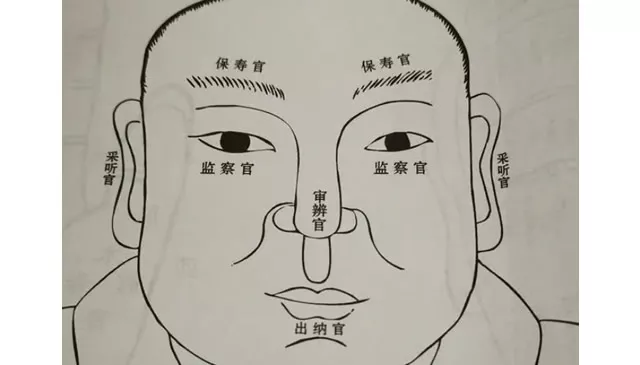
The five features include: first, the ears, which are the organs of hearing; second, the eyebrows, symbolizing longevity; third, the eyes, which serve as inspectors; fourth, the nose, which functions as the discerning organ; and fifth, the mouth, which is responsible for intake and output. The "Great Harmony Ode" states: for each well-formed feature, one can enjoy ten years of nobility, and if a household is well-formed, it promises ten years of wealth. Among the five features, having even one well-formed leads to a decade of nobility. With all five features well-formed, a person can enjoy a lifetime of wealth and nobility.
The ears should be vibrant in color, high and prominent above the eyebrows, with a complete outline that closely fits the sides of the head, plump and thick, and with a wide area around the ear canal; this indicates a well-formed organ of hearing.
The eyebrows should be broad, clear, and long, with a double arch extending into the temples, shaped like a crescent moon or a rhinoceros horn, full and beautiful at both ends, and positioned high on the forehead; this indicates a well-formed longevity feature.
The nose should have a straight and upright bridge, a broad and flat area between the eyes, with a root connecting to this area. A high and prominent nose implies longevity, a rounded tip, and well-defined nostrils shaped like an inverted gallbladder, neat like a cut bamboo tube, and vibrant in color; this indicates a well-formed, discerning organ.
The mouth should be square and large, with red, well-defined, and thick lips shaped like a bow, opening wide when speaking and closing tightly when at rest; this indicates a well-formed organ of intake and output.
The eyes should have a subtle gaze, with a clear distinction between the whites and the pupils, well-aligned pupils, and a radiant sparkle, or they may be long and extend to the temples; this indicates a well-formed inspector. Even when the crescent moon is just a sliver in the sky, it still shines brightly; "when all five features are well-formed," it means that the ears, eyebrows, eyes, mouth, and nose are all well-aligned, suggesting that such a person is destined for lifelong wealth and nobility.
The Five Mountains
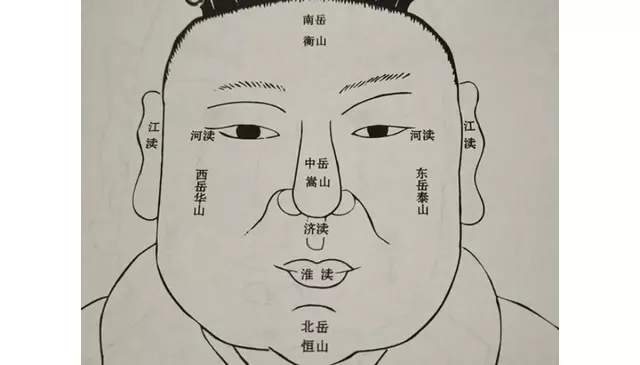
The forehead corresponds to Mount Heng (Southern Mountain), the chin to Mount Heng (Northern Mountain), the nose to Mount Song (Central Mountain), the left cheek to Mount Tai (Eastern Mountain), and the right cheek to Mount Hua (Western Mountain). The Central Mountain should be tall and prominent, while the Eastern Mountain should rise high and face the Central Mountain. If it isn't tall or steep, it lacks power and indicates a person of lesser status, with limited longevity. If the Central Mountain is flat and lacks power, the other four mountains will lack leadership; even with other good features, one will not achieve great wealth or authority, nor significant longevity. If the Central Mountain is not tall and is too long, it suggests average longevity. A sharp and thin Central Mountain may foresee misfortune in old age. A tilted Southern Mountain signals misfortune and household instability. A sunken Northern Mountain indicates a lack of achievement and eventual poverty. If the Eastern and Western Mountains are tilted and lack power, it reflects a malicious heart and a lack of compassion. The five mountains should support each other, with the Central Mountain as the main feature, while the other four mountains face towards it.
Translation:
The forehead corresponds to the Southern Mountain (Mount Heng), the chin to the Northern Mountain (Mount Heng), the nose to the Central Mountain (Mount Song), the left cheek to the Eastern Mountain (Mount Tai), and the right cheek to the Western Mountain (Mount Hua). The Central Mountain should be upright and prominent, and the Eastern Mountain should also be tall, oriented towards and echoing the Central Mountain. If it is not upright or prominent, it is considered "powerless," reflecting common qualities and limited longevity. If the Central Mountain is flat and lacks power, the other four mountains lose leadership; even with good features, they will struggle to achieve great wealth and power, and their lifespan will be short. If the Central Mountain is not tall enough and is overly long, it suggests average longevity. If sharp and thin, it may lead to misfortune in old age. A tilted Southern Mountain signifies misfortune and an unstable household. A sunken Northern Mountain signifies a lack of achievement and eventual poverty. If the Eastern and Western Mountains are tilted and lack power, they indicate a malicious heart and a lack of compassion. The five mountains should support each other, with the Central Mountain as the focal point, and the other four mountains should face it.
The Four Rivers
The ears represent the Yangtze River, the eyes the Yellow River, the mouth the Huai River, and the nose the Ji River, collectively known as the Four Rivers. The Four Rivers should have deep and lasting foundations and stable banks to ensure wealth and resources accumulate without depletion. The ears, like the Yangtze River, should have wide and deep ear canals, with a compact shape, reflecting intelligence and the preservation of family wealth. The eyes, representing the Yellow River, suggest that deep-set eyes indicate shorter lifespans, long eyes indicate wealth, and bright eyes denote intelligence. Shallow or murky eyes suggest a difficult fate, overly round eyes may lead to early death, while moderately sized eyes reflect nobility. The mouth, representing the Huai River, should be square and wide, with the upper and lower lips fitting together. If the upper lip is too thin to cover the lower lip, it's called "not covering," and if the lower lip is too thin to support the upper lip, it's called "not supporting." "Not covering" or "not supporting" suggests short lifespans and lack of blessings; failure to cover indicates a decline in family wealth. The nose, like the Ji River, should be full, prominent, smooth, and round, without visible nostrils or damage; such a nose foretells family prosperity.
Translation:
The ears are analogous to the Yangtze River, the eyes to the Yellow River, the mouth to the Huai River, and the nose to the Ji River, known together as the Four Rivers. The Four Rivers should have deep and stable sources to accumulate wealth and resources efficiently. The ears, denoting the Yangtze River, need wide and deep ear canals, with a compact form indicating wisdom and safeguarding family wealth. The eyes, analogous to the Yellow River, indicate that deep-set eyes often come with shorter lifespans, while elongated eyes are signs of wealth, and bright eyes symbolize intelligence. Shallow or cloudy eyes suggest a challenging fate, overly round eyes could lead to an early demise; ideally proportioned eyes signify nobility. The mouth signifies the Huai River; it should be square and wide with well-fitted upper and lower lips. An upper lip too thin to cover the lower is termed "not covering," and a lower lip too thin to support the upper is termed "not supporting"; both indicate short lifespans and lack of blessings, and failing to cover indicates diminishing family wealth. The nose, like the Ji River, should be full and prominent, smooth and rounded with no visible nostrils or damage, indicating family prosperity.
The Three Masters and Three Pillars
A pointed forehead suggests youthful disasters, while a crooked nose implies a restless middle age. To gauge old age circumstances, look to the chin; a square and elevated chin heralds good fortune. The head is termed the "Longevity Pillar," the nose as the "Beam Pillar," and the feet as the "Support Pillar."
Translation:
A pointed and narrow forehead suggests youthful disasters. A crooked and misaligned nose signifies wandering in middle age. The state of old age is largely indicated by the chin; a square and prominent chin is considered auspicious. The head is referred to as the "Longevity Pillar," the nose as the "Beam Pillar," and the feet as the "Support Pillar."