Exploring the Connection Between the Three Stops in Face Reading and Their Corresponding Aspects
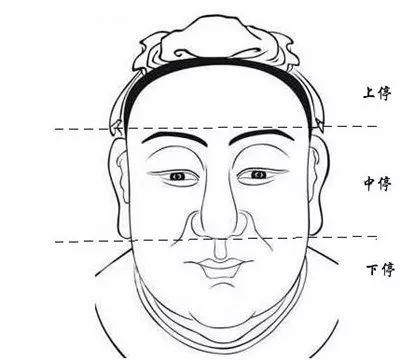
Let's begin by understanding the concept of facial features referred to as the "three sections." In ancient times, a "section" meant dividing something into multiple parts, with each part being called a section. Therefore, the "three sections" of the face involve dividing the face into three distinct parts, known in physiognomy as the upper section, middle section, and lower section. This division occurs from top to bottom and corresponds to the fluctuations in a person's fortunes during three life stages: youth, middle age, and old age.
I. Upper Section
This section spans from the hairline on the forehead to the eyebrows, covering the entire forehead.
The upper section signifies heavenly aspects, representing wealth and fame, and influences fortunes during youth, specifically between the ages of 15 and 30. It reflects one's relationship with their parents and personal wisdom. A high, full, and broad upper section suggests good family upbringing, exceptional talent, and potential high social status in the future. Physiologically, a full forehead indicates good brain development, leading to thoughtful and intelligent individuals with superior mental and professional abilities, which is why it is considered fortunate.
For example, literary genius Qian Zhongshu and brilliant physicist Qian Xuesen are both celebrated national treasures. Observing their youthful photos, one can clearly notice the characteristics of a well-defined, full, and prominent upper section!
II. Middle Section
This section extends from the eyebrows to the tip of the nose, including the eyebrows, eyes, nose, and ears. The middle section symbolizes human attributes and governs fortunes in middle age, specifically from ages 31 to 50. It also relates to longevity and is regarded as one of the more significant facial features.
Why is it considered important? The nose in the middle section is part of the respiratory and circulatory systems, and a person's health is closely linked to these systems. Examining the middle section can provide a basic assessment of one's health status. Additionally, ancient wisdom suggests that by the age of thirty, one should be established; during this time, individuals are expected to take responsibility for themselves and set their life goals and direction.
III. Lower Section
This section stretches from the tip of the nose to the chin, governing fortunes in old age, specifically from age 51 onward. The lower section symbolizes status and blessings. In physiognomy, it is believed that a long lower section leads to a prosperous old age. A full and rounded lower section indicates a blessed and fortunate later life.
In conclusion, the three sections of the face are considered auspicious when they are balanced. Equal proportions among the three sections indicate a life characterized by steady development, wealth, and honor.