The Secrets of Face Reading: The Eyes, by Jin Zizai
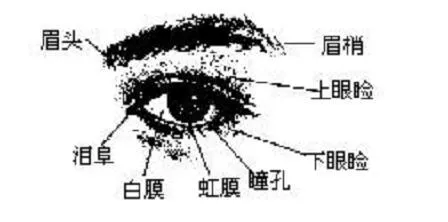
In face reading, facial features are said to shape 70% of one’s fortune, with the eyes alone accounting for 30%. The eyes are considered the most important feature, reflecting one’s spirit, charisma, courage, and wealth.
Classical physiognomy grouped eyes into types such as dragon eyes, turtle eyes, lion eyes, and sparrow eyes. Modern practitioners often find these labels hard to apply accurately, which can lead to misreadings.
Below, we decode the basics of eye physiognomy.
1. The Inner Corner of the Eye
The inner corner of the eye—also called the tear mound—contains a small red fleshy area known in classical texts as “zi” meat, which ancient readers called the “dragon palace.”
Three consistently reliable pointers:
First, some people have larger inner corners and others smaller; size itself isn’t the issue unless it protrudes. If the red area is visible when viewed head-on, it suggests financial loss around age 35; in severe cases, even bankruptcy.
Second, if the inner corner runs straight—meaning the eye’s inner edge lines up vertically with the bridge of the nose—it points to marital challenges. Major emotional shifts may occur around ages 35, 44, and 45, and early marriages are more prone to divorce.
Third, if the inner corner curves like a hook, it fits the profile of “peach blossom eyes.” These individuals tend to attract the opposite sex, are resourceful, and can steer situations to their advantage. Career breakthroughs may occur around ages 35–36.
Jin Anxian’s Clarifications:
1. Will altering the inner corners change one’s fortune?
No. It improves appearance only.
2. What does a mole at the inner corner signify?
It suggests a strong sexual drive and potential involvement in sexual entanglements or disputes.
2. The Outer Corner of the Eye
The area at and behind the outer corner of the eye is called the “spouse palace,” a key zone for reading marital dynamics.
Three consistently reliable pointers:
First, the lines at the outer corner (crow’s feet) signal tendencies. Having many before age 30 points to a lustful nature; having many after 30 is normal. Having none before 30 is also normal, but having none after 30 suggests a lustful nature.
Second, when crow’s feet extend straight toward the temples, couples may argue frequently. Financial setbacks may occur around ages 29–30, with potential marital changes around 39–40. If the outer corner or the lines angle upward, the person tends to be optimistic; if they angle downward, more pessimistic.
Third, color matters. A bluish tint at the outer corner signals marital discord, while a smooth, glossy look suggests harmony.
Jin Anxian’s Clarifications:
1. What does a mole at the outer corner signify?
It influences marital relationships.
2. Will removing a mole at the outer corner improve the spouse palace?
Moles mean different things depending on location. Removing one is cosmetic and does not change fate; the real shift comes from mindset and consciously avoiding negative influences.
3. The Pupil
The pupil—more precisely, the iris—varies in size and color (e.g., black or yellow).
Three consistently reliable pointers:
First, a large pupil suggests a kind heart; a small pupil suggests a composed, restrained temperament.
Second, if there is more visible white than black, the person is compassionate and easily trusting. If there is more black than white, they may be shrewd and ruthless, with a potential for violent behavior.
Third, a black pupil indicates trusting people over principles, while a yellowish iris points to prioritizing principles over people.
Jin Anxian’s Clarifications:
1. How should we interpret blue eyes in non-Chinese individuals?
This reflects ethnic characteristics; for example, blue eyes can indicate sensitivity, irritability, and initiative.
2. Do colored contact lenses affect one’s fortune?
No. Fortune is predetermined, though contacts can enhance appearance.
4. The Upper Eyelid
The upper eyelid—the space between the eyebrows and the eyes—is also called the “property palace.”
Three consistently reliable pointers:
First, thick, drooping lids suggest indulgence and greed; thin lids suggest sensitivity and calm.
Second, a wide upper lid points to a kind nature and solid family ties; a narrow lid suggests impatience and weaker family bonds.
Third, a mole on the lid signals a risk of theft or loss and ongoing worries about property.
Jin Anxian’s Clarifications:
1. What is the ideal look for the property palace?
It should be broad, full, and glossy, ideally with a slight yellowish glow.
2. What do extremely thin eyelids indicate?
Known as “gold pot eyes,” they point to stinginess, sensitivity, and emotional coolness, with limited support from relatives.
3. Which years does the property palace govern?
In eye-based readings, roughly ages 35 to 40.
5. The Lower Eyelid
The lower eyelid (eye bag area) reflects kidney vitality and is called the “children’s palace.”
Three consistently reliable pointers:
First, a drooping or dark lower lid suggests weak kidney energy.
Second, a black mole on the lower lid points to concerns related to children.
Third, fine lines on the lower lid—called “shadow lines”—are subtle signs of good fortune.
Jin Anxian’s Clarifications:
1. Will an injury to the lower eyelid affect one’s fortune?
Strictly speaking, external injuries affect appearance, not fate. For deeper insight, consult your BaZi.
2. Will removing eye bags improve fortune?
No. It may enhance appearance and slightly improve romantic prospects, but it does not change fate.
Jin Anxian’s Conclusion:
The eyes are the windows to the heart and the most important facial feature. Ancient readers relied heavily on eye types to judge fortune, but in modern practice these rigid categories have limited usefulness and can be misleading.
For example, people with triangular eyes are often labeled as cunning or scheming, a topic many avoid. Yet the core rule of physiognomy is that no single feature should be read in isolation. Each trait must be weighed alongside others. Triangular eyes paired with drooping brows may indicate caution rather than malice; with a large nose, it may point to self-protection. Triangular eyes combined with a sharp, pointy nose, however, can signal deceit.
People today also focus on eye aesthetics—but do cosmetic enhancements affect fortune?
The short answer is yes, but mainly by boosting self-confidence.
Facial features are closely linked with one’s BaZi: features are the outward expression of destiny, while BaZi reflects the inner pattern. You can change features, but not your inherent fate.
For instance, creating double eyelids from monolids improves looks and, if it lifts your mood, may gradually influence your personality—but it won’t drastically alter your fortune.
In essence, you’re changing the surface, not your destiny. That said, if an improved appearance elevates your mindset and fuels growth, it can bring intangible benefits to your fortunes.
These are the fundamentals of eye physiognomy. Always read features together, not alone. We’ll explore practical applications after we finish covering all features.
Exclusive Contribution: Jin Zizai