Unveiling the Astonishing Connections Between Sanxingdui and the "Shan Hai Jing
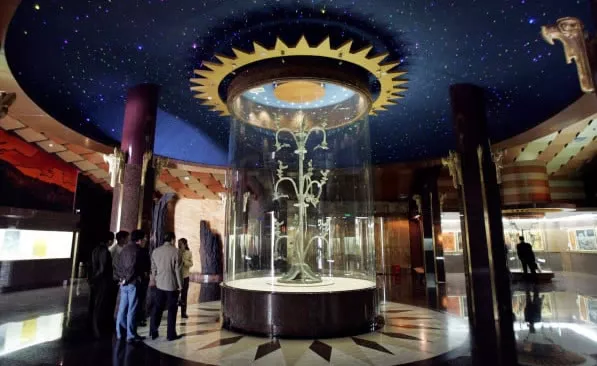
A wealth of ancient artifacts has been unearthed from the Sanxingdui site, including national treasures like bronze human figures, bronze sacred trees, bronze masks with bulging eyes, gold scepters, jade artifacts, gold masks, and kneeling human figures. Scholars were amazed to find that many of these artifacts have inexplicable and close connections to the miraculous stories recorded in the "Shan Hai Jing" (Classic of Mountains and Seas). In other words, numerous bronze items from Sanxingdui align closely with narratives found in the "Shan Hai Jing." This remarkable coincidence has stunned the academic community, piqued the interest of researchers, and prompted a reevaluation of historical truths, leading to questions about theories such as evolution and atheism.
Although the "Shan Hai Jing" has traditionally been viewed as an ancient text filled with fantastical stories, researchers now believe that its content is very likely based on real events. The artifacts uncovered from Sanxingdui support this idea. In other words, these artifacts share striking similarities with the accounts in the "Shan Hai Jing."
One of the first links noted between the Sanxingdui artifacts and the "Shan Hai Jing" pertains to the spring deity "Ju Mang," who is said to govern all life. The text describes Ju Mang as having "a bird’s body and a human face, riding on two dragons," and notes that people would wear blue clothing to worship Ju Mang each spring. This custom has been documented since the Zhou Dynasty.
During the excavation at Sanxingdui, researchers found a bronze statue featuring a human head with a bird body near the third sacred tree. The unique and unusual patterns on its clothing differ entirely from those of the Xia and Shang civilizations, leading researchers to believe it bears resemblance to ancient imagery from Iran and Egypt.
The second artifact resembling the "Shan Hai Jing" is the "Fusang Tree" unearthed from Sanxingdui. The text mentions ten suns in the eastern sea that take turns illuminating the earth. While one sun oversees the land, the other nine suns, yet to take their turn, transform into golden crows resting on the Fusang Tree. This narrative eventually inspired the popular folk tale of "Hou Yi Shooting the Suns."
The bronze Fusang trees discovered at Sanxingdui stand four meters tall and are divided into three layers, with a divine bird perched on each of the nine branching tips. Researchers were captivated by the craftsmanship of the Fusang tree, and its resemblance to the description in the "Shan Hai Jing" further amazed archaeologists.
The third artifact that researchers believe closely matches the "Shan Hai Jing" is the "bronze divine bird." Similar to the golden crows on the sacred tree, it is adorned with crown-like feathers and long tail feathers. Some birds have back feathers standing tall, and their simplistic design and abstract avian form closely resemble the "colorful bird" described in the "Shan Hai Jing," depicted with elaborate plumage. Such divine birds, akin to phoenixes, are seen as symbols of auspicious omens; their appearance signifies peace and tranquility, marking the origin of later phoenix legends.
The fourth artifact associated with the "Shan Hai Jing" is the "bulging-eyed mask," notable for its striking and unique shape and considerable weight.
Some scholars believe this mask was likely used in rituals. The bronze mask with bulging eyes embodies the image of the "Zhu Long" (Candle Dragon) described in the "Shan Hai Jing," which brings daylight by opening its eyes and night by closing them, with its breathing signifying the transition between winter and summer. The text uses the term "bulging eyes" to describe this deity.
Given that a growing amount of content from the "Shan Hai Jing" aligns with Sanxingdui culture, experts in folklore and religious studies assert that these astounding coincidences demonstrate that the "Shan Hai Jing" is not merely a compilation of myths and imaginations. Rather, it is a genuine exploration of ancient Chinese geography and ethnic culture. It appears that modern understanding is still quite limited.
Consequently, the academic community finds it increasingly difficult to accept the "Shan Hai Jing" as simply a collection of myths, as its records appear to be based on actual historical events.
Many researchers believe that among China's ancient cultural sites, few can match the mystery of Sanxingdui. Previous excavations have covered less than 20,000 square meters, yet this is only the tip of the iceberg of Sanxingdui culture, enough to challenge contemporary rigid perceptions of history.
Some argue that numerous archaeological findings throughout history have directly challenged the theory of evolution. Yet, these findings have become a taboo topic that proponents of evolution deliberately sideline. When Darwin proposed the theory of evolution, he was likely unsure because he recognized the theory's struggle to explain the intermediate processes of species evolution.
However, in modern society, these unverified hypotheses are often revered as doctrines, gaining prominence. Thus, it is emphasized that regarding the origins of humanity, there essentially exist two theories: creationism and evolution. With the emergence of the Sanxingdui culture, it is believed that humanity will soon discover the true source of its existence. This discovery will help further understand and validate that many myths from different ethnic groups were indeed based on real events.