The Enigmatic Wild Man of Shennongjia: Legends from the Classic of Mountains and Seas
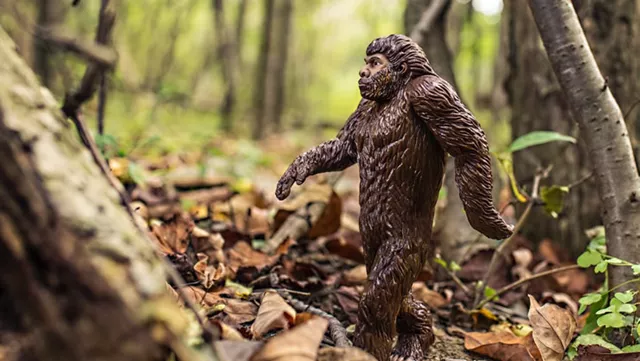
The Shennongjia region has long been entwined with legends of mysterious "wild men." Scientists have made numerous excursions into the area, uncovering hair, footprints, and feces attributed to these elusive creatures. Yet, to this day, none have been captured.
Much like North America's "Bigfoot" and Tibet's "Yeti," the Shennongjia "wild man" joins the ranks of the world's unsolved mysteries, drawing scientists, explorers, and tourists from across the globe to delve into the jungle in search of clues.
The Enduring Legend of the "Wild Man"
The "wild man" is described as an unverified species of upright-walking, intelligent higher primate, taller than apes. Internationally, similar humanoid creatures are known by various names: "Bigfoot" in the United States, "Yeti" in South Asia, and "Snowman" in Mongolia and the Caucasus region of Russia.
The Shennongjia "wild man" legend traces back to ancient times, with early references found in the "Shan Hai Jing" (Classic of Mountains and Seas) from the Warring States period (4th to 5th century BC). This text describes a creature about ten feet tall, hairy with long hair, swift in its movements, and known for its laughter. It was called the "Gan Giant" or "Xiao Yang," and "Baboon." The renowned Warring States poet Qu Yuan also wrote about it in his poem "Mountain Ghost" in "Chuci, Jiu Ge," describing the "wild man" as a human-like creature perched on mountain ridges, decked in vines, suspicious yet smiling. Local records from Hubei's Xunyang Prefecture during the Qing Dynasty mention Fangshan as being inhabited by these hairy beings, who would often come down to assault chickens and dogs. Resistant individuals were reportedly seized and attacked, with bullets proving ineffective against them. Fangshan corresponds to the Fang County region in what is now the mountainous northern area of Shennongjia.
Despite these ancient accounts, the "wild man" was thought to be purely mythical until May 1976, when reports surfaced of a "red-haired monster" near Chunshuyah in the Shennongjia forest, at an altitude of 1,700 meters, drawing widespread media attention.
In 1977, a scientific expedition consisting of over 100 experts from fields like paleoanthropology, botany, zoology, and geology embarked on a major investigation in Shennongjia, surveying approximately 1,500 square kilometers. They found "wild man" footprints ranging from 21 to 48 centimeters in length and collected samples of hair and feces. They also discovered nests made from arrow bamboo, suitable for sitting or lying down. Despite subsequent scientific efforts, capturing a "wild man" remains unrealized.
Is the "Wild Man" a Mere Myth?
Investigations into the "wild man" have gathered numerous eyewitness accounts and considerable physical evidence and clues. However, meticulous examinations often reveal that most reported sightings are misidentifications of known animals. Could the legendary stories of the "wild man" simply be human creations?
In 1956, 12-year-old Wang Congmei was walking home when a humanoid creature suddenly attacked her, prompting her to scream in alarm. Her mother, Xu Fudi, rushed over with a manure hook and, with the help of a gathering crowd, they killed the creature and preserved its limbs, believing it to be a "wild man." In 1980, these remains were rediscovered in a storage room of a middle school and later analyzed by researcher Zhou Guoxing, who found them to belong to a modern species of short-tailed monkey, averaging 1.2 meters in height.
A researcher from the Institute of Vertebrate Paleontology and Paleoanthropology at the Chinese Academy of Sciences noted, "Encountering an unknown animal can be an exhilarating experience. For those with limited zoological knowledge and field experience, especially if they've heard tales of the 'wild man,' it's easy to mistake any hairy, upright figure for such a creature during an adrenaline-charged moment."
In another case, a local Shennongjia expert brought a foot specimen to Beijing. It had five toes, no claws, and sparse yellowish hair. Initially speculated to belong to a "wild man," X-ray analysis and comparison with a bear skeleton eventually identified it as a bear paw. Over time, its claws had been artificially removed, and its hair loss and color changes made identification challenging.
The researcher commented, "Years of fieldwork have shown me that so-called unidentified evidence often turns out to be normal animal fur, bear tracks, or human footprints in muddy paths. To date, none of the 'wild man' sightings have been reported by professional zoologists, which calls their credibility into question."
Is the Existence of the "Wild Man" Possible?
Zoological, ecological, genetic, and paleobiological principles suggest the existence of such an unknown animal is improbable. A species needs a certain population size and genetic diversity to survive.
Many assume that a single male and female pair can sustain a species. However, in reality, higher animal species cannot survive with just one pair or even a few dozen individuals. Small populations face the risk of inbreeding, which leads to weaker offspring and eventual genetic decline, resulting in extinction. To avoid inbreeding and ensure genetic health, a population typically needs several hundred individuals. If hundreds of "wild men" did exist in Shennongjia, they would likely be more easily found.
Nevertheless, some argue: "How small can a population be before it cannot sustain itself? Is our inability to find more individuals due to their rarity or our discovery limitations? Similar to the realization with giant pandas, we initially found only a few but now have located thousands. It's challenging to determine how many 'wild men' truly exist, as their presence is fleeting and hard to quantify."
Does the "Wild Man" Have an 85% Chance of Existing?
While some paleoanthropologists are skeptical of the "wild man's" existence, attributing sightings to misidentifications, the former director of the Zhoukoudian Museum is convinced the "wild man" is real, claiming an 85% probability of its existence in a media interview.
He pointed out that hair samples attributed to the "wild man," when examined under an electron microscope, displayed keratin scale patterns resembling a herringbone design typical of primate hair. The hair's cross-sectional analysis showed it to be thicker, with small water cavities and uneven pigment granule distribution, unlike any known animal hair. Protein analysis also aligned with primate hair characteristics.
Thousands of "wild man" hair samples from various scientific expeditions have been sent to research institutions in Beijing, Shanghai, and Wuhan for analysis. Results consistently show that the hair is more advanced than that of modern orangutans, gorillas, chimpanzees, and gibbons.