Illiterate Rapper Who Memorizes Thousands of Lines of Poetry
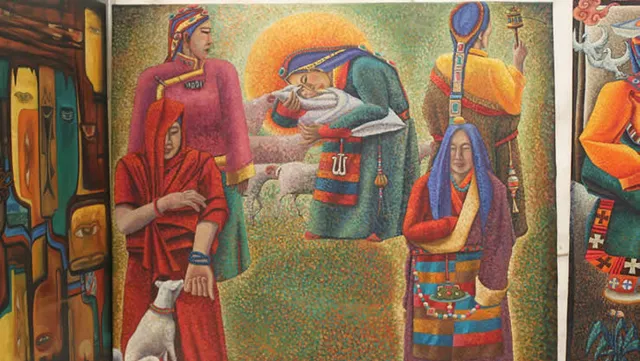
Mystical Props
In Jiangda County, Changdu, there is an artist named Zhabasen Ge who is known for holding a piece of paper while performing. Interestingly, despite being illiterate, he sometimes holds nothing more than a blank sheet of paper. Yet, as long as he symbolically holds it, he seems to be able to "see" and understand the words, which allows him to recite and sing at length. Other performers use magical hats, introducing their unique shapes and meanings before wearing them. These hats seem to possess a mystical quality, for once donned, stories appear in their minds, and they begin their official performances.
What are merely props to us—blank paper or hats—may hold magical significance to these artists, possibly akin to a fairy's wand imbued with supernatural powers.
Another performer uses a copper mirror. In the Lhünzhub area of Changdu, an artist named Kachazaba venerates this mirror. After making offerings of barley and blowing on it, he sprinkles it onto the mirror, where he claims to see reflected images and text. From this mirror, he has transcribed 11 volumes of the "Epic of Gesar," one of which, titled "Diga'er," has been published by Tibet People's Publishing House, split into two parts.
Inspiration from Dreams
Storyteller Zhaba, born in 1905, passed away in 1986 at the age of 81. At just eight years old, in 1913, Zhaba vanished for seven days. His parents, fearing the worst, requested a lama to chant prayers for his soul. Unexpectedly, they found him sleeping behind a large rock near their home. He was covered in dirt, yawning persistently, and unaware that seven days had passed. He later recounted that it felt like a dream, in which General Danma under Gesar opened his belly, replaced his organs with a book containing the epic. From then on, he, who had never attended school, began to fluently recite verses from the "Epic of Gesar."
Initially, villagers dismissed his recitations as childish babble, assuming he was mad. However, some noticed similarities to Gesar's tales. After three days with no improvement, his father took him to nearby Benba Monastery for guidance. A high lama, Benba Rinpoche, had foreseen a visitor and had his disciples keep the temple doors open. Upon meeting Zhaba, Rinpoche reassured his father, saying, "You can go home with peace of mind; the child is fine. Let him stay here for a few days." Rinpoche then bathed Zhaba in a large copper pot of water and milk, proceeding to chant prayers. This ritual was repeated over three days, helping Zhaba regain composure over his recitations. Soon after, a Tibetan lama visiting post-pilgrimage advised Zhaba's mother on raising him to be protected and pure, saying, "Your son will be more precious than a golden house."
After his monastic visit, Zhaba had changed. He began singing Gesar stories effortlessly, as though he had known them all along. The villagers were amazed by his performances, and he gained widespread praise. From then on, Zhaba established a lifelong career reciting the "Epic of Gesar," capable of confidently reciting tens of thousands of words wherever he went, even amid the upheavals after 1949.
Similarly, storyteller Yumei recalled a pivotal event in her 16th year. While herding yaks with her friend Tsirenji, she fell asleep and dreamt of two large lakes, one black and one white. A red-faced monster emerged from the black lake to drag her in, but a beautiful fairy from the white lake saved her. The fairy declared Yumei belonged to Gesar's people and promised to teach her the epic so she could share it with the Tibetan people. A young man from the white lake then emerged, bathed her, gifted her jewels, and instructed her to go home. A divine eagle transported her to a sky burial platform, where it took a piece of her flesh as an offering. Pain awoke her and, upon returning home, she exhibited similar behavior to Zhaba—mumbling and dazed— until a lama's prayer restored her. Once recovered, she began reciting the "Epic of Gesar."
Another storyteller, Sangzhu, experienced something similar at 11 while herding in northern Tibetan mountains. Seeking shelter from rain in a cave, he dozed off and dreamt of a battle where King Gesar saved him. This marked the start of his disorientation. Brought to Zhonghu Monastery, the master Lidan helped him recover. One night, Sangzhu dreamt of reading the epic, consuming volumes with interest, leaving him able to perform them clearly and vividly upon waking.
Finally, storyteller Tsiren Zhandui from Shenzha County also received inspiration from dreams. At 13, he dreamt of a victorious Gesar, awakening three days later to recite the epic. Even at nine, post losing his mother, he had been mischievous but dreamt of a lama asking if he'd want to recite the epic or manage a monastery. His instinctual reply to sing the epic came true, as he continued dreaming of Gesar until he could perform the tales by 13. His abilities quickly became popular, cherished by local herders.
During performances, Tsiren Zhandui appears half-immersed, partially closing his eyes to focus entirely on his recitations. He can perform 63 volumes of the "Epic of Gesar," delivering the story in poetry. Each volume starts with 4 to 8 poetic lines summarizing the plot. He attributes his storytelling spirit to remaining pure, avoiding impure meat, and keeping away from physical harm, ensuring unobstructed meridians that allow this gift to flow through him, enabling the effortless delivery of poetic narratives.
The art of storytelling the "Epic of Gesar" is not passed down through traditional teaching methods like master-disciple or familial ties; it's believed to stem from "fate" and the presence of "divine beings." The appearance of successive generations of storytellers relates to the reincarnation of Gesar figures, enabling the seamless recital of thousands of words of legend.
Treasure Troves
There exists another method of acquiring storytelling prowess known as "treasure troves." This method, said to have been pioneered by Guru Padmasambhava, involves concealing teachings for future discovery by those destined to find them. When the time comes, these individuals are guided to locations like lakes, rocks, or caves to unearth these treasures. Although on the surface they might retrieve just a few words, these words reveal the entirety of certain scriptures to them. Some storytellers are believed to have received the "Epic of Gesar" in this manner. These artists are sometimes called treasure diggers. An artist named Gerijianzan from Guoluo, Qinghai, experienced inspiration in darkness, leading him to write the epic. Local experts commend his work, and he claims he can produce 120 volumes; by the time he was interviewed, he had already completed over 30.
Not only is King Gesar legendary, but the descendants who narrate his stories also lead lives full of legend. Perhaps it's due to the unpredictable, divine assistance they receive that the "Epic of Gesar" has been preserved and shared for thousands of years, enduring as a cultural treasure.