Unveiling the Mystery: Sweden's Ghost Fire and Its Enigmatic Aura
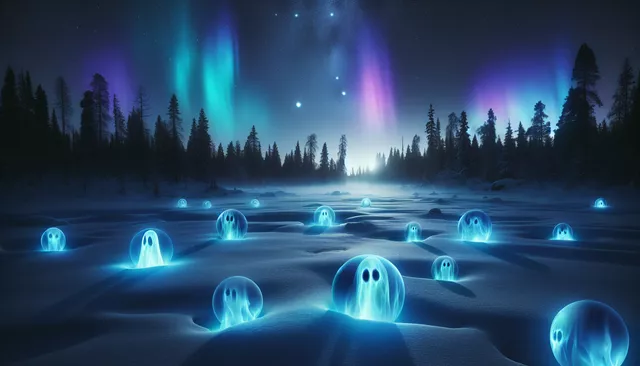
I am standing in the pitch-black Swedish forest, surrounded by the gentle rustling of pines and the playful movements of squirrels. Before me unfolds a mysterious and extraordinary phenomenon. The faint light in the night sky is unlike typical moonlight or starlight; it flickers in and out, like the twinkling of fairies, as if signaling from another world. Though dark and enigmatic, it has a unique poetic beauty.
This is the phenomenon known as the "will-o'-the-wisp," celebrated as the "Waltz of the Goddess of Night," a captivating sight deeply rooted in Nordic mythology, legends, and poetry.
The name "will-o'-the-wisp" has misled many, especially those who firmly believe in the supernatural forces behind it. They recount each will-o'-the-wisp's story as if narrating an epic. However, scientific facts reveal that these lights are a natural occurrence known as "eternal lights."
The origin of this light stems from specific nighttime climatic conditions, where methane and phosphine rise from the ground and interact with electromagnetic fields in the air, resulting in that mysterious flickering light. The emergence of this faint glow is so ghostly and dazzling that it inevitably inspires deep contemplation.
Once, on a cold winter night, I ventured deep into the forest with a local guide, searching for the elusive will-o'-the-wisps. The landscape was breathtaking, with silver branches intertwining and casting an ivory hue under the moonlight. Suddenly, we noticed a gentle glow coming from a thicket. The light shimmered like a reflection in a deep well, profound and mysterious, as if it had journeyed through the depths of time. We couldn't help but hold our breath, afraid to disrupt the tranquility of this rare treasure.
To me, and my soul, that light was like a flame burning in the cold winter night—both ethereal and warm, evoking stories told through the golden tongues of ancient Nordic myths. The brilliant glow of the will-o'-the-wisp evokes a sense of wandering through the vast, endless forests of Scandinavia.
However, the beauty of these will-o'-the-wisps also serves as a warning of an impending crisis. While methane and phosphine are common elements in nature, their excessive presence signals environmental anomalies on Earth. Their increase often heralds painful changes in the planet's environment. Unfortunately, people frequently focus only on the beauty they bring to the night, overlooking the environmental warnings they signify.
I believe that the will-o'-the-wisp phenomenon in Sweden leaves a lasting impression worldwide. Although these natural night lights collectively create an unparalleled realm of light and shadow, we must not ignore the environmental messages they convey.
This is the truth about the will-o'-the-wisp phenomenon in Sweden. It reveals both the charm of nature and the environmental challenges humanity must face. Only by standing at the intersection of nature and culture, and by extending our perspective from Sweden's Arctic Circle to the corners of the world, can we truly understand how this beautiful yet fragile world operates and how each of us can contribute to preserving this beauty.