The Messenger of Death: Are Crow Omens Real or Just Superstitions?
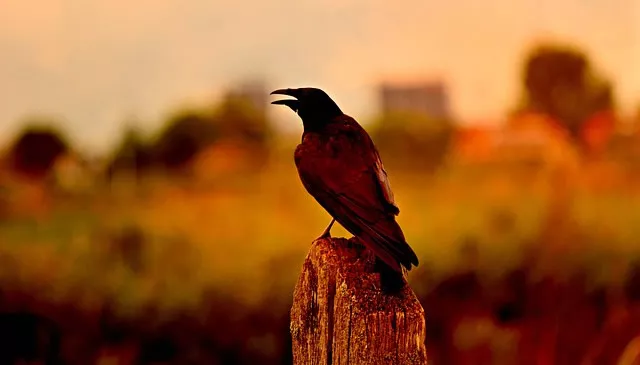
Image source: Pixabay
The crow, a common bird, holds a unique and mysterious significance in cultures and legends worldwide. From being Odin's messenger in Norse mythology to a harbinger of death in Eastern cultures, crows carry diverse symbolic meanings. Are they truly messengers of fate, or merely products of human superstition? Let's journey through time and cultures to uncover the truth behind the omens of crows.
I. The Symbolism of Crows in Various Cultures
1. Messengers of Wisdom in Norse Mythology
In Norse mythology, crows symbolize wisdom. Odin, the chief god, has two crows named "Thought" (Huginn) and "Memory" (Muninn), who fly around the world each day, reporting back to their master.
Case Study: Odin's crows not only serve as his eyes and ears but also symbolize the extension of human wisdom. Here, crows are not associated with darkness; instead, they represent wisdom and insight.
2. Harbingers of Death in Eastern Cultures
In Eastern cultures, crows are often seen as ominous signs and considered messengers of the dead. Ancient Chinese literature frequently highlights the connection between crows and death. For instance, in "Strange Stories from a Chinese Studio," the appearance of crows often foretells someone's end.
Case Study: In Pu Songling's writings, crows exude mystery and terror. Their appearances consistently coincide with death and disaster, creating the classic image of messengers of the dead.
3. Symbols of Death in Western Cultures
In Western cultures, crows are similarly regarded as symbols of death and misfortune. Edgar Allan Poe's famous poem "The Raven" depicts the crow as an emblem of death and despair, evoking a chilling response.
Case Study: In this poem, the raven repeatedly says "Nevermore," symbolizing endless sorrow and loss. The crow is closely linked to death and despair, becoming a classic literary symbol of death.
II. Scientific Explanations for Crow Omens
1. The Intelligence and Adaptability of Crows
Crows are considered highly intelligent birds with great adaptability and learning capabilities. They can use tools, solve complex puzzles, and even display social organization.
Terminology Explanation:
- Adaptability: The ability of organisms to adjust in response to environmental changes to survive under new conditions.
- Social Organization: Cooperation and division of labor within a group to maintain survival and reproduction.
Case Study: Scientific research reveals that crows demonstrate complex social behaviors and communication skills. For example, they warn each other of danger and can recognize and remember human faces, attributing to their mysterious significance.
2. The Connection Between Crows and Death
Crows are often perceived as omens of death, likely due to their ecological habits. As scavengers, they frequent areas like battlefields and graveyards, which associate them with death.
Case Study: Crows’ scavenging behavior brings them to places where death has occurred, such as battlefields or cemeteries. This naturally leads people to associate them with death, fostering the image of "messengers of the dead."
III. The Interplay of Culture and Superstition
1. Omens from a Psychological Perspective
Psychologically, human fear and superstition regarding crows may stem from protective mechanisms developed through evolution. In the face of the unknown and death, humans tend to seek explanations, and crows, as prominent visual symbols, easily acquire supernatural meanings.
Case Study: The "Barnum Effect," a psychological phenomenon, refers to people's tendency to believe that vague, general statements describe their personal circumstances accurately. Crows as omens of death exemplify this effect, where vague fears manifest in the form of crows.
2. The Influence of History and Legends
The image of crows as omens has been reinforced through history and legend. Ancient tales, literary works, and religious texts collectively shape the mysterious image of crows, making them symbols of misfortune.
Case Study: In many historical events, crows' appearances signaled impending disaster. During England's Great Plague, the abundant presence of crows caused widespread panic among local residents.
IV. Modern Science and Crow Research
1. Ecological and Behavioral Studies of Crows
Modern scientific research on crows has unveiled their complex ecological behaviors and social structures. The intelligence and adaptability of crows afford them a significant role in the natural world.
Case Study: Crows can use tools to obtain food, a behavior rarely observed among birds. For instance, crows in the Kalahari Desert employ sticks to extract insects from tree holes.
2. The Language and Communication of Crows
Crows are not only intelligent but also possess a sophisticated communication system. They use various calls, body language, and behavioral signals, and can even mimic sounds made by other animals.
Case Study: Scientists have discovered that crow calls convey different meanings, serving purposes like warnings, courtship, and territorial declarations. For example, a crow's "warning call" alerts companions to avoid danger.
V. Modern Interpretations of Crow Omens
1. Cultural Heritage and Modern Interpretations
Crows as symbols of omens are part of our cultural heritage and continue as a form of superstition in modern society. While modern science sheds light on their ecology and behavior, the mysterious nature of their symbolism remains.
Case Study: In films, literature, and art, crows persist as symbols of mystery and misfortune. For example, in the film "The Crow," the protagonist uses the crow as a representation of revenge and death.
2. Balancing Superstition and Science
How can we balance superstition and science? Understanding the ecology and behavior of crows while respecting their symbolic place in culture is an important step toward scientific rationality.
Case Study: Through scientific education and outreach, we can dispel superstitions about crows and appreciate their ecological value and behavioral traits. Activities like crow conservation and public scientific education are essential.
VI. Conclusion: The Dual Nature of the Messenger of the Dead
Crows, known as the "messengers of the dead," are part of both culture and history, and intrinsic to the natural ecosystem. Their intelligence and adaptability grant them crucial roles in nature, while their mysterious symbolism persists in literature and legends.
As the ancients said: "Act with insight and seize opportunity." Whether crow omens are real or products of superstition, they remind us to maintain keen observation and rational thought between nature and culture. Facing the unknown and fear, a dual perspective of science and culture helps us find balance, understanding nature while respecting cultural diversity.
Let us continue exploring the incredible world of nature and culture with this dual perspective, uncovering the truth behind crow omens and embracing a future rich in science and culture.