The Complete Guide to Tarot Spreads: The Seven-Planet Divination Method
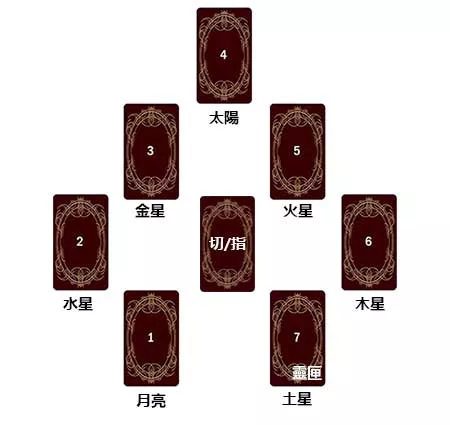
The so-called Seven-Planet Divination Method draws on the seven classical planets in medieval astrology: the Moon, Saturn, Venus, the Sun, Mars, Jupiter, and Mercury. It uses the life areas governed by these seven planets to read different facets of a person’s situation.
The Seven-Planet Divination Method is somewhat similar to the Fate Divination Method in that both use seven cards, but they address different concerns. The Fate Divination Method focuses specifically on love, while the Seven-Planet method evaluates a person’s current circumstances across multiple areas, making it a more general diagnostic reading.
I. Scope of Application
When you need a comprehensive analysis of a situation and insights from different angles, choose the Seven-Planet spread. It’s designed to clarify the nature of a specific issue or to provide a holistic assessment across several aspects of a problem. Note that this spread can be challenging: the planetary meanings are broad, and beginners may find interpretation difficult. In addition, the relationships among the planets aren’t intuitive for most people, so this spread is best for those with some background in astrology.
II. Card Layout
- After shuffling and cutting, hold the deck in your left hand and fan the cards face down. Note: the end you hold should be the end that was just cut, with card faces down.
- Ask the querent to randomly select seven cards and place them in positions 1 through 7 as shown in the diagram.
- Turn the cards face up and begin the reading.
III. Card Position Meanings
Each of the seven cards corresponds to a planet.
- The Moon represents family influences and a sense of security.
- Mercury represents business and trade, as well as communication and interactions with others.
- Venus signifies finances and interpersonal relationships, and also reflects a person’s emotional life.
- The Sun represents status and recognition, and relates to personal self-expression.
- Mars indicates challenges and conflict, and also relates to one’s capacity for action.
- Jupiter represents opportunities and luck, and is associated with long-term goals.
- Saturn signifies responsibility and limitations, and is also connected to health concerns.
The cut card, located at the center of the spread, represents the querent’s subjective thoughts. If an indicator card is used, it reflects the querent’s characteristics.
IV. Order of Interpretation
When interpreting, first assess how the cut card or indicator card influences the entire spread. Next, determine which position is most strongly affected. Then read the cards in this sequence: Moon, Mercury, Venus, Sun, Mars, Jupiter, and Saturn. Finally, synthesize all information to offer guidance to the querent.
V. Precautions
The seven planets in this spread correspond to different areas of life, but they won’t carry equal weight in every divination. If the querent’s question emphasizes a particular area, the card representing that area becomes more important. For example, for family matters, place greater emphasis on the Moon; for communication issues, focus on Mercury.
Moreover, the cut card or indicator card influences every position, and the seven positions also affect one another. The strength of those influences ultimately depends on the querent’s specific question and which card most directly relates to it.