Complete Guide to Tarot Spreads - Hexagram Divination Method
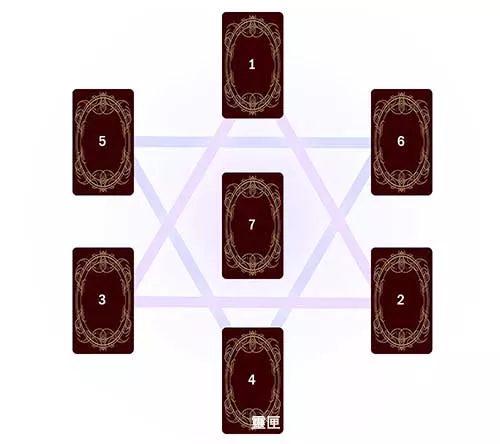
The Star of David—also known as the Shield of David or Solomon’s Seal—is said to have originated in Indian mystical traditions and was later introduced to the West by the Spanish. Beyond its use in Western witchcraft, it appears more broadly in Western astrology and Tarot. When the Star of David is broken down, the upright triangle symbolizes the masculine, while the inverted triangle represents the feminine, expressing harmony through the union of these two polarities.
In Western witchcraft, practitioners draw the Star of David under a full moon and place candles at each of its six points. Standing at the center, they pray for blessings, protection from disaster, and relief from misfortune and pain. It is considered especially effective for accelerating romantic opportunities or promoting career success.
In Western astrology, the Star of David places heaven (masculine) at the top point and earth (feminine) at the bottom, while the other four points correspond to the air, earth, water, and fire signs, reflecting themes of the past, future, power, and love.
In Tarot, the Star of David spread can be used to resolve inner doubts. If you want to understand the background of a problem and how the surrounding environment may help or hinder it, this divination method is especially suitable.
I. Applicable Areas
- Love and Marriage: ★★★☆☆
- Work and Study: ★★★★★
- Investment and Finance: ★★★★★
- Interpersonal Relationships: ★★★☆☆
- Other: ★★★☆☆
II. Card Layout
This spread can be used with the 22 Major Arcana, the 56 Minor Arcana, or the full 78-card Tarot deck.
III. Layout Method
Using 22 Major Arcana Cards
- Perform your usual shuffle and cut, then count down to the seventh card from the top and place it in position "1" as shown. Next, draw the eighth and ninth cards and place them in positions "2" and "3".
- Set aside the counted cards; they will not be used again. After placing the first three cards, count down from the remaining cards to draw the seventh, eighth, ninth, and tenth cards, placing them in positions "4", "5", "6", and "7".
Using 56 Minor Arcana Cards or 78 Tarot Cards
- From the top of the deck, count to the seventh card and place it in position "1" as shown; then set the counted cards aside. From the remaining cards, count down to the seventh card and place it in position "2". Repeat this step to draw and place the other cards in positions "3" through "7".
- Alternatively, after shuffling and cutting the cards, fan the deck in an arc, allowing the querent to randomly draw seven cards, which the reader will then place in positions "1" through "7".
Card Interpretation Order:
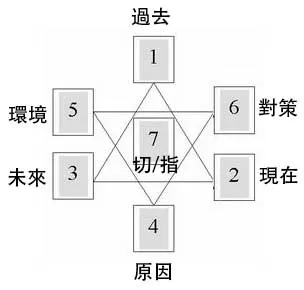
When interpreting the cards, first evaluate the seventh card (cut card or indicator card) to gauge its influence on the entire layout. After this assessment, begin with the fourth card (cause), followed by the first card (past), second card (present), fifth card (environment), third card (future), and sixth card (strategy). After completing all interpretations, synthesize the information and their interrelationships to provide guidance to the querent.
IV. Card Position Meanings
- Past: What has already occurred and the factors that led to the current situation.
- Present: The current situation.
- Future: The stage the situation is developing toward.
- Cause: The reasons behind the situation.
- Environment: The environmental factors influencing the situation.
- Strategy: The methods for dealing with the situation.
- Cut Card or Indicator Card: If a cut card is used, it represents the querent's subjective thoughts; if an indicator card is used, it reflects the querent's characteristics.