Three Key Elements in Facial Analysis

Physiognomy is the practice of interpreting a person's character or fate by examining their facial features. Many have heard the saying, "the face reflects the heart," meaning that a person's character, thoughts, and moral standing can be discerned from their facial features.
Appearance is thought to hint at good or bad fortune. Generally, kind‑hearted people tend to look benevolent, while those with malicious intent may appear more severe. However, the reverse can also be true. There is a saying, "a kind face with an evil heart," referring to someone who seems gentle but is actually wicked; conversely, "an evil face with a kind heart" describes someone who looks stern but is genuinely good. In short, reading facial features takes expertise and is not straightforward. Some sensitive individuals may intuitively sense certain traits, but a fuller assessment of a person's fortune still calls for professional astrological analysis.
There are many approaches to facial analysis. The most important features are the Five Features, the Three Divisions, and the Twelve Palaces, which are introduced below.
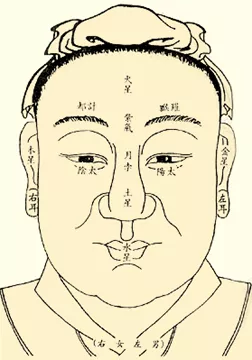
1. Five Features
People often ask, "What are that person's Five Features like?" but many may not clearly understand what the Five Features are. In physiognomy, they are the five facial organs: ears, eyebrows, eyes, nose, and mouth. Each is given a specific honorific title:
- Ears: called the "Listening Official."
- Eyebrows: called the "Longevity Official."
- Eyes: called the "Monitoring Official."
- Nose: called the "Discerning Official."
- Mouth: called the "Receiving and Disbursing Official."
By analyzing these Five Features, one can make basic assessments about a person's fate and fortune. Broadly speaking, the eyebrows relate to health and status; the eyes reflect willpower and kindness; the nose pertains to wealth and health; the mouth is associated with happiness, sustenance, and benefactors; and the ears are linked to longevity.
2. Three Divisions
Besides the Five Features, physiognomy also uses the concept of the Three Divisions, as shown below:
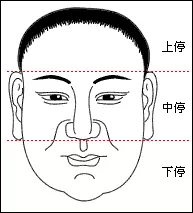
- Upper Division: The area from the hairline to the eyebrows. It governs youthful fortune, roughly ages 15 to 30.
- Middle Division: The area from the eyebrows to the tip of the nose. It governs fortune in middle age, roughly ages 31 to 50.
- Lower Division: The area from the nose to the chin. It governs fortune in later years, from about age 51 onward. In general, if the Upper Division is high, long, and full, it suggests high status. If the Middle Division is plump and well‑defined, it points to wealth and longevity. If the Lower Division is full, upright, and substantial, it indicates a blessed later life. In addition, the ear region is associated with youthful fortune, so well‑formed ears are considered beneficial in youth.
3. Twelve Palaces
Beyond the Five Features and Three Divisions, another key framework is the Twelve Palaces of physiognomy, shown below:
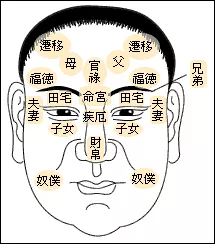
- Life Palace: Located between the eyebrows at the Yintang area. It influences a person's overall fortune.
- Wealth Palace: Located at the tip of the nose. It relates to wealth and financial luck.
- Sibling Palace: Represented by the eyebrows. It relates to the fortunes of sibling relationships.
- Spouse Palace: Located at the outer corners of the eyes. It relates to marital fortune.
- Children's Palace: Located on the raised area of the lower eyelids. It indicates whether children will be successful and whether there will be descendants.
- Sickness Palace: Located between the eyes in the Shangen area. It relates to health.
- Migration Palace: Located at the ends of the forehead at eyebrow level. It indicates fortunes related to movement, relocation, and travel.
- Servant Palace: Located on the lower cheeks. It relates to friendships and relationships with subordinates.
- Official Palace: Located at the center of the forehead. It relates to career, official posts, and academic prospects.
- Property Palace: Located on the eyelids between the eyebrows and eyes. It relates to a person's family fortunes.
- Fortune Palace: Located above the eyebrows, slightly outward. It relates to financial blessings and luck.
- Parents Palace: The father's position is slightly above the center of the left forehead, and the mother's is slightly above the center of the right forehead. It relates to one's relationship with parents.
By analyzing the Twelve Palaces, one can infer different aspects of fortune throughout a person's life. For example, to understand sibling ties, look to the Sibling Palace; to gauge career development, examine the Official Palace; to explore love and marriage, check the Spouse Palace, and so on.