Six Offices, Three Talents, Three Stops, Four Academies, Eight Academies - "The Divine Mirror of Ma Yi" Series Serialization (Part Six)
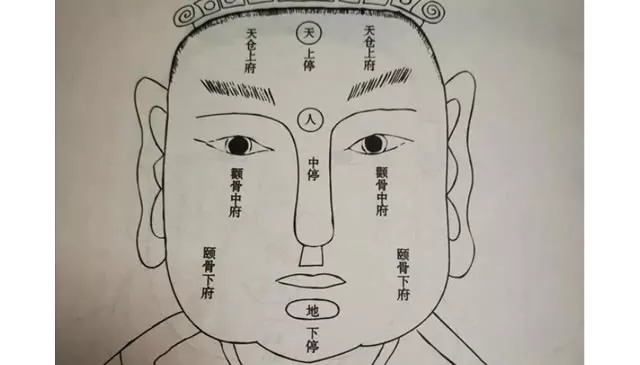
Six Palaces, Three Talents, Three Parts
The Six Palaces refer to the two zygomatic bones, two maxillae, and two mandibles. These should be full and robust, supporting each other seamlessly without any hollows or flaws. According to the "Secret of the Spirit Platform," the upper two palaces extend from the zygomatic angles to the celestial vault. The middle two palaces stretch from the life gate to the tiger's ears, and the lower two palaces extend from the mandibles to the earth platform. Having full and flawless Six Palaces symbolizes abundant wealth. A prominent forehead signifies great fortune, while a well-defined earth platform suggests vast opportunities; any shortcomings are considered unfavorable. The Three Talents consist of the forehead, nose, and chin. The forehead represents heaven and should be broad and rounded, described as "those with heaven are noble." The nose represents humanity and should be straight and symmetrical, described as "those with humanity have longevity." The chin represents earth and should be square and wide, indicating wealth and prosperity, known as "those with earth are wealthy." The Three Parts: from the hairline to the Yintang (third eye) is the upper part (representing early fortune), from the root of the nose to the tip is the middle part (representing middle fortune), and from the philtrum to the earth platform is the lower part (representing late fortune). It is said: if the upper part is long, youth will be fortunate; if the middle part is long, one will be as wealthy as a king; if the lower part is long, one will enjoy a fortunate old age. Those with equal Three Parts will achieve wealth and honor, while those with unequal Three Parts may face loneliness and poverty. A poem advises: "Examine the three parts on the face: the forehead should be high, and the ears wide. If the three parts do not meet these standards, academic pursuits will not lead to success."
Translation:
The Six Palaces refer to the two zygomatic bones, two maxillae, and two mandibles, which should be full and robust, supporting each other without any depressions or imperfections. The "Secret of the Spirit Platform" outlines that the upper two palaces extend from the zygomatic angles to the celestial vault, the middle two palaces extend from the life gate to the tiger's ears, and the lower two palaces stretch from the mandibles to the earth platform. Those with full and flawless Six Palaces are thought to possess abundant wealth. A prominent forehead indicates great fortune, while a well-defined earth platform suggests expansive opportunities; any deficiencies are seen as inauspicious. The Three Talents comprising the forehead, nose, and chin hold specific meanings: the forehead, representing heaven, should be broad and rounded, thus "those with heaven are noble"; the nose, symbolizing humanity, should be straight and symmetrical, thus "those with humanity have longevity"; the chin, representing earth, should be square and wide, thus "those with earth are wealthy." The Three Parts are defined as follows: from the hairline to the Yintang (third eye) is the upper part (indicating early fortune), from the root of the nose to the tip is the middle part (indicating middle fortune), and from the philtrum to the earth platform is the lower part (indicating late fortune). A common saying goes: if the upper part is long, youth will be prosperous; if the middle part is long, one will possess kingly wealth; if the lower part is extensive, one will enjoy a fortunate old age. Equal Three Parts indicate wealth and honor, whereas unequal Three Parts suggest a likelihood of loneliness and poverty. A poem suggests: "Carefully observe the three parts on one's face: the forehead must be high, ears shall be wide. If these three don't meet the criteria, scholarly pursuits may not yield success."
Four Learning Halls
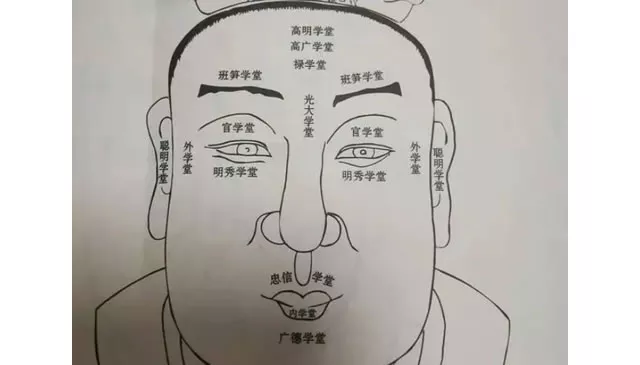
Firstly, the eyes represent the official learning hall; they should be long and clear, indicative of a position of authority. Secondly, the forehead represents the wealth learning hall; it should be broad and long, symbolizing both official status and longevity. Thirdly, the two front teeth represent the internal learning hall; they should be well-aligned and close together, signifying loyalty, trustworthiness, and filial piety. Sparse or small front teeth suggest arrogance. Lastly, the area in front of the ears represents the external learning hall; the ears should be full and shiny, denoting intelligence. Dull ears suggest foolishness and rudeness.
Translation:
Firstly, the eyes signify the official learning hall; they need to be long and clear, suggesting authority. Secondly, the forehead acts as the wealth learning hall; it should be broad and lengthy, indicating both official status and longevity. Thirdly, the two front teeth stand as the internal learning hall; they must be well-aligned and close together, pointing to loyalty, trustworthiness, and filial piety. Sparse or diminutive front teeth hint at arrogance. Lastly, the area in front of the ears functions as the external learning hall; the ears should be full and shiny, indicating intelligence; dullness there suggests foolishness and rudeness.
Eight Learning Halls
The first is the Hall of Brightness, referring to the head; it should be round or have prominent bones. The second is the Hall of Height and Width, referring to the forehead; it should be bright and moist with a prominent bone structure. The third is the Hall of Light and Grandeur, pertaining to the Yintang; it should be full and bright without any scars. The fourth is the Hall of Clarity and Elegance, concerning the eyes; they should be dark with abundant pupils, implying depth and insight. The fifth is the Hall of Intelligence, related to the ears; they should have defined contours and be silver-white or red-yellow. The sixth is the Hall of Loyalty and Trust, linked to the teeth; they should be well-aligned, close together, and as white as frost. The seventh is the Hall of Generosity, concerning the tongue; it should be long, red, and exhibit distinct lines. The eighth is the Hall of Eyebrows, connected to the eyebrows; they should be long, slender, and well-defined.
Translation:
The first aspect is the Hall of Brightness, referring to the head; it should be round or feature prominent bones. The second is the Hall of Height and Width, pertaining to the forehead; it should be bright, moist, and exhibit a prominent bone structure. The third is the Hall of Light and Grandeur, involving the Yintang; it must be full and bright, free of scars. The fourth is the Hall of Clarity and Elegance, relating to the eyes; they should be dark with plentiful pupils, suggesting depth and insight. The fifth aspect is the Hall of Intelligence, associated with the ears; these should possess well-defined contours and appear silver-white or red-yellow. The sixth is the Hall of Loyalty and Trust, tied to the teeth; they need to be well-aligned, closely set, and as white as frost. The seventh is the Hall of Generosity, dealing with the tongue; it ought to be long, red, and show distinct lines. The eighth is the Hall of Eyebrows, which pertains to the eyebrows; they should be long, slender, and well-defined.