Detailed Explanation of the "Mayi Shenxiang" Series: Five Stars and Six Days (Part Five) Serialization
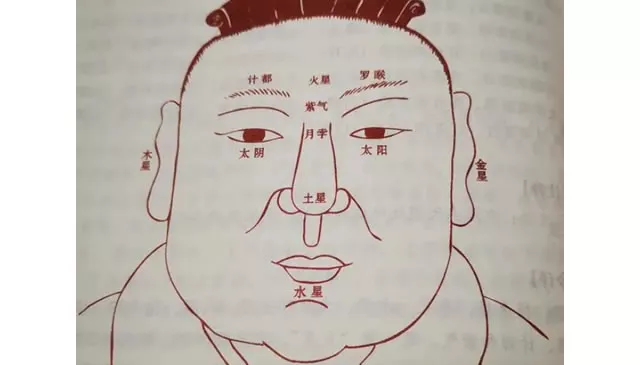
Five Stars and Six Auspicious Days
The Five Stars are Jupiter, Saturn, Mercury, Mars, and Venus. The Six Auspicious Days include the Sun, Moon, Lunar Node, Ketu, and the Purple Qi. Mars is linked with the forehead, which should ideally be square; a square forehead suggests a capability to achieve official positions. The Purple Qi is associated with the center of the forehead, which should be round and prominent, indicating a person fit for high office. Saturn corresponds to the nose, which should be substantial; a thick nose signifies longevity. Jupiter is linked with the right ear, which should be prominent, suggesting a person blessed with the Five Blessings. Venus is related to the left ear, which should be bright, indicating future official positions. The left eyebrow is connected to the Lunar Node, and it should be long, implying blessings in one's later years. Ketu associates with the right eyebrow, which should be neat, suggesting a favorable family life. The Moon pertains to the root of the nose, which should be straight, ensuring freedom from material worries. The right eye also relates to the Moon, where darkness indicates potential official roles. The left eye is connected to the Sun, with brightness suggesting wealth and blessings. Mercury is linked with the mouth, and a red hue indicates high-ranking positions.
Translation:
The Five Stars consist of Venus, Jupiter, Mercury, Mars, and Saturn. The Six Auspicious Days refer to the Sun, Moon, Lunar Node, Ketu, and Purple Qi. Mars is represented by the forehead, which should be square; this shape indicates potential for official roles. The center of the forehead, or "Purple Qi," should be round and prominent, suggesting capability for high office. Saturn signifies the nose, which should be thick for longevity. Jupiter relates to the right ear, which should be prominent, indicating Five Blessings. Venus ties to the left ear, which should be bright for obtaining official roles. The Lunar Node is linked with the left eyebrow, ideally long, indicating blessings in later life. Ketu is linked with the right eyebrow, advocating for neatness, implying a good family. The Moon corresponds to the root of the nose, best if straight, indicating no worries. The right eye tied to the Moon should be dark for potential official roles. The Sun corresponds to the left eye, which should be bright for wealth and blessings. Mercury signifies the mouth, and red suggests achieving high positions.
Poem on the Five Stars and Six Auspicious Days
Jupiter and Saturn are associated with the ears, valued for their clear contours. Red or white in color, regardless of size, ears that are wide, well-formed, and generally well-sized are favorable. Additionally, if they are higher than the eyebrows and eyes, whiteness like silver adds to their auspiciousness. Such individuals are blessed with Jupiter and Saturn, leading to early success. Narrow or uneven ears, or ears differing in size, can indicate a lack of these two stars, leading to property loss, financial troubles, and a lack of knowledge. The poem describes: "Jupiter and Saturn with clear contours indicate intelligence. Well-formed and upright, they align with auspicious signs, bringing wealth and honor anew." (Left ear) "Jupiter and Saturn blooming lead to poverty, misfortunes, and hardship. Even as a government official, one remains insignificant." (Right ear)
Translation: Jupiter and Saturn refer to the left and right ears, respectively. Their value lies in clear contours. Ear color may be red or white, varying in size; wide, well-formed ears, whether large or small, are favorable. Ears that are higher than the eyebrows are a sign of great fortune; those individuals will achieve success early. Protruding or uneven ears, lacking the two stars, indicate losses in property, financial troubles, and a lack of knowledge.
Summary of the poem: Ears should not be too close to the head; larger ear openings indicate intelligence. Blooming ears may lead to poverty. Narrow, pointed ears suggest a difficult life; even as an official, any position held will be minor.
Mercury relates to the mouth, known as the inner academy. It should have red lips, wide, with a deep philtrum, and straight teeth; this suggests being well-educated and able to attain official positions. Coarse lips and teeth, with drooping corners and a yellow hue, imply poverty. The poem states: "A four-character-shaped mouth, ruby red, with corners pointing up, indicates a talented scholar rising to high office at a young age." "If Mercury’s ends droop—thin and undefined—they resemble a beggar. A mouth slanted to one side suggests deceit and opportunism." (Mouth)
Translation: Mercury refers to the mouth, also called the inner academy. A wide, square mouth with red lips, a deep philtrum, and straight teeth indicates education and potential for official positions. Yellow, coarse, and shapeless lips with drooping corners signal poverty and low status.
Summary of the poem: A square mouth, resembling four characters, with red lips and distinct, upward corners, suggests intelligence and talent, leading to early success and high positions. Downward drooping corners, pointed and undefined, suggest poverty and a life spent begging. A slanted mouth indicates disputes and deceit.
Mars signifies the forehead. A broad forehead with a deep hairline suggests a person who will have wealth, sustenance, and many children; such individuals show talent and noble lineage. Born under Mars, they possess property and live to ninety-nine. A pointed, unattractive forehead with many lines signals Mars' fall, leading to lack of wealth, few children, and a difficult life, with no sibling support, resulting in the loss of spouse and property. The poem says: "The Mars palace broad and flat, smooth, with no lines, and three prominent lines like a river, will bring high positions in youth." "A narrow Mars palace leads to constant misfortune; chaotic lines suggest imprisonment, and red veins in the eyes indicate death by law in another state." (Forehead)
Translation: Mars signifies the forehead. A broad forehead with a deep hairline indicates wealth, sustenance, and many children; these individuals are talented and from noble backgrounds. Under Mars' influence, they possess property and live long. A narrow, unattractive forehead with lines signals Mars' decline, leading to poverty, few children, and no sibling support.
Summary of the poem: A smooth, line-free forehead suggests good fortune. Three prominent lines, resembling a river, predict significant youthful accomplishments. Narrow foreheads with lines suggest imprisonment, and red veins invading the eyes indicate legal troubles and potential death abroad.
Saturn represents the nose, which should have a full, thick tip, with nostrils not protruding; even and upright, suggesting wealth, longevity, and blessings from Saturn. A nose that's not straight, with a pointed tip and protruding nostrils, hints at Saturn’s decline, leading to poverty, few family assets, and a lack of integrity. The poem describes: "The Saturn nose is round, full like a cut tube, with large nostrils indicating high positions. Wisdom and talent bring fame and fortune." "A crooked Saturn nose means hardship; a pointed, thin tip implies loneliness and poverty. An eagle-beak nose suggests deceit and harm to others." (Nose)
Translation: Saturn relates to the nose, which should possess a full, thick tip, with non-protruding nostrils; it should be even and upright to indicate blessings, wealth, longevity, and fortune. A nose that isn't straight, with a pointed tip, hints at a decline of Saturn, leading to poverty, few assets, and low integrity.
Summary of the poem: A round, full nose with large nostrils suggests high status. Wise, talented individuals achieve fame and fortune. A crooked nose hints at hardship; a pointed, thin tip suggests loneliness and poverty. An eagle-beak-shaped nose implies deceit and harm to others.
Purple Qi Star centers on the forehead. This center should be clear and free from vertical lines, round like a pearl, indicating nobility. If white like silver, it signifies wealth; if yellow, it indicates basic necessities are covered. A narrow, uneven center, with hidden lines, is unfavorable, suggesting only two or three children, lack of strength, little fortune, and loss of property. The poem states: "A broad and round Purple Qi palace welcomes the emperor, indicating virtue." "A narrow, pointed Purple Qi palace, with a small chin and scant beard, lacks knowledge, leading to poverty and struggle." (Center of the forehead)
Translation: Purple Qi Star refers to the center of the forehead. It should be clear, vertical line-free, and round like a pearl, indicating nobility; white like silver denotes wealth; yellow indicates basic needs are covered. A narrow, uneven center with hidden lines is unfavorable, suggesting two or three children, decreased strength, little fortune, and property loss.
Summary of the poem: A broad, round center with a well-formed nose indicates wealth and high standing. A narrow, short center with scarce chin and beard signifies lack of knowledge and poverty.
The Moon and Sun represent the eyes, requiring a clear definition between black and white. Long and slender, reaching the temples, with more black than white and a bright sparkle, indicate Moon and Sun blessings, leading to success and noble kin. Excess white, or yellow and red hues, signal dual star decline, resulting in harm to parents, spouses, and children, many disasters, and a short life. The poem says: "The Sun and Moon, clearly distinct, vibrant and bright." (Sun) "This visage leads to high positions as a minister." (Left eye) "Slanted Sun and Moon, red veined pupils, and lack of spirit indicate a lonely life." (Moon) "Dull, dark Yin and Yang suggest death by knife; anticipate a short life." (Right eye)
Translation: The Moon and Sun represent the eyes, with clear black-and-white definition. Long and slender, reaching the temples, with more black than white and a bright sparkle, indicate blessings, success, and noble relations. More white than black, or yellow/red hues, suggest decline, leading to harm to loved ones, many disasters, and a short life.
Summary of the poem: Vibrant eyes with spirit indicate development and potential high positions. Slanted eyes, red vein penetration, and lack of spirit suggest a challenging life and potential untimely death.
The Lunar Node Star signifies the root of the nose. A broken, low root suggests Lunar Node influence, leading to descendant misfortune, numerous disasters, academic failures, property loss, and spouse/child harm. The poem claims: "The Moon should shine like glass, high and not low. If an official, you'll be a loyal minister, honored and successful." "A narrow, pointed Lunar Node palace results in family wealth loss and no career success." (Root of the nose)
Translation: The Lunar Node Star denotes the nose's root. Low and broken, it signals Lunar Node influence, leading to descendant misfortune, many disasters, failed studies, property loss, and spouse/child harm.
Summary of the poem: A high, clean, bright root like glass predicts loyalty, high positions, and a good spouse. A narrow, pointed root forebodes family wealth loss and career difficulties.
The Lunar Node and Ketu correspond to the eyebrows. Thick, black eyebrows extending to the temples signal wealth; children and parents will be noble, wealth will touch relatives, influenced by these stars. Connected, short, yellow-red eyebrows signal misfortune for children, possibly death. The poem illustrates: "The Lunar Node is elegant, long, well-defined near the three Yang." (Left Lunar Node) "Not only do they hold official roles, but kindness and reputation spread wide." "Sparse Lunar Node with high bones indicates impatience and love of violence." (Eyebrows) "Willow-like eyebrows suggest siblings may bear birthmarks." (Right Ketu)
Translation: The Lunar Node and Ketu relate to the eyebrows. Thick, black eyebrows extending to the temples indicate wealth; affluent children and parents, and wealthy relatives result from these stars. Connected, short, yellow-red eyebrows suggest children's misfortune, possibly death.
Summary of the poem: The left eyebrow should be elegant, long, and defined, near the three Yang; people like this hold roles of authority and spread kindness and reputation. Sparse left eyebrows and high bones imply impatience and tendency towards violence. Willow-like eyebrows suggest siblings with birthmarks.
Image source: Huai Gu San Ren