Jin Zizai's Secrets of Face Reading: The Twelve Palaces of the Face (Part 2)
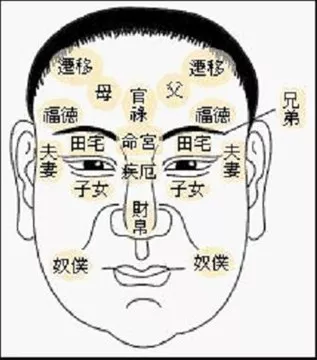
The Seventh House: The Spouse Palace
The Spouse Palace, also called the Couple Palace, is located at the outer corners of the eyes.
Basic interpretations—said to be evident at a glance:
First: If the area is smooth and unblemished, the spouse is said to embody all four virtues; if it looks full and well-fleshed, marriage brings prosperity.
Second: A deep indentation at the corner suggests multiple marriages; a mole at the corner warns to guard against extramarital affairs.
Third: Darkening at the corner points to separation; pronounced lines imply harm or difficulties affecting the spouse or family.
Question: People say one fish-tail line in the Couple Palace means one marriage, and two lines mean two marriages—is that true?
Answer: In the many classical texts I’ve read, I have not seen that claim. Fish-tail lines (crow’s-feet) are normal features, often seen in cheerful people.
A mole in the Couple Palace does not necessarily mean divorce. Question: If there is a mole in the Couple Palace, does it mean divorce is inevitable?
Answer: There is no such fixed rule. Traditional sayings about “harming the spouse” or “early divorce” speak broadly to marital misfortune. Divorce is just one expression; others include separation, long-distance situations, frequent arguments, or a partner in poor health.
The Eighth House: The Illness Palace
The location of the Illness Palace is debated: some place it at the root of the nose, others at the Longevity Point. As a practical guide, use the bridge of the nose as the main reference.
Basic interpretations—said to be evident at a glance:
First: A prominent, well-formed bridge indicates enduring good fortune and longevity; an unbroken line on the forehead suggests high scholarly achievement.
Second: A flat nasal root points to modest luck; a sunken Longevity Point suggests avoiding long journeys.
Third: Low, sunken lines indicate chronic illness; sharp, angular features suggest unavoidable suffering.
Question: Does a crooked nose indicate poor health?
Answer: A visibly crooked nose often corresponds to a curved spine; it isn’t, by itself, related to overall health. However, a nose with multiple bends may reflect a troubled conscience, which can lead to digestive issues.
Question: How does a crooked nose affect one’s career?
Answer: Everyone’s nose tilts slightly; here, “crooked” means a noticeable deviation. A crooked nose often indicates a tendency to evade responsibility, suggesting significant career ups and downs in middle age.
The Ninth House: The Migration Palace
Mai Yi says the Migration Palace is located at the outer ends of the eyebrows, known as the Heavenly Warehouse. Ancient physiognomists used this position to assess the state of a person’s yin and yang dwellings.
Basic interpretations—said to be evident at a glance:
First: A high, broad Horse position indicates official travel; a pronounced Horse bone suggests many benefactors.
Second: A narrow forehead with sunken bones indicates early separation from the mother; a low hairline suggests an inability to leave the family.
Third: A mole at the Horse position indicates travel-related misfortune; a horizontal line points to issues with ancestral graves.
It is best not to travel if the Horse position shows a poisonous mark. Question: What does a poisonous mark at the Horse position signify?
Answer: If the Horse position bears a poisonous mark or appears dark, it’s best to avoid travel, as many misfortunes may follow.
Question: Are there other areas related to feng shui?
Answer: The left and right mountain positions, as well as the Heavenly and Earthly Pavilions, are all related to feng shui.
The Tenth House: The Official Palace
Mai Yi says the Official Palace sits at the center and reflects one’s official career and prospects.
Basic interpretations—said to be evident at a glance:
First: A prominent, upright forehead suggests freedom from legal troubles; a sunken forehead indicates difficulty gaining recognition when seeking office.
Second: Broken lines or moles point to frequent unexpected troubles; a well-formed forehead corner suggests nearness to official recognition and fame.
Third: A smooth, flawless forehead indicates youthful renown; a well-balanced nasal root supports prosperity.
A person with a sunken forehead cannot achieve official status through normal means. Question: Does a sunken forehead mean one cannot hold office?
Answer: It doesn’t mean office is impossible, but it suggests one may not attain it through conventional pathways.
Question: If the Official Palace is strong but the eyes are poor, how is the official fortune?
Answer: Wealth is read from the nose, while nobility is seen in the eyes. If the Official Palace shows strong bone but the eyes lack nobility, it cannot be considered truly auspicious.
The Eleventh House: The Fortune Palace
Mai Yi says the Fortune Palace lies at the Heavenly Warehouse and connects with the Earth Pavilion. It reflects the fortune of blessings.
Basic interpretations—said to be evident at a glance:
First: A rounded Heaven and level Earth indicate abundant fortune and longevity; when the five mountains encircle harmoniously, blessings are complete.
Second: A high Heaven with a sunken Earth signals early misfortune; if both are sunken, resources are insufficient.
Third: A rounded Pavilion with a narrow forehead points to early hardship; a rounded forehead with a sharp Pavilion suggests difficulties in old age.
Question: Does the Fortune Palace refer to the Heavenly Warehouse and Earth Pavilion?
Answer: This is debated; generally, the Fortune Palace is viewed as the positions flanking the Official Palace.
Question: What does the Fortune Palace actually signify?
Answer: It represents innate luck, similar to the way full earlobes are said to indicate natural blessings.
The Twelfth House: The Parents Palace
The Parents Palace is located at the Sun and Moon corners of the forehead. It primarily reflects the fortunes and misfortunes of one’s parents.
Basic interpretations—said to be evident at a glance:
First: A high, rounded, and clear forehead indicates long-lived parents; a low, dark forehead suggests difficulties for both parents.
Second: A slanted Sun corner signals trouble for the father; a slanted Moon corner points to difficulties for the mother.
Third: A sharp, angular forehead indicates a lack of parental affection; high Sun and Moon corners suggest both parents are honored.
A head should show no inferior bones, and the forehead should not be uneven. Question: Besides the Sun and Moon corners, what other areas reflect the parents’ fortune?
Answer: In addition to the Sun and Moon corners, the eyebrows can also indicate the state of the parents. As the saying goes, “A high left eyebrow and low right eyebrow indicates the father passes first; a high left eyebrow and low right eyebrow indicates the father dies and the mother remarries.”
Question: If the Sun and Moon corners are high, round, and clear, is it better for them to be prominent or flat?
Answer: The skull should not show inferior bones, and features should not be uneven; unevenness points to early misfortune. A high, rounded, and clear forehead is favorable within the forehead region.
The interpretations of the twelve houses are essentially as outlined above. Each house can be elaborated in many ways that cannot be fully covered here. The key is to remember the main positions and then expand from there.
With this, the discussion of the five features and twelve houses is complete—foundational knowledge of physiognomy. The five mountains, four rivers, and the Four-Eight Academy will not be repeated, as many concepts overlap or are redefined for specific areas.