Chichen Itza: An Ancient Maya Pilgrimage Site
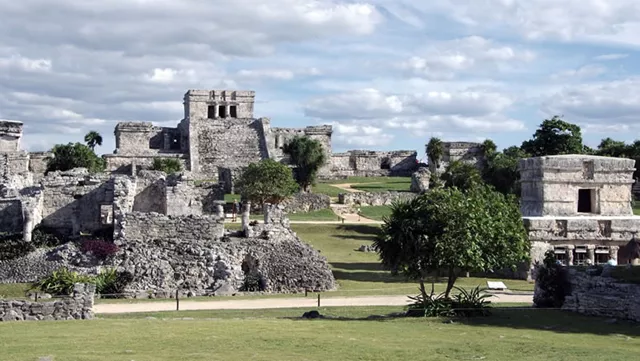
The Maya civilization is renowned worldwide for its ancient wisdom and culture. Chichen Itza stands as one of their significant archaeological sites, offering a glimpse into the rich culture, beliefs, and knowledge of the Maya through this centuries-old city.
Chichen Itza
Chichen Itza is a site from the pre-Columbian Maya civilization, meaning "at the mouth of the well of the Itza," and historically known to represent "seven great rulers." It was declared a "World Heritage Site" in 1988 and is recognized as one of the "New Seven Wonders of the World." This expansive site is located in the northern part of Mexico's Yucatan Peninsula and served as a major Maya city from the 2nd century to the early 10th century, reaching its height of development over time but experiencing decline after a civil war in 1221.
Due to the lack of surface rivers in the Yucatan Peninsula, Chichen Itza utilized three "cenotes" that provided abundant water year-round, making it a natural population hub. Two of these cenotes remain today, including the legendary "Sacred Cenote." This cenote was a sacred site for followers of the Maya rain god Chaac, who offered sacrifices such as jade, pottery, or incense. During droughts, human sacrifices were also made, elevating the site to a "pilgrimage destination."
Historical Background
Around 600 AD, during the Middle Classic period of the Maya civilization, Chichen Itza was an influential city, reaching its zenith following the decline of central lowlands and southern Maya cities.
In 987 AD, the Toltec king Quetzalcoatl led an army to the area and established it as the capital with local Maya allies, resulting in a blend of Maya and Toltec architectural styles and artworks during this time.
In 1221 AD, a large-scale uprising and civil war erupted, with archaeological evidence showing some wooden roofs of the ruins were burned. Consequently, the center of Maya rule moved to Mayapan. After this event, the population of Chichen Itza diminished, and no new large buildings were constructed, though the sacred "cenote" maintained its status as a pilgrimage site.
In 1531, Spanish conqueror Francisco de Montejo claimed sovereignty over Chichen Itza and planned to establish it as the capital of Spanish Yucatan. However, the Maya people revolted, expelling Montejo after several months.
Architectural Ruins
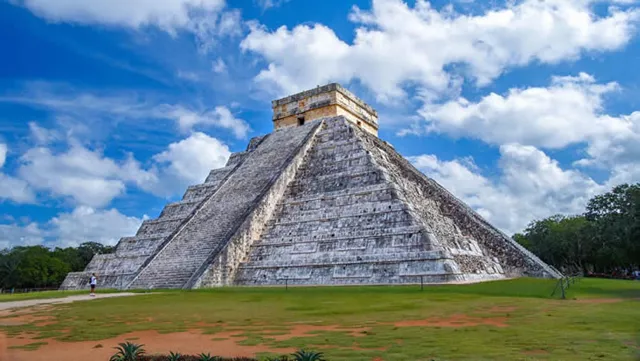
Chichen Itza boasts many remarkable architectural ruins still standing today. At the heart of Chichen Itza is the Temple of Kukulkan, also known as El Castillo, a square pyramid with tiered steps. At the base of these steps lies a serpent head, and during sunrise and sunset, a shadow resembling a serpent appears on the northern steps, descending as the sun moves. A tunnel on the northern steps leads to the top of the ancient pyramid inside El Castillo, where the jaguar crown of the serpent god can be seen. It is said that the inner pyramid was designed based on the lunar calendar, whereas the outer structure followed the solar calendar. Chichen Itza also contains the "Temple of the Warriors," reflecting the influence of the Toltec capital, Tula. This stepped structure features columns carved to resemble warriors, with an altar statue of Chac Mool, a figure, at its entrance.
Chichen Itza also includes seven Mesoamerican ball courts, the largest located 150 meters northwest of the pyramid. The court is adorned with stone slabs on both sides depicting figures of players, and in a tradition, the captain of one team would be sacrificed. One of the outer walls hosts a jaguar temple, showcasing another jaguar crown. Adjacent to the ball court are two opposing open platforms where the rulers could converse across a distance.
Among the most distinct buildings is "The Nunnery," a government palace during the Classic period. To the east of "The Nunnery," lies a temple known as "The Church," featuring beautifully decorated masks of the rain god. To the north, there is a circular building on a large square platform known as the "Oval Observatory," also referred to as the "Snail" because of its spiral stone staircase inside. This observatory was used to observe the spring equinox, the maximum north-south tilt of the moon, and various astronomical phenomena. The Maya used the sunlight passing through the door to determine the summer and winter solstices, while reflections of water in large stone basins around the building helped them observe constellations, demonstrating their sophisticated and precise calendar system.