Symbolic Signs and Totem Worship in Maya Culture: An Examination
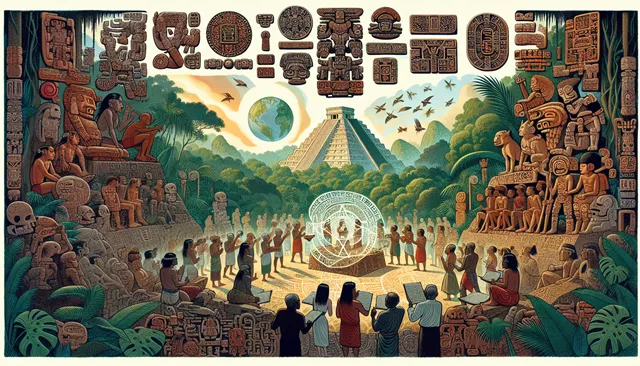
Beneath the luminous night sky, the hidden designs of the sun echo the passage of millennia. Once more, she enters the enigmatic cave that preserves the heritage of the Maya civilization. Intricately carved stone statues, worn by time, and ancient murals adorned with symbols and totems seem to create a doorway to the past, inviting her to explore the rich and mysterious Maya culture more deeply.
In this land, imposing mountains bear the weight of ages past, while the silent cornfields sway with the years of farmers' toil. Yet, the quest for knowledge continues; we're like children, embracing our curiosity about the unknown world. We hold firm to the belief that each stone tablet and every symbol is more than a mere decorative element of life; they are profound philosophies and cultural insights condensed within the stone inscriptions and murals.
Maya totems represent reverence, desires, and the embodiment of life’s order and worldview. Eagles, jaguars, and monkeys frequently appear in their hymns, whether as sovereigns soaring through the sky, silent children of the earth in deep forests, or as emblems of cleverness and wisdom. These totems not only convey the beliefs of the Maya people but also illuminate the world's order.
If totems signify spiritual devotion, then the symbolic signs of the Maya are a legacy of wisdom. Each symbol tells a story, rich with meaning. Spirals, right angles, squares, and waves convey their distinctive insights into mathematics, astronomy, and the concept of time. This knowledge bears witness to the multiple layers of Maya culture, reflecting their intelligence and close bond with nature.
Moreover, these symbols and totems significantly enhance the forms and substance of Maya art. By merely observing the intricate lines forming the totems, one can witness the Maya people's detailed observation of life and their complex thoughts. Every etching on the stone tablets seems to resonate with the profound mysteries of the universe, blending life experiences with reflections to create an indescribable beauty and wisdom.
Astronomical symbols, for example, are an essential aspect of Maya culture. The Maya believed in a close-knit relationship between humans and the natural world, where even the slightest change could influence their survival and reproduction. This cultural trait that venerates nature and cherishes life led the Maya to hold the stars and moon in high regard, viewing them as links connecting heaven and earth. Consequently, they represented concepts of astronomy, calendars, and time through symbols like the sun, moon, and stars, passing them down through rituals, worship, and legends.
Some suggest that deciphering these wise symbols provides a key to unlocking the myriad codes scattered by nature. As a result, even in today's modern era, we experience a distinct longing and fascination for those enigmatic ancient civilizations.
The Maya's symbolic signs and totems are akin to celestial bodies in the universe, endlessly rotating and shimmering, with each symbol holding a unique secret. Understanding them feels like traversing time and space, engaging in dialogue with the ancients, and bringing that splendid world back into focus. What appears to be simple lines actually encompasses deep philosophy, imprinting a way of life and a vision for the future through countless symbols. Although we are separated from the Maya civilization by vast mountains, rivers, and a millennium of time, through these totems and symbolic signs, we can sense their respect for life, love of nature, quest for knowledge, and curiosity about the unknown. This undoubtedly draws us closer to the ancient and captivating Maya world and profoundly reminds us that every nation that has ever existed holds its own unique cultural code. Understanding this code means understanding a people, comprehending humanity's intertwined journey with nature, society, and spirit, and ultimately, understanding ourselves.