The Tarot Reading Process
Image source: Unsplash
The process of divination has no single, universally accepted rulebook. Most readers develop their own habits and preferences, and with skill, any consistent approach can work. Over time, the Tarot community has created many elaborate rituals that can feel overwhelming. In reality, most of these can be omitted without affecting accuracy. As long as you avoid empty theatrics, you can adopt them selectively—or even create your own. In this sense, rituals function more like personal routines that help you feel grounded and focused. The minor downside is that once a ritual becomes a habit, you might feel uneasy without it, which can affect your confidence and, in turn, your reading. Remember: rituals are optional and don’t determine accuracy.
Before we get into the process, two terms for beginners: the “querent” is the person asking the question. The “diviner” is the person reading the cards. If you’re reading for yourself, you’re both. The querent may also be called the “seeker” or “client,” and the diviner may be called the “interpreter” or “analyst,” among others.
While there are no hard-and-fast rules, the process can be distilled into a few core steps most readers follow:
Ask a constructive question
Before you touch the cards, clarify your question. Asking a good question is harder than it seems. A helpful guideline is to leave “room for change.” Instead of asking, “Will he leave me?”—which can feel helpless—try “How can I improve our relationship?” or “Given the current situation, what’s likely ahead for us?” Tarot doesn’t hand down absolute verdicts; it reflects “what is likely to happen if things continue as they are, without intervention.” Think of life like a video game with multiple endings: each choice leads to different outcomes, and Tarot is a kind of cheat that quietly shows you “what ending you’re headed toward if you keep going this way.” If you don’t like that ending, you can make different choices. The outcome is ultimately in your hands.
Adjust the environment and mindset
Don’t treat a reading like a game, especially when reading for someone else. Make sure the querent sincerely wants to address their concern, rather than joking around, doubting everything, or “testing” the diviner. If this basic condition isn’t met, inaccurate results are more likely and won’t help resolve the issue. Mindset is closely tied to accuracy.
There are no strict rules for the environment. A quiet space can help everyone relax and focus, but if you can concentrate in a noisy place, that’s fine too. At minimum, use a clean, reasonably sized table so shuffling and larger spreads aren’t awkward. If you want to be more particular, lay a velvet cloth on the table to protect the cards. A dark, solid color reduces visual distraction; black velvet, in particular, makes the images pop and looks great.
Once you’ve covered the above, center your thoughts, relax your body, avoid dwelling on negatives, and aim for a calm, steady mood. Then prepare to shuffle.
Decide on the spread
Choose a spread that fits your question, and decide before you shuffle to avoid confusion. This choice also determines whether you’ll use an indicator (significator) card and how you’ll handle cutting the deck. For more on spreads, see “Overview of Spreads.”
Shuffle the cards
There are many ways to shuffle. Two common methods are:
1. Poker-style: This is not the flashy “riffle-and-bridge” you see at the card table. That kind of flourish is better left to playing cards—unless you don’t mind wearing out or damaging your deck (and absolutely do not do this with someone else’s Tarot deck). Here, “poker-style” refers to the basic overhand shuffle most people know: hold the full deck face down in your right hand and, with your left hand, repeatedly take random packets from the top and drop them back on top (for right-handed readers). If you don’t use reversals, this is sufficient. If you do use uprights and reversals, periodically rotate portions of the deck 180 degrees as you shuffle.
2. Mahjong-style: Place the whole deck face down on the table and mix it around with your hands, clockwise or counterclockwise, as if shuffling Mahjong tiles. This method is extremely thorough and naturally mixes in reversals. The downside is that it works best on an appropriate surface—ideally with a cloth underneath.
Of course, you’re not limited to these two methods. Whatever method you choose, shuffle long enough to randomize the deck. Eyes open or closed doesn’t matter. Either the querent or the diviner can shuffle. The point is randomness—a core requirement of any divination method, whether it’s I Ching coin tossing, drawing lots, and so on. For more on why Tarot works, see “Why Tarot Works.”
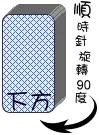
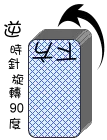
If you’re using reversals, keep this in mind when gathering the cards: the right-hand side marks the bottom (see the images below). Whether you’re reading for yourself or someone else, treat the right side as the bottom for the upcoming spread. For a self-reading, rotate the deck 90° clockwise to orient it correctly. When reading for another person, a 90° clockwise rotation aligns with your perspective; a 90° counterclockwise rotation aligns with the querent’s perspective for uprights and reversals.
.gif) |
.gif) |
 |
 |
| Self-reading |
Reading for others From your perspective |
Reading for others From the querent’s perspective |
Cutting the deck
If you’re using an indicator (significator) card, you can skip this step. Cutting should be done by the querent, because the purpose is to reflect the querent’s mindset. Method: take a random packet from the deck; the bottom card of that packet is the cut card. For more on cutting, see “Cutting the Deck.”
Selecting cards
Fan the cards face down. The querent draws the required number of cards. It doesn’t matter which hand they use, or whether their eyes are open or closed. Having the querent draw ensures the most direct signal; if someone else draws for them, the information becomes second-hand. It’s best for the querent to interact with the cards personally so the draw reflects the situation as directly as possible.
Interpreting the cards
Place the drawn cards into the spread in order: the first card the querent drew goes to position 1, and so on. Once everything is laid out, you’re ready to interpret!