Complete Guide to Tarot Spreads: The Tree of Life Divination Method
The Tree of Life is a comprehensive tarot spread that is both time-consuming and intellectually challenging, involving a complex interpretation process with all 78 cards. This spread is appropriate for holistic divination of significant matters, but not for simple fortune-telling.
When surface-level explanations leave us unsatisfied and we wish to delve deeper, we can opt for the Tree of Life spread. Owing to the profound nature of the questions it addresses, this spread is relatively complex and demands a higher level of understanding from the reader.
The interpretations derived from the Tree of Life spread are often profound and abstract. Therefore, before using it, one should have a deep understanding of Tarot along with a rich accumulation of life experiences. For those with extensive life experience, mastering this spread becomes more feasible.
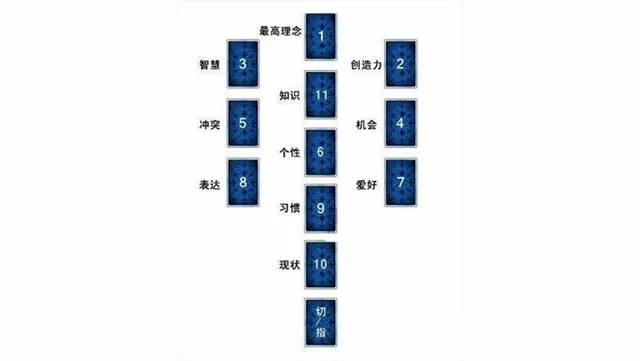
Divination Steps:
Although the Tree of Life spread comprises only 10 positions, it involves all 78 cards in the prediction. It addresses a wide range of complex aspects and requires interpretation to begin from the tenth position and work upward to the first, differing from other spreads. Similarly, cards are drawn starting from the tenth position and placed in descending order (10-1; an image of the spread is attached above). A complete Tree of Life spread is extensive and requires thoughtful consideration. It is also a long-term spread that generally should not be reused for a year following its initial use.
Techniques for Using the Tree of Life Spread
Card Drawing Method:
Count the tenth, eleventh, and twelfth cards from the top and place them in positions 1, 2, and 3.
(Tenth, eleventh, and twelfth cards)
Then count the tenth, eleventh, and twelfth cards again and place them in positions 4, 5, and 6.
(Twenty-second, twenty-third, and twenty-fourth cards)
Count the tenth, eleventh, and twelfth cards once more and place them in positions 7, 8, and 9.
(Thirty-fourth, thirty-fifth, and thirty-sixth cards)
Finally, count the tenth card and place it in position 10.
(Forty-sixth card)
Suggestion: Randomly draw ten cards and place them sequentially in positions 1 through 10.
Order of Interpretation:
First, assess the impact of the cut card or indicator card on the entire spread, then interpret in the following order: current situation, habits, expression, interests, personality conflicts, opportunities, wisdom, creativity, and highest ideals. It is important to note that the eleventh card, representing knowledge, should be drawn after interpreting the first ten cards, enabling the diviner to integrate it with prior interpretations to guide the querent.
Meanings of the Positions in the Tree of Life Spread:
The right side of the tree represents positive divine aspects, while the left side represents negative aspects.
- 10 represents the Kingdom (Malkuth): Results, home, material world, physical body, daily life, practical situations.
- 9 represents the Foundation (Yesod): Center of the soul, imagination, fantasy, habits, past life, subconscious foundation.
- 8 represents Glory and Splendor (Hod): Thought, knowledge of truth and falsehood, verbal expression and communication, skills, science, and applied science.
- 7 represents Victory and Endurance (Netsah): Love, sexuality, instincts, art, inspiration, feelings, beauty, joy.
- 6 represents Beauty (Tiphareth): Personality, self, traits, health, contributions to others, goals, primary purpose or intention.
- 5 represents Severity and Power (Geburah): Strength, conquest, challenges, conflict, re-adjustment, obstacles, disharmony, provocation, expression of power, leadership.
- 4 represents Mercy and Grace (Chesed): Kindness, favorable opportunities, giving, wisdom, benefactor, assistance, praise, strength.
- 3 represents Understanding (Bina): Awareness and understanding of the mind, mother, spirit, shadow, nearing completion, planning ability.
- 2 represents Wisdom (Chhokmah): Creativity, external values and thoughts, father, intention, light, intelligence and knowledge, instincts.
- 1 represents the Crown (Kether): High-level thoughts, correct judgment of goals and intentions, harmonious state, root or cause of problems.
Precautions:
The interactions between the cards in the Tree of Life spread are highly complex. In addition to the cut card or indicator card influencing all cards, there are multiple combinations between the cards. For example, the highest ideals, creativity, and wisdom form a spiritual triangle; opportunities, conflict, and personality form a rational combination; interests, expression, and habits create an emotional combination; creativity, opportunities, and interests align with the pillar of kindness associated with masculine energy; wisdom, conflict, and expression align with the pillar of severity linked to feminine energy; and the highest ideals, personality, habits, and current situation relate to the pillar of balance tied to essence. These combinations possess strong interactivity and influence, demanding attention during interpretation.
Example of Divination: What significance does moving to a new city for work have for my development?
Background: The querent has recently arrived in a new city and feels unfamiliar with his surroundings. He relocated because a friend achieved considerable success there, and he hopes for similar luck. However, reality doesn't match his expectations; although he quickly found a job, he isn't satisfied. Being in a new place, he's not accustomed to the lifestyle, leading him to question if moving for work was a sound decision. Therefore, he seeks a reading.

Analysis of Individual Cards:
His cut card is the reversed Ten of Wands, indicating that the querent feels deeply uneasy about his current situation and hopes for assistance from friends.
The current situation card is the Six of Wands, suggesting that the querent's arrival in the new city has been relatively smooth; the so-called difficulties arise from his high expectations leading to dissatisfaction.
The habits card is The Devil, suggesting that without an objective assessment of his situation, things might worsen. This is tied to his mindset; fear stems from unattainably high expectations, possibly leading him to unhealthy life choices to fill the void, potentially reversing his situation.
The expression card is the reversed Nine of Stars, indicating that the querent lacks planning in his life and studies, tends toward taking things lightly, and avoids hardship, which may hinder his progress. He's also somewhat lazy and not forthright with others, impacting his relationships with colleagues and friends in the new setting.
The interests card is the Ace of Wands, indicating that for new beginnings, the querent must first possess passion and drive.
The personality card is the reversed Ten of Swords, suggesting that compared to his past, the querent has made progress in the new environment. He needs to find things that bring him joy instead of dwelling on worries.
The conflict card is the reversed Seven of Swords, indicating potential issues may arise from the leakage of some of the querent's private matters, which could have negative consequences.
The opportunity card is the Eight of Stars, suggesting the situation isn't entirely bleak; with some additional effort, improvements are likely.
The wisdom card is the One of Stars, indicating that the future will bring new beginnings and advancements for the querent, showcasing his ability to use wisdom. Should the situation improve, he will receive substantial support and have many temporary sources of income.
The creativity card is the King of Wands, suggesting that if the querent exhibits a strong desire for progress and sufficient creativity, he will receive help from male friends, guiding him toward success.
The highest ideals card is the Four of Wands, indicating that the querent's ultimate goal is to achieve a relatively successful and stable life; at times, his thoughts and actions may contradict his ultimate ideals.
The knowledge card is the Six of Cups, indicating that the querent may become stubborn due to old knowledge; it depends on what he's holding onto. If it's correct, it should still be maintained.
Comprehensive Analysis and Suggestions:
In this case, the querent's issue revolves around his mindset. His friend's success in the new city fuels similar hopes, but such comparisons aren't valid as everyone's circumstances and opportunities differ. The querent's expectations are set too high, so even smooth transitions bring disappointment when expectations are unmet.
The diviner emphasizes that every new choice is a new beginning, with potential for both success and failure; the querent shouldn't regret his decision. The cards imply that the new city holds many opportunities for the querent; his task is to seize these opportunities.
Image and text source: First Constellation Network