The Secrets of Face Reading by Jin Zizai: Eyebrow Edition
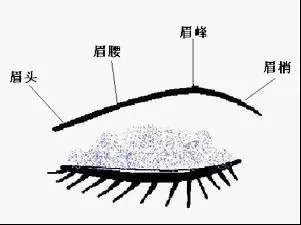
Eyebrows frame the eyes and signal charm; they reflect one’s appearance and symbolize intelligence. They’re also linked with relationships among siblings and friends. In traditional physiognomy, the left eyebrow is divided into two parts: the front is called “Lingyun” (soaring clouds) and the back “Fanxia” (rosy clouds). The right eyebrow is similarly split into “Ziqi” (purple aura) and “Caixia” (rosy clouds). By shape, eyebrows are grouped into twenty-four types—such as “Bazi” brows, spiral brows, Arhat brows, broom brows—which can feel daunting to modern learners. Here, I’ll share the essentials.
1. Eyebrow Head
The eyebrow head is where the brow begins near the bridge of the nose, along the midline of the face. It may seem unremarkable, but it carries many readings.
Three reliable insights:
The first is the arrow-shaped brow head, where the hairs stand upright. This suggests notable changes in relationships around age 31. People with this feature also tend to be impatient.
The second is connected brow heads. The space between the brows is the “Yintang” (hall of impression). When the brow heads meet, they “injure” the Yintang. Such individuals often have complex personalities, are not very open-minded, and may be cautious and sensitive; in severe cases, they can become paranoid or vindictive.
The third concerns thickness at the brow head. It’s common to see a thick head with a thin tail. Thickness refers to both color and hair density. A thick brow head points to impulsive actions and emotion-driven decisions that one may later regret.
Old Jin's Clarifications:
1. What does it mean when eyebrows are too close to or too far from the Yintang?
“Close to the Yintang” means the brows are so thick that the Yintang looks narrow; “far from the Yintang” means the brows grow away from it. By contrast, when the brows avoid the Yintang and leave it bright and smooth, the person tends to be open-minded, generous, and not nitpicky.
2. Eyebrow Peak
The eyebrow peak is the highest point of the brow, like a mountain summit or the arch of a curved eyebrow.
Two reliable insights:
First, the brow peak corresponds to career altitude. Those with a pronounced peak often reach impressive career heights.
Second, people with a defined peak tackle tasks with energy and drive, elevating even ordinary work.
Old Jin's Clarifications:
1. What if there’s a mole in the middle of the eyebrow?
A mole centered in the brow suggests intelligence, but being “too clever” can invite missteps. In tough times, one may hit career roadblocks and be prone to limb issues, such as weakness or injuries.
2. Does having no brow peak mean there’s no career rise?
Physiognomy reads what is present; absence isn’t a verdict. A straight brow without a peak can still point to a bold, ambitious way of doing things.
3. Eyebrow Tail
The eyebrow tail is the end of the brow and is also seen as a sign of external wealth. A scattered tail can bring financial loss during the period governed by the eyebrows.
Three reliable insights:
First, the tail reflects rationality. Ideally, the head and tail should be of similar thickness, signaling consistency in action. A thick head with a thin tail suggests emotion outweighs reason; a thin head with a thick tail suggests reason outweighs emotion.
Second, a sharp, well-defined tail is best. Such people tend to be intelligent, perfectionistic, and capable of building wealth. If the brows are scattered, there may be financial losses around ages 33 and 34.
Third, an upturned tail forms a “sword brow.” An upward tail indicates boldness and passion in action, while a downward tail suggests kindness and a nonconfrontational nature.
Old Jin's Clarifications:
1. Does a scattered tail mean lifelong financial loss?
Not necessarily. People with scattered tails may spend impulsively or invest without a plan. Around ages 33–34, partnership opportunities could bring losses. However, if one also has a thick nose and a small mouth, the impact may be blunted. Physiognomy should be read holistically, in context with other features.
4. Eyebrow Shape
Eyebrow shape refers to the overall set of the brows—their width, length, and color.
Three reliable insights:
First, long eyebrows suggest slower, more deliberate thinking. Length can refer to both the hairs and the outline. In general, longer is better than shorter. A long outline can mean slower thought but a romantic nature; a short outline suggests quick thinking but a tendency toward excessive pragmatism.
Second, very thick brows point to impatience and, in traditional medicine terms, excess “liver heat.” Conversely, very thin brows may indicate limited emotional depth.
Third, fine brows suggest dexterity and skill, while very thick brows can correlate with clumsiness.
Old Jin's Clarifications:
1. What makes a good eyebrow?
Ancient teachings prize brows that are clear and translucent: each hair looks glossy and distinct against the skin, with even density throughout. Such brows are considered ideal, signaling high intelligence and sincerity in relationships.
2. Do white eyebrows guarantee longevity?
While white brows are common in older people and often associated with long life, developing white brows before age 35 is seen as a sign of declining vitality.
Summary:
Eyebrows mirror a person’s intelligence and outwardly express inner emotions. They also correspond to friendships and sibling bonds.
There’s a wealth of material on this topic; here I’ve focused on the most direct, practical basics. In practice, many ask whether shaping or tattooing brows affects fortune. This deserves a careful answer.
Eyebrows and facial hair are the only facial features that can be altered to potentially influence fate, based on the “Iron Sword” principle. In ancient belief, growing facial hair could shift one’s luck: for instance, someone with a wide nose who struggles to accumulate wealth might grow a mustache; someone with a sharp chin and poor later-life fortune might grow a beard. Likewise, if the brow heads cross or marriage luck is weak, consider shaping the brows. Pluck rather than shave or cut. The ideal brow is slightly fuller, with a clear beginning and end. Avoid eyebrow tattooing—it’s said to harm marriage luck—so proceed with caution.
Exclusive Contribution: Jin Zizai