The Art of Interpreting Folk Facial Features: Yin Tang and Ren Zhong

"At their core, human nature is inherently good. While our natures are similar, our habits can vary." According to Teacher Yixin's interpretation of the opening lines of the Three Character Classic, our original nature and innate qualities are fundamentally good and uniform. However, as we grow, we're shaped by the influences of those around us, as well as our education, environment, learning conditions, and personal efforts. These factors lead to differences in character, resulting in variations in our fortunes.
A desirable facial appearance is often described with phrases like "a face like a full moon, radiant and glowing." In contrast, those with less favorable fortunes may display "dark gray complexions, sallow skin, and thin faces." Teacher Yixin provides insights into the folk physiognomy secrets relating to facial features, such as the hall of impression and the philtrum. Let's delve into these together, and I welcome any corrections from fellow practitioners.
A square face indicates intelligence and decisiveness: a round face signifies warmth and generosity.
Note from Yixin: People with square faces often present a straightforward and upright appearance, making them well-suited for leadership roles. These individuals usually have broad foreheads, symbolizing wisdom and strategic thinking, and often have promising careers. Their rounded cheekbones and jawline suggest resilience and a propensity for gaining experience. A face resembling a full moon, with a smooth and glossy complexion, conveys grace, friendliness, and sincerity, often leading to early success and potential in governance.
A well-defined hall of impression indicates smooth endeavors: a spacious hall of impression suggests a generous spirit.
The hall of impression, located between the eyebrows, should be wide enough to accommodate a coin's width, representing broad-mindedness and integrity. Conversely, a narrow hall where the eyebrows are joined often signals a petty and narrow-minded person who is calculative and holds grudges, making collaboration difficult. The color of the hall of impression should be bright and match the rest of the face. If it appears gray, purple, red, or blue, it may indicate potential career problems and approaching bad luck, leading to obstacles. A consistent color suggests smooth progress in plans.
A pale hall of impression indicates financial loss: a red hall of impression signals impending disaster.
If the hall of impression is discolored, such as pale or grayish-white, it often foretells mourning or financial loss. On the other hand, an unexpected appearance of red or dark purple in this area is a forewarning of legal troubles, disputes, or health issues. During this time, one should exercise caution and be mindful of their actions.
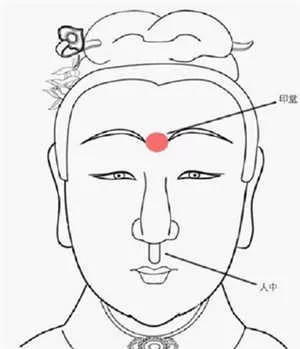
A wide philtrum indicates longevity; a shallow philtrum suggests a shorter lifespan.
The philtrum, located below the nose, is where the Ren and Du meridians converge. The Ren meridian starts at the perineum and moves upward through the body's center, reaching under the lips, while the Du meridian runs from the perineum up the spine to the head, then forward between the eyes and down to the upper gums. In traditional Chinese medicine, the Ren meridian is linked to "nourishing blood," while the Du meridian is associated with "nourishing qi." When both meridians are harmonized, they signify smooth energy flow and a balanced life. A flat or shallow philtrum is often related to poor fortune and a shorter lifespan, coupled with potential health concerns. Conversely, a deep, long, and wide philtrum signifies longevity.
Full cheeks indicate a tendency to take advantage; thin cheeks suggest cunning and deceit.
When observing someone, if their cheeks appear plump, ensure you avoid losses in dealings, as these individuals often seek small gains. Those with thin, pointed ears typically lack innate vitality, and a face lacking prominent cheekbones often suggests a deficiency in integrity. Therefore, individuals with rabbit-like ears and cat-like cheeks may be inclined toward scheming and dishonesty.
Three horizontal lines on the face indicate a lack of principles.
Individuals with sagging facial skin and several horizontal lines often lack discipline in their actions, reflecting a lack of responsibility and a lazy disposition.
A tight, bony face suggests harshness in dealings.
A face that appears tight and bony, with a bluish tint, often indicates a deficiency in liver energy, contributing to a harsh and unkind demeanor, as well as a tendency for scheming and malicious behavior.
Hollow under the eyes indicates worries about children.
The area under the eyes, known as the “three yin and three yang,” provides insights into offspring and reproductive capabilities. If this area shows grid-like, wave-like, or deep bags, it often suggests poor sleep and nervous exhaustion, along with potential kidney weakness or excessive indulgence, which can negatively impact the fortunes of one's children, leading to signs of unprosperous offspring.
Yixin's Wisdom: Throughout history, capable individuals have never schemed against others. It is only the incompetent who become envious and plot harm. By understanding some aspects of physiognomy, we can interpret a person's character and morality, helping us avoid potential issues in our lives and work.