**The Goddess's Call: Women in Greek Mythology**
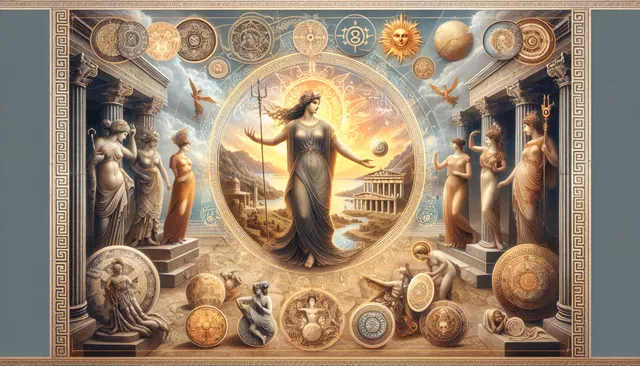
As the evening breeze gently envelops me, I find myself contemplating the timeless masterpieces "Calm Lacoon" and "Venus Looking Back" within the hall of time. These works embody the excellence and allure of female figures in ancient Greek mythology.
The poetic essence of ancient Greek mythology serves as a distilled form of philosophy and a repository of wisdom, having nurtured the rich tapestry of the world's diverse cultures. When delving into these myths, we cannot overlook the pivotal role of female figures—the goddesses—who spark endless imagination.
Each goddess is a singular entity, with her own disposition and tale. Much like the women who touch our lives, each being and each soul tells a unique story. Their inner worlds, composed of layers of emotion and intellect, grow deeper over time through our reflections.
Athena, the goddess of wisdom and protector of the ancient city-state of Athens, is renowned as the mother of riddles and the wellspring of thought, having unraveled the enigmatic challenge of the Sphinx. Her image is one of strength, and her wisdom imparts comfort and serenity. She embodies contemplation and symbolizes profound intelligence.
Hestia, the nurturing force of the household and guardian of the eternal flame, gives selflessly and quietly, woven into the very fabric of mythology. Every celestial and human gathering finds its place within Hestia's temple, demonstrating her inclusive love and harmonious presence.
The Titan queen Themis, mother of Prometheus, is the embodiment of order and justice. Though caught in the tumult of love and power, she remains clear-minded and poised, acting as a guiding light toward justice in a chaotic world.
Circe, the conjurer of stormy seas, introduces both upheaval and disruption. Yet her role is a necessary balance; the world's equilibrium is a dance between serenity and chaos, reflected in the ocean's ceaseless transformations and expansiveness.
Aphrodite, the goddess of love, epitomizes the union of love and beauty. Under her influence, beauty becomes ennobled and evolves. It is said that without her presence, the human realm would lack vibrancy, and philosophy would be rendered lifeless.
Persephone, the queen of the underworld, is remembered for her dual nature. She represents life’s impermanence as well as hope, illustrating that by embracing life's darker facets, we can better chase the light.
Each person is unique, and every goddess holds an irreplaceable place in this universe. Their diversity and richness make them the "goddesses" we aspire to, narrating tales of humanity and reasoning. Their images are both earthy and ethereal, radiant yet shadowed, animated and lively or serene and lyrical.
This is ancient Greek mythology—vivid and tangible, grand yet detailed; this is the essence of the ancient Greek goddesses, each bearing her own story and spirit, offering humanity a lens through which to understand the world and themselves, and to grasp emotions and inner thoughts.
Therefore, I invite you to navigate this expansive sea of mythology with me, to listen to the voices that have softened over time yet remain intertwined with our spirits, to seek out those sparks that, despite residing in remote corners, continue to burn brightly in our hearts. Let their stories become part of our lives, their wisdom ignite our spirits, and allow us to awaken the voices of the goddesses in our lives today.