Global Legends of Giants and Their Impact
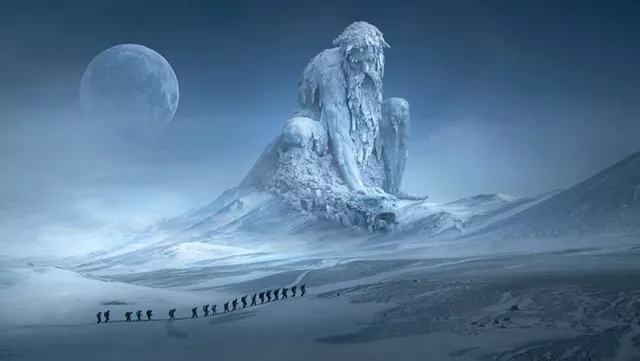
“Giants” are enormous humanoid beings that vastly surpass human size. Much like deities, dragons, and floods in various legends, many civilizations around the world have documented the existence of such beings. For example, in Chinese mythology, there is Pangu, the primordial giant who created the world; in Greek mythology, we have Atlas, the Titan who holds up the sky on his shoulders; and in Norse mythology, Loki, the god of fire and trickery, is also a giant from Jotunheim and a brother of Odin, the father of the gods. Thus, giants are not only a race but can also possess divine attributes.
Giant Legends and World Heritage
Mythological figures often lack tangible remains, making it challenging to trace their existence and raising questions about their authenticity as the foundation of later beliefs and civilizations. However, many well-known relics around the world are tied to characters from folklore, adding a sense of reality to beings and events known only from written records and oral traditions.
Among the current world heritage sites, some magnificent landmarks purportedly created by giants have withstood thousands of years of weathering. In England, there is the "Giant's Causeway," a breathtaking 8-kilometer-long landscape featuring up to 40,000 hexagonal stone columns that seem deliberately arranged, forming a stunning scene along the coast. Legend has it that this was built by the legendary hero Finn MacCool from Celtic mythology, who inherited the bloodline of the Tuatha Dé Danann, as his mother, Muirne, is the granddaughter of the king of giants. Thus, he is also known as a kind and brave giant.
There are various stories about why Finn built the Giant's Causeway. One story suggests that as an Irish giant, he wanted to confront a Scottish giant, and to do so, he moved numerous rock columns into the sea. However, his frightened opponent destroyed the path as he fled, resulting in the current formation. Another tale suggests that during their battle, he threw giant stones, forming what is now known as Giant's Island. Later, to welcome the giantess he loved, he constructed this causeway. Regardless of the version, one can't help but compare him to Hercules, the son of Zeus.
In Malta, there is a temple attributed to giants, located on Gozo, Malta's second-largest island, known as the "Ggantija Temple," which translates to "Giant's Tower." Unlike the earlier sites mentioned, this one is a Neolithic monument over 5,600 years old, predating the Egyptian pyramids. Among the relics discovered globally, it is among the oldest and is the most ancient of Malta's megalithic temples. Artifacts unearthed there suggest it was a place of worship related to fertility rituals. Research indicates that its earliest origins can be traced back to around 3600 BC, with local legends describing it as constructed by giants who consumed only honey and broad beans, giving birth to male infants who then built these temples.
Interestingly, this island is also known as "Calypso Island," named after the sea goddess who kept Odysseus on Ogygia for seven years. Knowing these legends, one might feel differently when visiting these relics.
Patagonian Giants: The Two-Headed Giant Mummy
The modern exploration of the world and the development of civilizations across various countries brought immense benefits and costs since the late 15th century's "Age of Discovery." This period led to a significant expansion of humanity's understanding of the world while sacrificing countless sailors' and crew members' lives and damaging the lives, homes, and cultures of local indigenous peoples. The once-thriving Aztec civilization also faced its demise as a result.
In that era, the state of knowledge and technology meant that exploration at sea was a risky adventure, leading to many famous navigators and explorers whose reputations—whether positive or negative—have persisted for centuries and continue to flourish in various films and literary works. Their adventures naturally included encounters with strange beings and events.
According to some ancient European records, there existed a race of giants in Patagonia, referred to as the "Patagonian Giants." The famous explorer Ferdinand Magellan began his circumnavigation in 1519, and it is said that his crew encountered a type of giant on their route to the Spice Islands. The chronicler of the expedition, Antonio Pigafetta, recorded seeing giants dancing on a shore, standing twice the height of ordinary humans. When they met, the crew found that their height only reached the giants' waists, yet these beings had quite impressive physiques.
The discovery by Magellan's fleet led many to associate Patagonia with giants, with the name thought to mean "land of the big feet," and early world maps even marked it as "the land of giants." Even decades later, many successors reported encounters with the Patagonian giants. For instance, after Magellan, the second English explorer to complete a circumnavigation, Francis Drake, had a priest on board named Francis Fletcher, who wrote in 1579 about encountering Patagonian giants over 220 cm tall. In the 1590s, English sailor Anthony Nevis claimed to have seen a giant's remains measuring 3.7 meters in Patagonia. Similarly, in the same era, William Adams, an Englishman on a Dutch ship, reported a conflict with tall residents of Tierra del Fuego. Reports of giants dwelling in Patagonia continued to emerge in 1598, 1599, 1615, and 1766, reinforcing the perception of the reality of Patagonian giants.
In ancient Chinese mythology, the giant deity Xing Tian continued to fight even after losing his head, and many myths feature giants with unusual characteristics. One legend mentions a "two-headed giant" in Patagonia, known as "Kap-Dwa," with very few records about him. However, it is rumored that he became a mummy, later attracting human curiosity.
The legend dates back to 1673 when several Spanish sailors captured this two-headed giant. During his escape, however, he was speared through the chest by a Spaniard, ending his life. Later, the two-headed giant's body was mummified and sent to England in the 19th century, where it circulated among circus owners and was exhibited at Burnham-on-Sea in England for 45 years before being purchased by Sir Thomas Howard in 1959.
Where is the two-headed giant now? It is said that he was later transported to Baltimore, Maryland, where he was acquired by a local antiques and collectibles business called "Antique Man," becoming part of the collection of Robert Gerber and his wife. However, according to Gerber, the origins of Kap-Dwa have slightly changed; he claims that this mummy was discovered by a British captain named George Beekler, who had it mummified by residents of Paraguay. Initially found dead on a beach, it was later exhibited in a museum in Blackpool, England, for several years. Despite the variations in the accounts, both records mention that Kap-Dwa had a spear lodged in his chest, indicating that he met with misfortune in life, leaving proof of his existence in the world and highlighting the darker, violent side of humanity during that dazzling era.
Today, archaeological exploration focuses on the preservation of artifacts, and people are starting to reflect on and make amends for past wrongdoings. Although the destruction cannot be undone, the world continues to progress. The remnants of the past lay the groundwork for the future, and we must not forget their contributions. Learning from them is a crucial process that civilization cannot ignore or evade.