What Insights Can the Social Hierarchy of Ancient Egypt Provide to Contemporary Society?
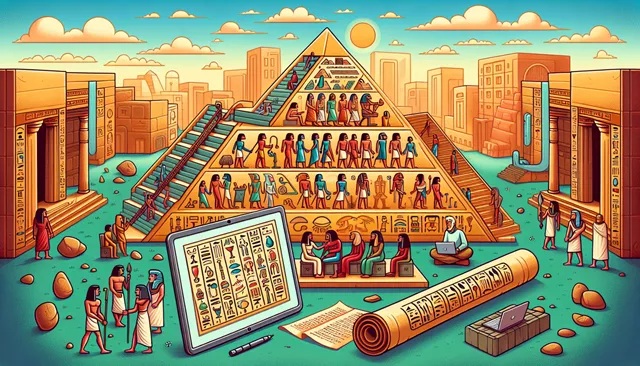
The moonlight washes over the horizon as the pyramids gradually emerge along the banks of the Nile, whispering stories from millennia past. This is ancient Egypt, a civilization of brilliance, mystery, and wealth. A gentle breeze carries the sound of cicadas, flowing like the melodious waters of the river, captivating both heart and mind. The social hierarchy here is unique and strict, akin to a gem set at the pyramid's peak, sparkling with a spectrum of colors, both deep and light, layered and distinct.
The social structure of ancient Egypt offers profound insights into the ethics, morals, and power dynamics that define human society. It categorizes people into hierarchical levels, from the Pharaoh at the top to the slaves at the bottom, with each level having defined rights and responsibilities. Despite its strict limitations, this hierarchy remarkably sustained societal stability and prosperity during its time.
One key lesson from ancient Egypt's social system for today's society is the emphasis on fairness and justice. In ancient Egypt, every individual had a clear role and task, with laws and morals guiding their actions. The capability to establish and maintain a well-defined hierarchy reflects a society's pursuit of fairness and justice.
Another valuable lesson concerns the distribution of power. While different levels held varying degrees of authority, each had its own scope and checks on its power. This system emphasized decentralization and balance, preventing the abuse and excessive centralization of authority. Much like modern democratic systems, which promote the distribution of power and establish diverse checks and balances.
However, the social hierarchy of ancient Egypt also serves as a reminder to avoid extreme elitism, where a person’s value is defined solely by birth and status. Everyone should have equal rights and opportunities to realize their potential. This aligns with contemporary values that emphasize individual rights and dignity, especially the protection of vulnerable groups, demonstrating the universality of human dignity and rights.
By drawing from the social hierarchy of ancient Egypt, we can better manage and distribute power today, effectively promote fairness and justice, and respect and protect the rights and value of every individual. As Niels Bohr said, "Everything that is, is a reference for the future." Immersed in ancient Egypt's social currents, we might see our own reflections and glimpse the future through history's mirror.
Looking ahead, we see modern society’s efforts to implement fairness, prevent power abuse, and respect human rights and social equity. The social hierarchy of ancient Egypt vividly illustrates a pyramid-shaped system, where those at the base support the power above, while the power guides the people below through law and morality. Though this hierarchy belongs to the past, its lessons endure.
Beneath the vast desert, the wisdom of ancient Egypt's social hierarchy ages like fine wine, intoxicating those who explore it, guiding each person to find enlightenment. As we reassess our social landscape, perhaps Egypt’s pyramid-like hierarchy reminds us that no matter the changes, the pursuit of fairness, justice, power constraints, and human respect remains crucial. Yet, we must also face the future bravely, continuously innovating to create a more equitable, open, and inclusive world, while never forgetting our history.